
Top Qualities to Look for in a Corporate Event Band
Corporate buyers evaluating bands for the first time often run the screening process on instinct Did the demo sound good? Did the band feel professional in the email exchange? Did the reviews look positive? Those signals are useful, but they’re proxies for a deeper question: does this band reliably deliver the result the event actually needs? A structured evaluation framework turns the screening process into something a buyer can defend to their manager, their procurement team, or their executive sponsor, rather than a gut call that’s hard to explain after the fact.
This article maps the six-criterion evaluation framework corporate buyers should use when shopping for a band: professionalism and reliability, versatility, experience, audience engagement, communication, and verifiable reputation. For broader cluster context, the companion articles cover the definition of a corporate band, the four buyer personas hiring corporate bands, and how bookings actually happen across the four major channels.
Key Takeaways
Corporate buyers should evaluate bands across six structured criteria rather than on overall impression alone: professionalism and reliability, versatility and repertoire range, experience and track record, audience engagement skill, communication and responsiveness, and verifiable reputation through reviews and references. Each criterion maps to a specific risk the buyer is trying to reduce and a specific signal the band either does or does not give off during the screening process.
Professionalism and reliability are threshold criteria a band that fails these is screened out regardless of musical quality. According to the U.S. Bureau of Labor Statistics occupational profile for musicians and singers, performing-musician work is highly variable in professionalism standards across the broader market, and the corporate event tier specifically demands the high end of that spectrum. The signals buyers should screen for include responsiveness to inquiries, clean contract presentation, current insurance documentation, and the absence of any communication-style red flags that suggest the band may be difficult to work with on-site.
Versatility and repertoire range matter because corporate audiences are demographically mixed. A buyer evaluating a band for a holiday party with employees ranging from new graduates to long-tenure leadership needs a band that can move credibly across multiple eras and genres in the same evening. The cluster’s entertainment format comparison table includes versatility as one of the structural differences between corporate band programming and adjacent live-entertainment formats, and bands that can credibly demonstrate genre-spanning repertoire consistently outperform bands that present a narrower setlist.
Track record and reputation are the buyer’s primary risk-reduction tools. Reviews, callable references from comparable past clients, named corporate logos in the band’s portfolio, and demonstrable years of corporate-tier work all reduce the buyer’s professional exposure if something goes wrong on the day of the event. The reference call is especially predictive buyers who actually call references before booking experience materially fewer post-booking surprises than buyers who rely on written testimonials alone.
Music licensing for live performance of cover material at corporate events is required and typically inherited by the buyer through the venue or event organizer. Performing-rights organizations including ASCAP and BMI issue the public performance licenses that authorize cover repertoire. Bands that can speak fluently about licensing during evaluation conversations confirming that the venue holds appropriate licenses and explaining the chain give buyers a confidence signal that experienced corporate-tier bands consistently provide and inexperienced bands consistently miss.
Watch DJ Will Gill perform live. Contact him now to discuss your corporate entertainment booking.
“A structured evaluation framework turns the screening process into something a buyer can defend, rather than a gut call that’s hard to explain after the fact.”
Why Corporate Buyers Need a Structured Evaluation Framework
The corporate band booking is a higher-stakes decision than the dollar amount alone suggests. A poor band booking doesn’t just produce a forgettable evening it produces a forgettable evening with hundreds of employees, clients, or board members in attendance, and the buyer is the person whose name is attached to the choice. A structured evaluation framework reduces both the probability of that outcome and the buyer’s professional exposure if it happens anyway.
The six criteria covered in this article are not equally weighted for every event. A formal client appreciation gala leans heavily on professionalism, track record, and reputation; a casual employee summer picnic leans more on audience engagement and versatility; a brand activation leans on fit and on-camera presentation. Buyers should weight the criteria to the event they’re actually planning rather than treating them as a uniform checklist.
Six-Criterion Evaluation Framework: What to Verify, What to Watch For
| Criterion | What It Signals | How to Verify | Red Flags |
| Professionalism & Reliability | Will deliver as contracted; safe to defend | Response time, clean contract, current insurance certificate | Slow response, no written contract, evasive on insurance, pressure to commit |
| Versatility & Repertoire | Can land a mixed corporate audience | Repertoire list, multi-era performance video, willingness to learn custom material | Boilerplate setlist, single-mode video, “we play our set the same way every time” |
| Experience & Track Record | Booking risk is manageable | Named corporate clients, callable references, corporate-specific reviews, recent activity | Mostly non-corporate history, reluctance to name clients, suspicious-looking reviews |
| Audience Engagement | Will adapt to the room in real time | Performance video showing audience reaction, references citing room-reading skill | Video shows band performing past audience, no energy modulation, no front-person presence |
| Verifiable Reputation | Quality is documented, not asserted | Independent reviews, marketplace ratings, press features, callable corporate references | Only on-site testimonials, references that won’t return calls, no independent footprint |
Evaluation criteria weights vary by event type and persona; this framework is a starting structure rather than a uniform checklist.
Professionalism and Reliability: The Threshold Criteria
Professionalism is the first criterion because it’s a threshold a band that fails on professionalism gets screened out regardless of musical quality, because the buyer cannot defend hiring an unreliable band to anyone who later asks. The criterion covers everything from initial inquiry response time through on-site behavior, and the screening signals are visible long before the booking is signed.
What to evaluate. Response time to the initial inquiry (within hours, not days). Email tone and professionalism (clear writing, no typos, real names and signatures). Contract clarity (a clean performance agreement provided by the band, not a verbal arrangement). Insurance documentation (current general liability certificate, typically $1M-$2M coverage, available on request). Technical rider (the band knows what it needs and can communicate it to your AV team). Communication style (constructive, not defensive when you ask hard questions).
Red flags. Delayed responses without explanation. Refusal to provide written contracts. Inability or unwillingness to share insurance documentation. Vague answers to specific questions about equipment, runtime, or technical requirements. Pressure to commit before you’ve finished due diligence. Any of these are reasons to move on, even if the music sounds good.
Versatility and Repertoire Range: Matching the Audience
Corporate audiences are demographically mixed in ways that wedding audiences or club audiences typically are not. A holiday party might include senior leadership in their 50s and 60s alongside new hires in their 20s, and the band has to land both groups within the same two-hour set. A band that can only credibly deliver one era or one genre will struggle to do this; a band with deep, organized repertoire spanning multiple decades will adapt in real time.
What to evaluate. Repertoire breadth (multiple eras, multiple genres represented in the band’s setlist documentation). Demonstrated range in performance video (footage showing the band moving between styles within the same event). Flexibility on requested material (will the band learn a specific song for the event, and is there a typical lead time and fee for custom additions). Mode adjustment (can the band shift between background-volume cocktail-hour mode and high-energy dance-set mode within the same booking).
Red flags. Repertoire lists that look identical to every other band’s repertoire list (suggesting the band hasn’t actually internalized the songs). Performance video that shows only one mode or one genre (suggesting versatility is theoretical rather than demonstrated). Resistance to programming conversations or “we just play our set the same way every time” framing (suggesting the band isn’t going to adapt to your event).
Experience and Track Record: Risk-Reduction Signals
Experience is the buyer’s primary tool for reducing the risk that the booking goes wrong. The signal is not just “how long has the band existed” but “how much corporate-event-specific experience does the band have, and is that experience documented and verifiable?” A band with ten years of wedding experience is not necessarily ready for a Fortune 500 corporate event, and a band with three years of dedicated corporate experience can be more qualified than a much older band with mostly bar work.
What to evaluate. Number of corporate engagements per year (active corporate bands typically book 30+ corporate events annually). Named corporate clients (logos, named events, and named venues that the buyer can verify independently). Years in the corporate market specifically (not total years as performers). Reviews and ratings from corporate events specifically (rather than mixed reviews across event types). Recent activity (a band that hasn’t booked corporate events in two years may have lost the operational fluency).
Red flags. A track record that’s entirely from non-corporate events (weddings, bars, private parties without corporate context). Reluctance to name specific corporate clients (even partial names “a major financial services firm in Chicago” should be available if the work is real). Reviews that all read similarly (suggesting they may not be genuine). No recent booking activity.
Audience Engagement and Communication: In-Room and Off-Stage
The final two criteria audience engagement and communication operate at different points in the booking lifecycle but measure the same underlying quality: the band’s ability to read context and respond appropriately. A band with strong audience-engagement skill reads the room in real time and adjusts the set; a band with strong communication skill reads the buyer in real time and adjusts the booking conversation. Both qualities tend to correlate.
Audience engagement signals. Performance video showing the band reacting to the audience (not just performing past them). Lead vocalist or front-person who engages with the room (not just looking at the music stand). Visible energy modulation moments of quiet conversation-friendly playing alternating with high-energy dance moments. References from past clients specifically noting “the band read the room well” or “the energy was exactly right.”
Communication signals. Constructive responses to hard questions during the booking conversation. Proactive surfacing of details the buyer might not have thought to ask about (load-in timing, technical requirements, breaks). Willingness to discuss programming with the buyer or producer. Reasonable accommodation of custom requests. The communication-quality signal during booking is one of the most reliable predictors of how the band will be to work with on-site.
Verifiable reputation. Beyond reviews on the band’s own website, look for independent third-party signals Google Business reviews, marketplace ratings on platforms like The Bash or GigSalad, named features in press, and the ability to provide callable references from comparable past clients. Reference calls in particular are predictive: most buyers don’t actually call references, and the buyers who do are systematically less likely to experience post-booking surprises.
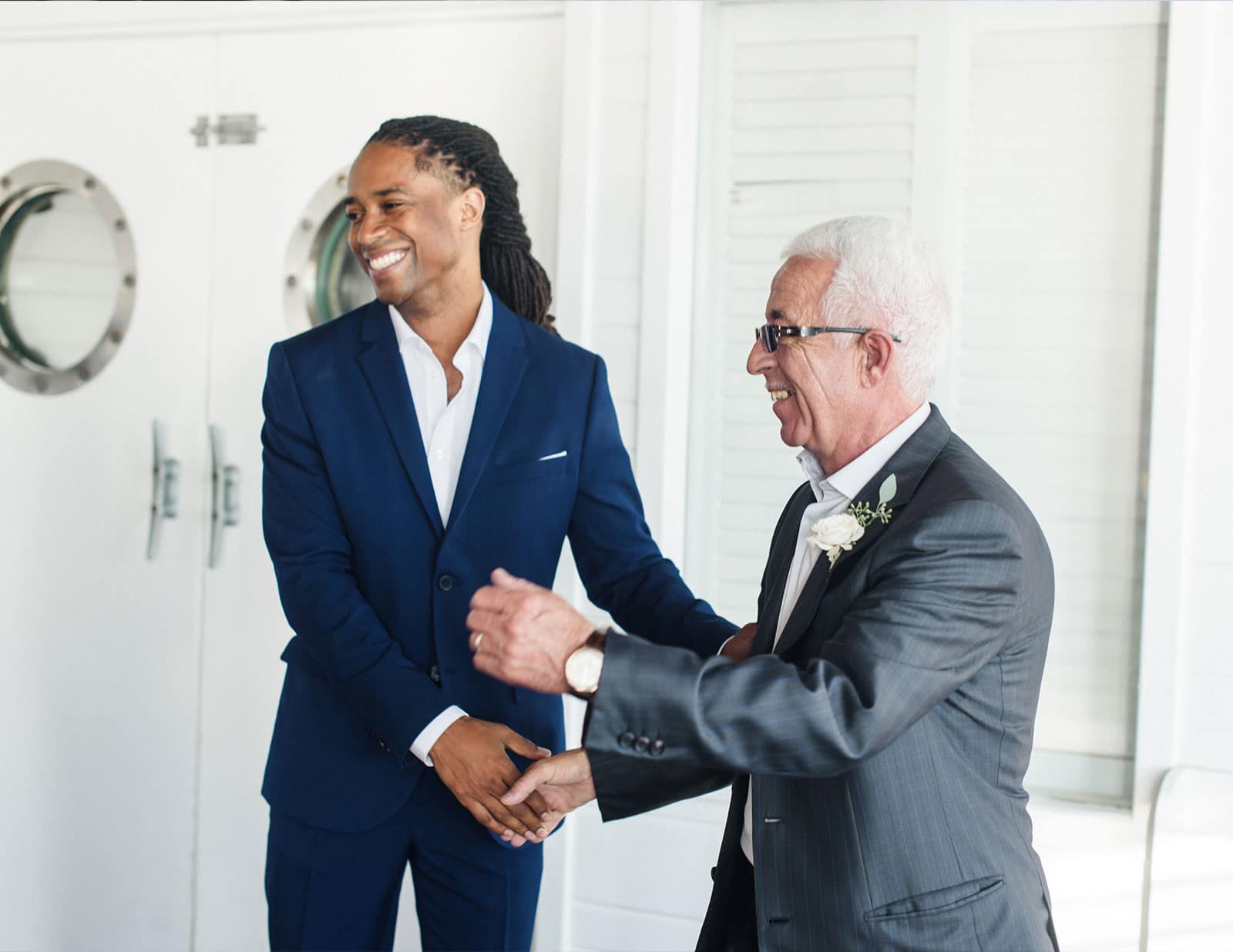
DJ Will Gill
Will Gill is a professional corporate DJ, emcee, and audience-engagement host whose 3-in-1 service meets the same six-criterion evaluation framework corporate buyers use for bands professionalism and reliability, versatility across eras and genres, documented track record at the corporate tier, real-time audience engagement, clear communication, and verifiable reputation and is one of the most-considered alternatives to corporate band programming for clients who want repertoire flexibility (any era, any genre, no fixed setlist), simpler production logistics (one vendor, one contract, less stage space), and an emcee-led approach to event pacing. A Forbes Next 1000 honoree, the Wall Street Journal’s #1-ranked corporate DJ and emcee, with 2,520+ five-star Google reviews from 600+ annual corporate engagements and a roster including AT&T Business Diamond Club, Google, Amazon, Microsoft, Salesforce, the United Nations, and the Boys & Girls Clubs of America. See his on-stage credits on IMDb. Reach out to discuss your 2026 corporate event entertainment programming.
Corporate Events Hosted Annually
Five-Star Google Reviews
WSJ-Ranked Corporate DJ and Emcee