
Why Conferences Need More Than a Music Personality (2026 Hiring Guide)
A conference is not a nightclub. It has a budget, a board, a board deck, an HR department, a five-generation audience, and a CEO who expects Monday-morning outcomes that justify the spend. Hiring a music personality whose entire instinct is built on late nights, loud rooms, and chart hits is one of the fastest ways to put all of that at risk. The person on the microphone is not in the background. They are operating inside your run of show, near your executives, and on the company’s record.
Conferences are also more expensive and more measurable than ever. Industry research from Qondor reports 65% of event planners experience budget overruns, with an average overspend of around 20%, while Bizzabo’s 2026 benchmark shows events are now expected to deliver on pipeline influence, deal velocity, and customer retention rather than attendance alone. In that environment, the entertainment line item carries weight it never used to. This is what to look for before you sign.
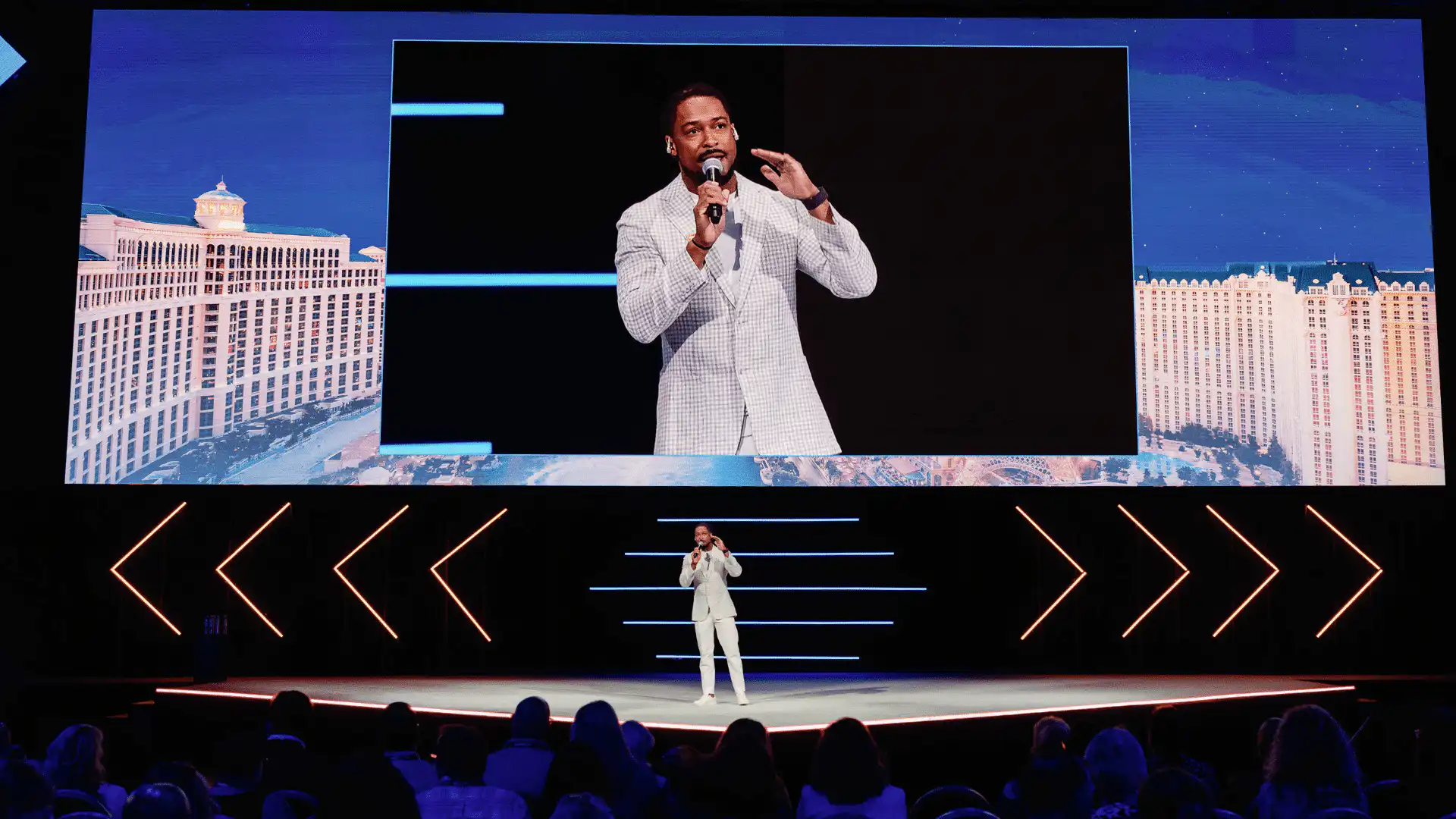
DJ Will Gill in action at a corporate conference. Contact him here to discuss your next event.
Key Takeaways
A music personality plays a set. A corporate engagement designer runs a job, with discovery, run-of-show coordination, HR-safe content control, and audience activations tied to your business goals.
Reliability is a financial control. 65% of event planners experience budget overruns, averaging 20%, much of it driven by late changes, overtime, and last-minute fixes that an unprepared entertainer can multiply.
Today’s conference room holds up to five working generations, with Millennials at about 35%, Gen X around 33%, Boomers about 25%, and Gen Z about 5% of the U.S. labor force, according to Pew Research data. The music has to land for every one of them.
Entertainment is the most memorable element of an event. 73% of attendees recall the entertainment six months later, ahead of the keynote, food, or venue.
Off-site events are still on the record. The EEOC’s 2024 Enforcement Guidance on Harassment in the Workplace covers conduct at work-related events, which means anything coming out of the microphone or speakers is part of your HR posture.
1. The Difference Between a Gig and a Job
A music personality is built around a gig. Get on the decks, read the dance floor, run the room, get paid, leave. The instincts work in a club because the goal of a club is the dance floor. The goal of a conference is bigger and quieter. Learn something. Align a team. Launch a product. Recognize the people who hit quota. Send everyone back to work on Monday with a clearer sense of where the company is going.
A corporate engagement designer is built around the job. Discovery calls weeks out. Script and run-of-show review. Custom music programming tied to each segment. Walk-in cues calibrated for the room you actually have, not the room they wish they were in. The on-stage performance is real, but it is downstream of an enormous amount of unglamorous preparation that planners do not see and never have to think about, which is exactly the point.
Conferences are not parties with chairs. They are business operations with entertainment inside them. Hire for the operation.
2. Reliability Is a Financial Control
It is 7:55 a.m. on day one of a three-day summit. The CEO walks the stage in five minutes. The room is filling. The booth is empty. Every minute past the cue is a minute of overtime labor on a crew that is on the clock from the moment they arrived for load-in.
This is not a hypothetical cost. Qondor’s analysis of event budgets puts the overrun gap between planned and actual costs at 27 to 28 percent, with the most common driver being labor and last-minute fixes. Production cost reporting from Globestream Media notes that labor alone accounts for 30 to 50 percent of an AV budget, with rates rising 25 to 50 percent in recent years. When the person on the microphone shows up late, fails to advance their cues, or treats a corporate call time like a club call time, the cost lands across every other line item in the room.
A corporate engagement designer arrives early, reads the brief, knows the names of the executives, has backup equipment in case, and treats the call sheet as a contract. That predictability is not a personality trait. It is a budget control.
3. Run of Show Coordination Is the Real Skill
A conference run of show is a minute-by-minute document. Walk-in music plays for exactly the right duration, fades out cleanly when the video package starts, the VP of Sales walks on to a track that supports her energy, the panel takes the stage to something restrained, the awards block has personalized walk-up cues built per honoree, the audience activation needs an underbed that does not fight the emcee mic, the closing video lands on a button that the music has to clear.
A music personality is rarely trained for that level of choreography with a production team. They are trained to play the dance floor. The difference shows up in the worst places: dead air during a transition, music spike under a speaker’s voice, walk-on cue missed by twenty seconds while the executive stands awkwardly in the wings.
Pre-production exists specifically to prevent these problems. Industry reporting on event production budgets notes pre-production consumes 20 to 25 percent of the total budget for a reason: issues caught on paper cost nothing, while issues caught mid-event with a full crew multiply. The entertainer who shows up for discovery calls, asks for the run of show, and rehearses the cues is the entertainer protecting your budget.
4. HR Risk Lives in the Speakers
A radio edit is not always enough. Explicit references, sexualized hooks, lyrics that punch down on protected groups, and crowd-work that ventures into territory the company would never green-light in a meeting: all of that is now inside your liability perimeter the moment it plays over your speakers.
This is not an opinion. The EEOC’s 2024 Enforcement Guidance on Harassment in the Workplace explicitly extends to conduct that happens outside the workplace if it is a work-related context, involves coworkers or supervisors, and affects employment conditions. Off-site means off-site. It does not mean off the record. Major employer policies, including Meta’s published harassment policy, explicitly apply to office parties, off-sites, and client entertainment events.
A corporate engagement designer screens every track for explicit content, double meanings, and references that read fine on a club floor and read like a lawsuit in a ballroom. The mic stays HR-safe by default because the rest of the career depends on it. A music personality without that frame can torch a Monday HR inbox in 40 seconds of unedited audio.
5. The Multigenerational Room Problem
The conference floor is the most age-diverse room a working person sits in. The World Economic Forum has noted that five generations are working side by side for the first time in history, with the age spread of the workforce wider than it has ever been.
In U.S. labor terms, Pew Research data places Millennials at about 35% of the workforce, Gen X around 33%, Baby Boomers at about 25%, and Gen Z at roughly 5%, with a small remainder of Silent Generation employees still active. A playlist that wins the 22-year-old reps will lose the 58-year-old SVP. The reverse is also true.
A music personality typically sticks to a brand: the genres and the era that made them. A corporate engagement designer programs across decades on purpose. Motown next to modern pop, classic rock leaning into 90s R&B, the throughline being the songs that get every demographic in the room to nod or sing along, not the songs that announce the DJ’s taste.
The skill is reading a corporate crowd’s lives, not pushing a curated set onto it.
6. Culture Moments Are Designed, Not Discovered
The reason companies spend serious money on conferences is rarely “to play music.” It is to reinforce culture, recognize people, align a team behind a strategy, and create a few moments that get cited at the next all-hands.
These moments do not happen by accident. They are produced. A personalized walk-up song for every President’s Club winner. A pre-keynote walk-in that ties to the CEO’s theme. A quick interactive activation after lunch on day two that connects strangers in the room from different regions. A custom audio sting under the announcement of the new product name. The on-stage performer is doing real production work, not just music selection.
This is also where the ROI math closes. Gallup workplace data cited in live event ROI reporting shows companies with high engagement see 23% higher profitability and 18% lower turnover than companies with disengaged workforces. The entertainment moments that make people feel seen are not soft assets. They feed directly into retention and culture metrics that leadership tracks.
7. The Executive Factor
Your VIPs, board members, major customers, and C-suite need to be comfortable in the room. That comfort is partly logistical (volume drops cleanly when the CEO talks to a major client near the stage), partly behavioral (the entertainer is professional with leadership and respectful of the hierarchy), and partly content-driven (nothing coming out of the speakers will make an executive grimace in front of a guest).
A music personality often has a rider that creates friction: hospitality demands, late call times, an entourage, and an attitude. A corporate engagement designer is low-maintenance for the planner and high-service for the executives. No drama. No surprises. Available before the day, present during the day, gone clean after the day.
That is what executives recognize and what gets you re-booked.
8. The Cost of Getting It Wrong
The argument against hiring a specialist is usually budget. The math under that argument rarely holds up.
If the entertainment is offensive, off-tempo, or chaotic, it reflects on the planner and the company hosting the event. People can forget the keynote. They will remember if an inappropriate song is played during the awards. Industry research cited in event ROI reporting found 87% of attendees form lasting opinions about a brand based on the quality of the event experience. The entertainer carries a disproportionate share of that perception.
Add the production cost layer. Independent event planners typically charge 10 to 20 percent of the total event budget for full-service coordination, AV runs another 10 to 15 percent or more, and any failure on the entertainment side ripples into both lines as overtime, last-minute changes, and stress.
A corporate engagement designer is not the most expensive line on the run sheet. They are the one that lowers the variance on every other line, because they reduce the risk that something on stage forces an emergency rework downstream.
9. What to Look for Before You Sign
Five quick filters before you finalize a contract.
One. Do they ask about the business goal before the sound system? If the discovery call is all about gear and none about purpose, they are wired for a gig.
Two. Do they read the run of show? A corporate operator wants the document. A music personality wants the set time.
Three. Is their music HR-safe by default? Ask explicitly. “Do you screen lyrics for explicit, sexual, or discriminatory content?” The right answer is “always.”
Four. Can they program across generations? Ask for a sample set list for a 25-to-65 audience. If everything is from one decade or one genre, your room will not be served.
Five. What are their references at corporate clients, not bars? Hilton, AT&T, PepsiCo, the United Nations, a Fortune 500 sales kickoff: ask for those. If the resume is all clubs, festivals, and weddings, the corporate read is going to be a learning curve, and your conference is not the place to provide that learning.
10. Investing in Peace of Mind
Planning a conference involves managing catering, travel logistics, registration, Wi-Fi, badging, sponsors, F&B, and 200 other moving pieces. The person with the microphone should be the line item you do not have to manage.
Hiring a corporate engagement designer instead of a music personality is not about taste. It is about choosing a partner whose default behaviors are aligned with how a conference actually runs. On time. Prepared. Clean. Inclusive. HR-safe. Coordinated with production. Built around your message rather than around their brand.
When the budget conversation comes around, look past the famous names. Look for the professional who asks what the event is trying to accomplish before they ask what the rider includes. That is the partner who turns your conference into a result.

About the Author
William “DJ Will Gill” Gilbert creates corporate event experiences that go beyond the music. As a DJ, host, and audience engagement specialist, he knows how to read a room and keep attendees involved from start to finish. Over the course of more than 600 corporate events, Will has worked with organizations including AT&T Business, CDW, Virgin Galactic, Home Depot, Hilton, PepsiCo, PayPal, and the United Nations. His work has also been recognized by Forbes Next 1000 and The Wall Street Journal, and he has IMDb credits tied to Super Bowl LIV, the FIFA World Cup, the Formula 1 Las Vegas Grand Prix, The Voice, and Real World: Hollywood. Outside of live events, Will is the founder of TheAIDJ.com, a patent-pending AI playlist tool created to support today’s music curators.
2,520+ Google Reviews · IMDB · Mixcloud · Instagram ·
Frequently Asked Questions
Why is a conference not a nightclub?
It has a budget, a board, an HR department, a five-generation audience and a CEO expecting outcomes.
Do budgets overrun?
Qondor research reports 65% of planners overrun, averaging about 20%.
How many generations are in the room?
Up to five: Millennials about 35%, Gen X 33%, Boomers 25%, Gen Z 5% per Pew data.
Is entertainment remembered?
73% of attendees recall entertainment six months later.
What should I look for?
A corporate engagement designer with run-of-show coordination and HR-safe content control.