
What Is a Corporate DJ and What Do They Do?
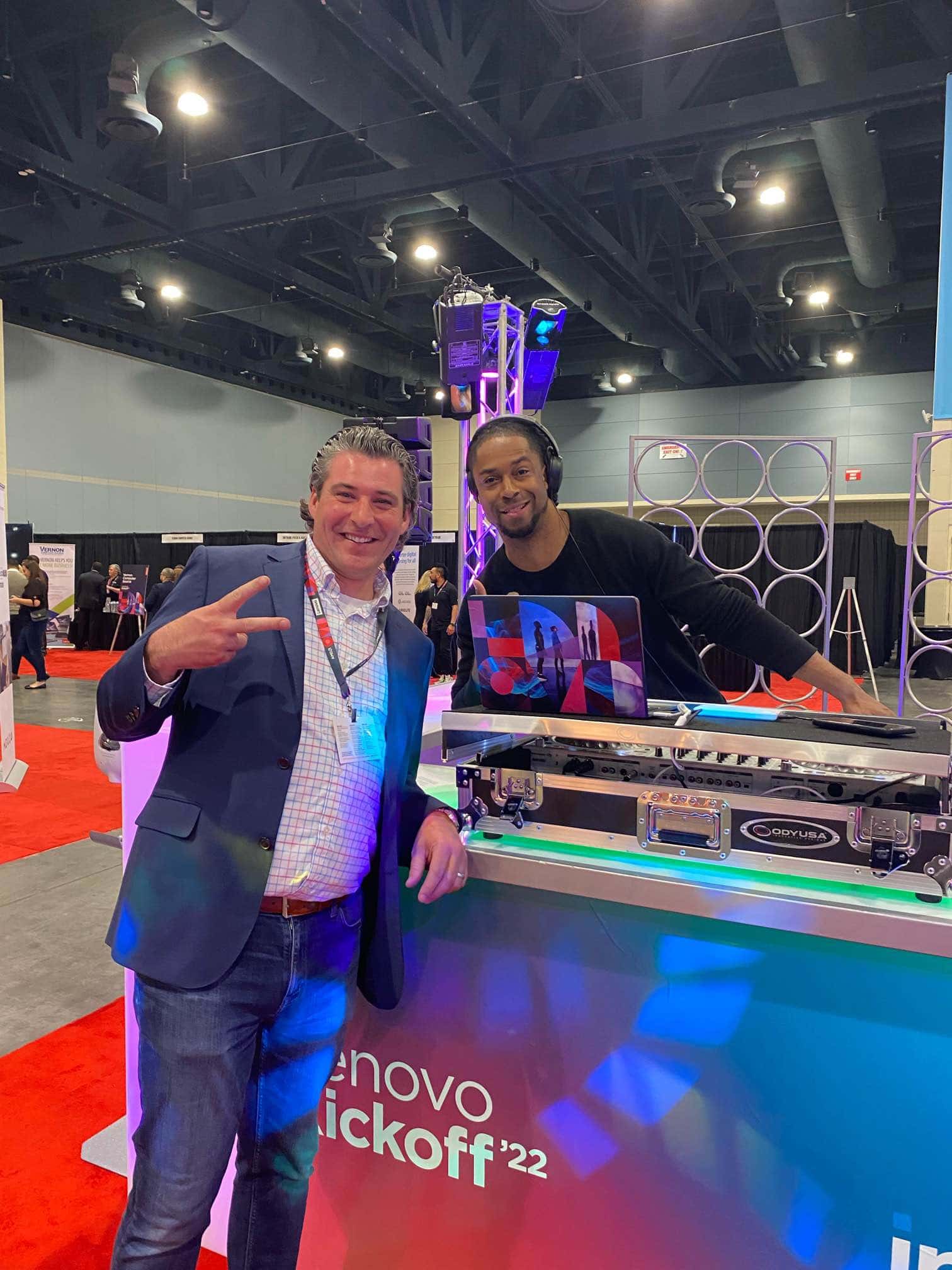
What is a corporate DJ and what do they do? A corporate DJ is a professional who programs music for business events: walk-in and dinner sets, award-show stings, dance floors that respect HR, and transitions timed to the agenda rather than a club crowd. Will Gill, the Wall Street Journal’s #1 rated corporate event DJ, pairs that craft with emcee hosting and team building in one 3-in-1 show.
The term “corporate DJ” gets used loosely, and that creates real confusion for event planners trying to figure out who they actually need for their event. A DJ who plays weddings on weekends and occasionally books a company holiday party is not the same thing as a professional whose entire practice is built around corporate event entertainment. The difference in what they do, how they prepare, and what they deliver is significant enough to matter for anyone planning a business event.
Here is a clear, complete answer to what a corporate DJ is, what they actually do, and what distinguishes them from every other kind of DJ.
“A corporate DJ is not a DJ who happens to play at business events. It is a professional who has built their entire practice around the specific demands of the corporate event market.”
A corporate DJ’s secret weapon is the right playlist.
Introducing TheAIDJ.com
Behind every smooth corporate set is careful song selection. AIDJ builds it for you: describe the crowd and mood, preview the blend, and export the set. A simple way to prep like a pro.
What Is a Corporate DJ: A Clear Definition
A corporate DJ is an entertainment professional who specializes in providing DJ services for business events conferences, general sessions, award dinners, sales kickoffs, company celebrations, product launches, incentive travel events, and similar corporate programming. The specialization is meaningful because corporate events operate under fundamentally different conditions than the other contexts where DJs typically work.
A club DJ performs for an audience that came specifically for the music and has selected themselves into that environment. A wedding DJ serves a predetermined guest list with deep personal stakes in the event’s success. A corporate DJ serves a professionally diverse audience that came for business reasons, where the entertainment is one component of a larger program with specific objectives, and where the DJ’s performance reflects directly on the company hosting the event.
Those differences shape everything: how a corporate DJ prepares, how they interact with clients, what their music library needs to contain, how they communicate on the microphone, how they coordinate with the event’s other stakeholders, and how they measure a successful performance. The corporate DJ role is not a variation of other DJ contexts it is its own discipline with its own standards.
What Does a Corporate DJ Actually Do?
The job description of a corporate DJ covers significantly more than the performance itself. Understanding the full scope helps clarify why the role commands the fees it does and why experience matters so much in evaluating candidates.
Pre-Event Preparation and Coordination
A professional corporate DJ invests substantial time before the event begins. This includes a detailed client intake process to understand the event’s business objectives, the audience composition, the full run of show, key moments that require musical emphasis (speaker entrances, award presentations, break transitions), any music preferences or restrictions, and the technical requirements of the venue.
This intake shapes the music preparation. A corporate DJ builds a specific event playlist not a generic setlist but a curated program tailored to the specific demographic, the event format, and the arc the client wants to create from arrival through final song. According to the Professional Convention Management Association, music is consistently among the top three factors in attendee satisfaction at corporate events. That outcome does not happen by accident; it is the product of specific preparation.
Pre-event coordination also involves communication with the venue’s AV team, coordination with the show caller or event producer on cue points and timing, and confirming logistics including load-in time, power requirements, and setup space. A corporate DJ who shows up on event day without having completed this coordination is creating unnecessary risk for the client.
Open-Format Music Programming Across Demographics
The defining musical challenge of corporate DJ work is breadth. Corporate event audiences typically span multiple generations, industries, cultural backgrounds, and musical reference points simultaneously. A room of 300 employees at a company’s national conference might include people whose formative musical experiences ranged from the 1970s through the 2010s, across genres from classic rock and R&B to pop and hip-hop.
A corporate DJ serves that entire room, not the fraction of it whose taste matches their personal preferences. This requires an open-format approach the ability to move fluidly across genres and eras, finding the musical common ground that engages the broadest possible cross-section of the audience at any given moment. It also requires a genuinely deep library: a DJ who only knows current chart music cannot serve an audience with 30 years of musical history in the room, and a DJ who only knows classic hits cannot keep younger audiences engaged through a three-hour dinner.
Every track in a corporate DJ’s library should be a verified radio edit no explicit content. This is not optional in a professional corporate context. A single explicit lyric during an award dinner with executive leadership in the room creates a problem that overshadows everything else the DJ did well.
Energy Arc Management Throughout the Event
Corporate events have a shape a program arc that moves through different phases with different energy requirements. Cocktail hour networking requires ambient social music at a volume that enables conversation. Dinner service requires music that establishes atmosphere without competing with the speeches. Award presentations require musical cues that emphasize the moment. The post-program celebration may require a full build toward a packed dance floor.
The corporate DJ manages these transitions deliberately, reading the room continuously and adjusting the music program to serve what the event needs at each moment. This is not passive it requires active attention and real-time decision-making throughout the performance. A DJ who preloads a playlist and lets it run without engagement is not doing corporate DJ work; they are performing a music service.
Emcee and Hosting Responsibilities
Many corporate DJs also function as the event’s emcee, which means taking on microphone responsibilities in addition to music performance. This includes welcoming the audience, making announcements, introducing segments and speakers, facilitating transitions between program elements, and keeping the energy connected across the full event.
The on-mic skill set is genuinely distinct from the DJ skill set, and not all DJs who claim to offer emcee services have developed it to a professional standard. A corporate DJ who handles both functions well provides significant value because the integration of music and hosting under a single professional creates a more coherent event experience and reduces the coordination overhead of managing separate vendors for each function.
The Corporate DJ’s Core Responsibilities at a Glance
What a Corporate DJ Is Responsible For
| Pre-Event Coordination | Client intake, run-of-show review, music curation, venue AV coordination, and timeline alignment before event day. |
| Open-Format Music | Curating and performing a tailored music program across genres and decades to serve a diverse professional audience. |
| Energy Arc Management | Reading the room continuously and guiding the collective energy through each phase of the event program. |
| Timeline Support | Providing musical cues for key program moments and adapting in real time when the timeline shifts, which it always does. |
| Emcee and Hosting | On-mic presence for announcements, introductions, segment transitions, and audience interaction as needed. |
| Professional Operations | Contracts, insurance, prompt communication, technical self-sufficiency, and zero-drama vendor behavior throughout the relationship. |
How a Corporate DJ Differs from Other Types of DJs
The clearest way to understand what a corporate DJ is may be to understand what makes the role distinct from the two most common alternative DJ contexts: nightclub DJing and wedding DJing.
Corporate vs. nightclub DJing. A club DJ performs for an audience that came specifically to experience the DJ’s musical vision. The club audience self-selects for music, dancing is expected, the energy is consistently high, and the DJ’s personal taste and style are features, not potential liabilities. A corporate DJ serves an audience that came for business reasons, may not consider dancing part of their evening, spans demographics the DJ must serve rather than cater to, and where the DJ’s personal taste is largely irrelevant to what the room needs. The club DJ leads; the corporate DJ serves.
Corporate vs. wedding DJing. A wedding DJ serves a single family and social circle with deep emotional investment in the event. Song requests are often specific and personal. The DJ works from a relatively known demographic with understood tastes. A corporate DJ serves a professionally diverse group that may have nothing in common except their employer. The emotional stakes are organizational rather than personal, the music requirements are breadth-focused rather than sentiment-focused, and the event often includes program elements (presentations, speeches, award ceremonies) that require the DJ to function as a production partner, not just an entertainer.
These are not gradations of the same job. They are distinct roles with different skill requirements, different preparation processes, and different performance standards. A DJ who excels at club performance may have entirely the wrong instincts for a corporate event, and vice versa.
What Types of Corporate Events Use a DJ?
The range of corporate event formats that benefit from DJ services is broader than many planners initially recognize. The most common include conferences and general sessions, where a DJ manages the energy of a large audience through a full-day or multi-day program, providing music during breaks, walk-ins, and the post-conference networking reception.
Award dinners and recognition events are a natural fit for corporate DJs because they combine formal program elements with a celebratory social atmosphere that music actively supports. Sales kickoffs and company meetings benefit from a DJ who can build anticipation during pre-event arrival, energize the room coming out of presentations, and sustain momentum through an evening event.
Company celebrations, holiday parties, and employee appreciation events are perhaps the most straightforward corporate DJ applications these are explicitly entertainment-focused events where the DJ’s primary job is keeping a large, diverse group of employees engaged and having a good time for the duration of the event.
Product launches, client entertainment events, and incentive travel programs also regularly incorporate DJ services, particularly when the entertainment component needs to reflect positively on the sponsoring company’s brand and professionalism.
The 3-in-1 Corporate DJ: DJ, Emcee, and Audience Engagement
The most capable corporate DJs operate on a model that goes beyond music performance to encompass three integrated functions: DJ performance, emcee services, and audience engagement programming.
DJ performance covers the musical environment the open-format programming, energy management, and technical execution described above. Emcee services cover the on-mic hosting responsibilities: welcoming the audience, guiding transitions, introducing speakers, and maintaining the connection between entertainment and program. Audience engagement covers interactive elements game show segments, team-building activities, crowd participation moments that transform passive attendees into active participants.
When one professional delivers all three functions, the event experience becomes fundamentally more coherent. There is no gap between the DJ’s sense of the room’s energy and the emcee’s delivery because they are the same person. There is no coordination overhead between entertainment and engagement because they are integrated into a single performance philosophy. And there is no jarring tonal shift between hosted segments and music sets because one professional is managing both.
This is the model that has consistently produced the strongest corporate event outcomes across 600+ Fortune 500 engagements. It is also the reason that the most experienced corporate DJs command meaningfully higher rates than standard DJ-only performers the scope of what they are delivering is genuinely larger, and the value is proportionally greater.
What to Look for When Hiring a Corporate DJ
Now that you understand what a corporate DJ is and does, the evaluation criteria for hiring one become much clearer. The primary signals of a genuine corporate DJ professional are a track record specifically in corporate events (not wedding or club work described as “versatile”), a substantial review base with reviews from event planners and corporate clients specifically, demonstrated on-mic capability if emcee services are part of the scope, and a pre-booking process that includes thorough discovery questions about your event before they propose a price.
A corporate event DJ with real experience will ask you about your audience composition, your event’s business objective, the run of show, and the key moments that need musical support before agreeing to take the booking. A DJ who sends a quote without asking any of those questions has not fully engaged with what the role requires.
The review count matters as a credibility signal, but the content of the reviews matters more. Reviews from event planners who describe a DJ’s professionalism, reliability, adaptability, and on-mic presence are more informative than reviews from party guests who enjoyed the music. Look for the professional evaluator’s perspective, not just the audience’s.
Pricing is also a signal. A corporate DJ who quotes dramatically below market rate is either new to the market and learning on your event, or not operating at the professional standard the corporate context requires. Neither is ideal for a high-stakes company event. The investment in a genuinely experienced corporate DJ reflects the value that professional brings to the event and the cost of the alternative, when it underperforms in front of your company’s leadership and clients, is substantially higher.
“The right corporate DJ becomes invisible in the best possible way the event just feels right, and no one stops to analyze why.”
The Bottom Line
A corporate DJ is a professional entertainment specialist whose practice is built around the specific demands of business events. They bring deep music library breadth, open-format performance capability, energy arc management skill, professional coordination discipline, and frequently on-mic hosting ability to events where the entertainment reflects directly on the company sponsoring it.
What distinguishes a true corporate DJ from a generalist who occasionally books business events is not a single skill or credential it is the accumulation of experience, systems, and professional habits that only develop through sustained focus on the corporate market. When you hire a DJ who has that experience, the difference shows in every aspect of the engagement, from the first call to the last song of the evening.

DJ Will Gill
Will Gill is a Forbes Next 1000 honoree and WSJ-ranked #1 Corporate DJ and Emcee with 2,520+ five-star Google reviews. He has performed at 600+ Fortune 500 events across live, virtual, and hybrid formats, from Super Bowl parties, the Formula 1 Las Vegas Grand Prix, and FIFA World Cup 2026 to national conferences for the United Nations and Boys & Girls Clubs of America. His 3-in-1 service (DJ + Emcee + Audience Engagement) makes him one of the most requested corporate entertainers in the country.
Learn more about his DJ services.
Fortune 500 Events
Five-Star Google Reviews
WSJ-Ranked Corporate DJ
Watch Will Gill Work a Live Corporate Crowd
Real event footage beats any sales pitch. This is what the 3-in-1 show looks like in a room full of coworkers.
Frequently Asked Questions
What does a corporate DJ actually do at an event?
A corporate DJ scores the entire agenda: walk-in music, dinner ambience, award stings, transition beds, and a compliant dance floor, all coordinated with planners and AV.
Is a corporate DJ different from a club or wedding DJ?
Yes. Corporate work is agenda-driven and audience-mixed: clean edits, sponsor-safe energy, microphone skills, and production coordination matter more than mixing tricks.
What does a corporate DJ cost?
Professional corporate DJs run $5,000 for a half day to $8,000 for a full day. Multi-day programs are discounted, and virtual events start around $2,300.
Can a corporate DJ also emcee?
The best ones do. Will Gill built his 3-in-1 show around exactly that: DJ, emcee, and one-man team building from a single performer, one contract instead of three.
How do I vet a corporate DJ?
Watch footage of them in a corporate room, read third-party reviews, and brief them on your agenda before signing. Will Gill carries 2,520+ five-star Google reviews for exactly this diligence.