
The Ultimate Curator Music Toolkit for 2026
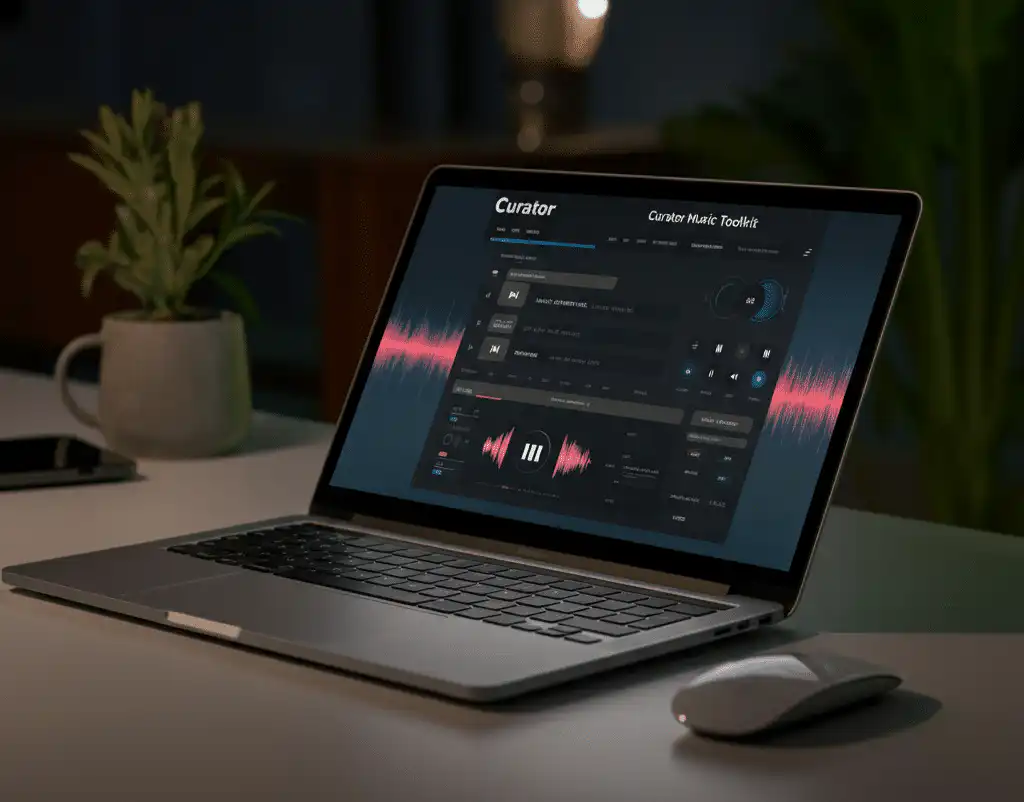
The modern music curator’s job has become structurally more demanding in 2026. The catalog scale has expanded past 200 million tracks across major streaming platforms, the discovery pipeline now runs through social-platform virality before chart entry, and the difference between a curator who breaks through and one who doesn’t comes down to which tools they use across four critical layers: discovery, organization, playlist creation, and distribution. The right tool stack compresses hours of manual work into minutes of efficient selection; the wrong stack (or no stack at all) means competing in a saturated attention market with manual processes that don’t scale.
This is the complete 2026 toolkit guide from the consumer-tier tools indie curators use to the professional-tier DJ infrastructure that working corporate curators rely on. For the playlist construction principles that pair with this toolkit, see our guide on building the perfect music playlist.
Key Takeaways
→ The modern curator toolkit operates across four integrated layers: discovery (finding music), organization (managing your library), playlist creation (building the listening experience), and distribution (sharing and growing audience). Working professionally requires competence at all four gaps in any single layer, creating operational bottlenecks that compound over time.
→ Streaming is now the dominant music consumption format, which makes curator tools a higher-leverage skill set than ever. The IFPI Global Music Report 2024 documented streaming as the largest revenue source in recorded music, generating roughly two-thirds of the industry’s $28+ billion annual recorded music revenue. Curator-driven playlist placement is now one of the highest-impact promotional outcomes in the music business.
→ TikTok virality has restructured the discovery pipeline. TikTok’s Year in Music 2025 documented that 8 of the top 10 Billboard No.1 songs in 2025 had a viral TikTok moment before reaching the top of the chart, and the February 2025 TikTok/Luminate Music Impact Report showed 84% of Billboard Global 200 entrants in 2024 went viral on TikTok first. Modern curator tools must integrate social-platform discovery alongside traditional editorial and algorithmic channels.
→ Professional DJ-tier tools operate on a fundamentally different infrastructure from consumer curation tools. DJ record pools like BPM Supreme, DJcity, and ZIPDJ provide curated weekly downloads with proper licensing and professional-grade metadata; DJ software like Serato, Rekordbox (now AlphaTheta), and Traktor provide harmonic mixing, BPM analysis, and live performance tools that consumer streaming platforms structurally cannot replicate.
→ Corporate event music curation requires a hybrid toolset combining consumer streaming awareness with professional DJ-tier infrastructure. 2024 corporate event research documented 82% of attendees citing atmosphere as the primary satisfaction factor, and atmosphere production at the corporate event level requires curator tooling that supports real-time live selection a workflow consumer tools don’t address.
See professional music curation in live performance contexts. To consult on tooling for your corporate event, contact DJ Will Gill directly.
Stop replaying the same songs.
Introducing TheAIDJ.com
AIDJ turns a plain-English request into a ready-to-play set, previews it instantly, and exports straight to Spotify. Discover music that actually fits the moment.
The Curator Tool Stack Foundation
Why Tools Matter in 2026
The scale problem. The major streaming catalogs now exceed 200 million tracks combined, with 80,000-100,000 new tracks uploaded daily. A curator working without proper tooling is trying to sift this scale manually, an impossible task at any meaningful coverage level. Professional curator tools exist because the scale has outpaced human capacity to process a catalog without computational assistance. The right tool stack does the sifting algorithmically; the curator’s role becomes higher-level selection, narrative construction, and audience matching rather than raw catalog browsing.
The Four-Layer Stack
The integrated workflow. The professional curator toolkit operates as a four-layer integrated workflow. Layer one is discovering the tools that surface music a curator wouldn’t find through the default streaming experience. Layer two is organizing the systems that hold a curator’s growing library in a searchable, taggable, retrievable form. Layer three is playlist creation, the tools that translate selection decisions into ordered, flow-conscious listening experiences. Layer four is the distribution of the platforms and services that move finished playlists to actual listeners. A break in any single layer creates a workflow bottleneck that compounds across the entire practice; competent curators build all four layers in parallel.
Tool Selection by Curator Type
The differentiation by use case. Different curator types need different tool stacks. A bedroom playlist curator building a Spotify following needs strong discovery tools and good distribution mechanics. An editorial curator at a streaming platform needs robust internal databases and rapid catalog processing. A working DJ needs harmonic-mixing analysis, BPM organization, and real-time performance integration. A corporate event DJ needs all of the above, plus brand-fit calibration and live audience reading tools. The toolkit isn’t a universal match for the stack to the actual use case.
Discovery Tools: Finding the Right Music
Streaming Platform Native Discovery
The default starting point. Spotify’s Discover Weekly, Release Radar, and Daylist; Apple Music’s Personal Radio and For You section; Amazon Music’s My Mix; YouTube Music’s recommendations; Tidal’s Track Radio; these algorithmic recommendation engines are reasonable discovery starting points for any curator. The structural limitation is taste reinforcement: each platform’s algorithm tends to recommend music similar to what a listener already engages with, which produces filter-bubble effects over time. Discovery beyond these tools is necessary specifically because algorithmic recommendations operate on taste reinforcement rather than taste expansion.
Music Blogs and Editorial Publications
The editorial discovery layer. Pitchfork remains the most influential independent-music editorial publication, with daily reviews, “Best New Music” designations, and feature coverage that meaningfully drives discovery within indie and alternative spaces. Bandcamp Daily functions as Bandcamp’s editorial layer, with deep coverage of independent and underground artists not surfaced by major streaming algorithms. Hype Machine aggregates music blogs into a single discovery interface, surfacing tracks gaining traction across independent music journalism. These editorial layers operate orthogonally to streaming algorithms, so what they surface often won’t appear in Discover Weekly until weeks or months later, if ever.
Reddit and Community Discovery
The crowdsourced layer. Reddit’s music subreddits function as one of the most underrated discovery channels. r/listentothis is dedicated to lesser-known music with strict community rules favoring genuine discoveries over established artists. r/indieheads covers a broader indie-rock and adjacent-genre conversation. Genre-specific subreddits exist for nearly every musical niche: r/hiphopheads, r/electronicmusic, r/popheads, r/metalcore, r/jazz, r/classicalmusic, and dozens more. The community discussion adds context that algorithmic recommendations cannot explain why something is good, what it sounds like, who it’s similar to, and what cultural moment it emerged from.
SoundCloud and Bandcamp for Independent Discovery
The independent-music infrastructure. SoundCloud remains the primary upload platform for independent and emerging artists across electronic music, hip-hop, and adjacent genres. Many tracks appear on SoundCloud months or years before reaching major streaming platforms, if they ever do. Bandcamp functions as the artist-direct sales-and-streaming platform for independent music across virtually every genre, particularly strong for experimental, electronic, jazz, ambient, and underground material. Both platforms reward direct browsing rather than algorithmic discovery, with curated tags, label pages, and artist-followed updates that algorithmic systems cannot replicate.
The 2026 dominant front end. TikTok has become the dominant front end of modern music discovery. TikTok’s Year in Music 2025 documented that newcomers Alex Warren, Ravyn Lenae, sombr, and Lola Young all launched primarily through TikTok virality, and that resurrected older tracks from Rihanna, Radiohead, and Black Eyed Peas reached new audiences through TikTok in 2025. A curator who isn’t monitoring TikTok music trends is missing a substantial portion of the discovery pipeline. Instagram Reels and YouTube Shorts function as parallel social-platform discovery channels, often surfacing similar tracks with slightly different audience overlap.
AI-Powered Tagging Tools
The metadata-analysis layer. Cyanite.ai applies machine-learning models to tag tracks with detailed mood descriptors (energetic, melancholic, aggressive, dreamy), genre subcategories, instrumental composition, and tempo characteristics, enabling fine-grained searches that streaming-platform tag systems don’t support. Musixmatch, primarily known as the lyrics database, provides professional tools for lyrical-content search alongside conventional metadata. Both tools support workflows where curators search for “tracks similar to X in mood, energy, and tempo,” the kind of query that algorithmic recommendations handle partially at best.
Organization Tools: The Digital Crate
Spreadsheets as the Foundation
The unglamorous, reliable base layer. Google Sheets or Excel is the most underrated curator tool in 2026. A well-structured spreadsheet with columns for artist, track title, album, year, genre, mood, BPM, key, energy level, and free-text notes becomes a personal music database that outperforms any streaming platform’s library feature for serious curation work. The free-text notes column is the differentiator, capturing the context that makes a track useful (“works in the 11 pm peak slot,” “Atlanta hip-hop curator placement,” “Spotify Daylist sleep-time pickup”) becomes searchable institutional memory that compounds over years of curation work.
Dedicated Music Organizers
The library management layer. Musicbee on Windows provides robust music library management with custom tagging, smart playlists that update automatically based on criteria, rating systems, and bulk metadata editing. Apple Music’s native library on Mac (or iTunes legacy on PC) offers similar functionality with deep integration into the Apple ecosystem. Plex’s music server provides cross-device library access with metadata management. These dedicated tools matter for curators working with downloaded files alongside streaming. The streaming-only curator can substitute streaming-platform library features, but workflow flexibility narrows substantially without dedicated organization infrastructure.
Cross-Platform Syncing Tools
The library portability layer. Soundiiz and TuneMyMusic solve the multi-platform fragmentation problem by moving playlists, libraries, and saved tracks between Spotify, Apple Music, Amazon Music, YouTube Music, Tidal, Deezer, and other services. Both support free tiers for occasional use and paid tiers for high-volume syncing and automated backups. For curators working across platforms (whether by personal preference, by client requirements, or by audience location), cross-platform syncing infrastructure converts platform fragmentation from a recurring friction into a one-time setup cost.
Tag Systems and Metadata Management
The retrieval layer. A tagged library is a searchable library. Professional curator tagging typically operates on at least four orthogonal axes: descriptive tags (genre, sub-genre, era), functional tags (warmup, peak-time, cool-down, transition), audience tags (corporate, wedding, club, festival), and quality tags (must-play, conditional, backup, retired). The investment in consistent tagging pays back during high-pressure retrieval moments, finding the right track for a specific situation in seconds rather than minutes. Spreadsheet-based tagging works for moderate libraries; dedicated organization software is required at higher volumes.
Playlist Creation Tools: The Build Layer
BPM and Key Analysis (TuneBat)
The harmonic-mixing input layer. TuneBat provides free BPM and musical key analysis for any track type in the artist and title, and TuneBat returns the tempo (in beats per minute), the Camelot Wheel key designation (used for harmonic mixing), and the standard musical key. The Camelot Wheel system enables harmonic mixing by showing which keys sound musically compatible with each other; transitioning between compatible keys produces smoother audio than mixing arbitrary keys. For curators building playlists with attention to flow rather than just track sequence, BPM, and key data is the foundation that makes harmonic decisions possible.
Harmonic Mixing Principles
The flow construction discipline. Harmonic mixing matches tracks by musical key so transitions sound musically continuous rather than disruptive. The basic rule: stay within compatible keys (one Camelot Wheel position apart, or matching the relative major/minor). The advanced application: use key changes deliberately to signal narrative shifts in a playlist, moving up a key for energy lifts, moving to a parallel minor for emotional weight, modulating to distant keys for surprise. Streaming playlists rarely respect harmonic mixing principles, which is why mass-market playlists often feel jarring track-to-track, even when individual songs are well-chosen.
Energy Mapping and Flow Design
The arc construction layer. Beyond track-to-track transitions, a playlist has a macro energy arc, the overall energy profile across its full duration. The intro sets tonal expectations; the build raises energy progressively; the peak is the highest-energy stretch; the resolution brings the listener back to a comfortable state. Different playlist purposes need different arcs. Workout playlists are typically front-loaded with sustained high energy; dinner playlists are often gentle throughout; party playlists arc up sharply and stay elevated. Mapping the intended energy arc before track selection produces tighter, more coherent playlists than building track-by-track without overall structural intent.
Cover Art Tools (Canva)
The visual identity layer. Canva offers free and paid templates specifically sized for streaming-platform playlist covers (Spotify uses 300×300 minimum, recommended 640×640 or larger). Adobe Express provides similar functionality with deeper integration to Adobe Creative Suite for power users. For curators building public-facing playlists, custom cover art is the single highest-leverage discoverability investment; playlists with custom covers consistently outperform default-cover playlists in both algorithmic and follower-driven discovery.
Distribution and Growth Tools
Streaming Platform Sharing
The default distribution layer. Each streaming platform offers native sharing of public playlist URLs for Spotify, share links for Apple Music, and public profiles for Amazon Music. Making a playlist public is the necessary baseline for any distribution strategy beyond personal use. Verified curator status (where available) provides additional credibility signals. Cross-posting the same playlist to multiple platforms is operationally expensive without cross-platform syncing tools (Soundiiz, TuneMyMusic). Most independent curators concentrate distribution on one or two platforms rather than spreading thin across all of them.
The amplification layer. Instagram playlist promotion (Reels and Stories featuring tracks from the playlist), TikTok content using the playlist’s signature songs, Twitter/X posts with vibe descriptions and playlist links, and YouTube content discussing the curation logic all drive measurable follower growth for streaming-platform playlists. The strongest distribution strategies pair the curation work with content that explains or showcases the curation listeners follow curators whose perspective they trust, and the content provides the perspective signal. Pure playlist-link sharing without supporting content typically underperforms content-supported sharing by an order of magnitude.
Playlist Promotion Services (PlaylistPush, SubmitHub)
The monetization layer. PlaylistPush and SubmitHub operate as marketplaces connecting artists seeking playlist placement with curators willing to review submissions. Verified curators with established followings can monetize their playlists by reviewing artist submissions (typically $1-$3 per review on PlaylistPush, similar economics on SubmitHub). The review work is real; curators are expected to actually evaluate the submitted tracks against playlist fit, but the income stream provides a meaningful side revenue source for serious independent curators with developed audiences. New curators should expect modest income at first; established curators with strong followings can produce meaningful monthly revenue.
Community-Driven Growth
The long-tail audience-building layer. Reddit, Discord, and niche music forums offer community-driven distribution where genuine value-add posts can produce sustained follower growth for a curator who consistently shows up with quality work. The rules vary by community; most forbid pure self-promotion but welcome curators who contribute to discussions, share work as part of broader conversations, and build relationships over time. The community-growth approach is slower than paid promotion but produces durable audience relationships rather than transactional traffic spikes.
AI-Powered Curation in 2026
Where AI Accelerates Curation
The acceleration use cases. AI tools excel at pattern-matching across catalogs, finding tracks similar to a reference song in mood, tempo, energy, instrumentation, or compositional structure. They handle metadata generation at scale (auto-tagging large libraries with mood, genre, and energy descriptors that would take days to apply manually). They surface candidate matches for curator-specified criteria faster than manual browsing can. For high-volume curation work where the curator’s role is selection-from-candidates rather than catalog browsing, AI tools compress the candidate-generation phase substantially.
Where AI Fails Curators
The limitation cases. AI tools struggle with curatorial judgment, knowing which track to play first, which track to drop, which track to save for a specific moment. They have no concept of audience emotional state, no model of room energy, and no read on cultural moment. They handle catalog-wide pattern matching well; they handle context-specific selection poorly. The professional curator’s value is the context-specific selection layer that AI structurally cannot replicate. The curator who treats AI as a catalog-accelerator does better than the curator who treats AI as a replacement for selection judgment.
The Hybrid Workflow
The integration practice. The most effective 2026 curator workflow integrates AI tools as catalog accelerators while reserving final selection judgment for the curator. AI surfaces candidate tracks matching specified criteria; the curator evaluates the candidates against current context, narrative needs, and audience considerations; the curator selects from the AI-generated candidate pool. The hybrid workflow produces both the breadth advantages of AI-assisted catalog processing and the depth advantages of human curatorial judgment. Pure-AI workflows produce generic-feeling playlists; pure-human workflows don’t scale to the catalog sizes 2026 curation work requires.
Professional DJ Tier Beyond Consumer Tools
DJ Pools BPM Supreme, DJcity, ZIPDJ
The professional download infrastructure. DJ record pools provide curated weekly downloads of new releases and remixes optimized for professional DJ use, extended mixes, intro/outro edits, acapellas, and instrumentals not available through consumer streaming services. BPM Supreme, DJcity, and ZIPDJ are the three dominant English-language DJ pools, with overlapping but distinct catalog focuses. Subscription pricing ranges from approximately $20 to $40 per month for professional access. Properly licensed downloads from DJ pools provide both the production-grade files professional DJs need and the legal coverage that consumer-tier sources cannot offer for commercial use.
DJ Software Serato, Rekordbox, Traktor
The performance infrastructure. Serato DJ Pro is the dominant DJ software in club and mobile/wedding DJ contexts in North America, with deep hardware integration across Pioneer, Rane, Numark, and other controller manufacturers. Rekordbox (now operated under AlphaTheta, following the Pioneer DJ brand transition) is the dominant club-installed software ecosystem. Traktor Pro from Native Instruments remains popular in electronic music and creative DJ contexts. All three offer automatic BPM and key analysis, beatgrid editing, harmonic-key tagging, cue point management, and library organization tools that consumer streaming platforms structurally don’t replicate.
Harmonic Mixing Software Mixed In Key
The harmonic specialization layer. Mixed In Key is the most established standalone harmonic-mixing analysis tool. Beyond what general-purpose DJ software offers, Mixed In Key provides specialized energy-level scoring (tracks rated 1-10 for energy), advanced cue point detection, mashup-friendly analysis, and integration with Serato, Rekordbox, and Traktor library structures. For DJs whose curation depends heavily on harmonic mixing precision, Mixed In Key remains the industry-standard supplemental tool even when working primarily within Serato or Rekordbox ecosystems.
Performance vs Streaming Licensing
The licensing reality. Professional DJ contexts require performance-grade licensing that consumer streaming subscriptions don’t provide. Spotify, Apple Music, and other consumer services license music for personal listening, not for commercial performance at events. ASCAP, BMI, SESAC, and SoundExchange handle public-performance royalties; venues typically maintain blanket licenses, but the DJ’s music sources must support the use case (which is one reason professional DJs use DJ pools rather than streaming for live work). For corporate event DJs, ensuring the music source matches the use case is a routine professional obligation rather than an afterthought.
Corporate Event Music Curation Tools
How Corporate DJ Curation Tools Differ
The integrated practice. Corporate event DJ curation operates at the intersection of consumer streaming awareness (knowing what’s currently trending in mainstream culture), professional DJ infrastructure (licensed downloads, harmonic-mixing analysis, live-performance software), and brand-fit calibration (filtering music for corporate appropriateness across age cohorts, regional taste profiles, and company positioning). The toolkit is multi-layered by necessity; a corporate DJ pulling from consumer tools alone misses production-grade licensing; pulling from DJ pools alone misses trending songs that don’t filter into traditional DJ infrastructure; pulling from either without brand-fit thinking produces selection mismatches that damage client relationships.
The Professional Database Approach
The structured library. Professional corporate DJ libraries are typically structured across several orthogonal organization dimensions: by genre (pop, hip-hop, rock, R&B, electronic, country, Latin, throwback eras), by energy level (warm-up to peak to cool-down), by audience type (executive, mixed-corporate, all-ages, regional-specific), by event moment (cocktail hour, dinner ambient, dance floor, awards ceremony, closing), and by sensitivity flags (clean versions only, no political content, no recent controversies). Building and maintaining this structured library is years of curatorial work; the structured library is the differentiator between a DJ who can credibly serve Fortune 500 clients and one who cannot.
Real-Time Selection in Live Contexts
The performance integration. Corporate event DJ work is real-time curation and selection decisions made in seconds based on what the room is showing, executed through DJ software running on event-grade hardware, supported by the structured library prepared in advance. The toolkit at the moment of performance is the integrated stack: DJ software (Serato or Rekordbox), library organization (built over years), harmonic-mixing analysis (Mixed In Key data or equivalent), backup hardware redundancy, and the curator’s developed judgment about what the room needs next.

About the Author
William “DJ Will Gill” Gilbert is the #1 Corporate DJ and Emcee, operating professional curator infrastructure (DJ pools, harmonic mixing analysis, structured corporate-event libraries, integrated live-performance tools) at Fortune 500 corporate event scale. Documented client work for AT&T Business, CDW, Virgin Galactic, NeoGenomics, Foot Locker, Home Depot, Hilton, BGCA, PepsiCo, PayPal, and the United Nations. Also a Forbes Next 1000 honoree with broadcast credits including Super Bowl LIV (2020), The Voice (2011), and MTV’s The Real World: Hollywood (2008). He is also a World Cup performer and a Formula 1 Las Vegas Grand Prix performer. 2,520+ five-star Google reviews accumulated over 600+ documented corporate events.
2,520+ Google Reviews · IMDB · Mixcloud · Instagram · Contact
Frequently Asked Questions
What are the four layers of a curator's toolkit?
Discovery, organization, playlist creation and distribution. The guide says working professionally requires competence in all four, since a gap in one becomes a bottleneck.
How big is the streaming catalog now?
Past 200 million tracks across major platforms, which is why tools matter more than they did when a curator could hold a library in their head.
Where do curators find new music?
Streaming platform native discovery, music blogs and editorial publications, Reddit communities, SoundCloud and Bandcamp for independents, TikTok, and AI tagging tools.
What is the foundation of library organization?
Spreadsheets. The guide treats a well-kept sheet as the digital crate everything else builds on.
How much of the music business runs on streaming?
The IFPI Global Music Report 2024 put streaming at roughly two-thirds of the industry's $28+ billion annual recorded music revenue.