
How to Plan a Corporate Event in Miami (2026 Planning Guide)
Planning a corporate event in Miami is harder than planning one almost anywhere else in the country. Not because the city lacks venues, vendors, or production capability. It has plenty of all three. The difficulty is that Miami operates on a tighter booking calendar, a more expensive peak season, and a more complex event-overlap landscape than most planners expect. The same hotel that quotes $180 a night in August will quote $480 during Art Basel week. The same Hard Rock Stadium event center that’s available in October is locked for FIFA World Cup hospitality in June 2026.
This guide is for corporate event planners working on Miami programs and trying to avoid the budget surprises, vendor conflicts, and timing mistakes that turn a great venue choice into a stressed-out execution. It is biased toward corporate work specifically: sales kickoffs, leadership summits, product launches, customer summits, and awards programs. The seasonal math, calendar overlaps, vendor coordination realities, and Miami Beach-specific regulations all apply.
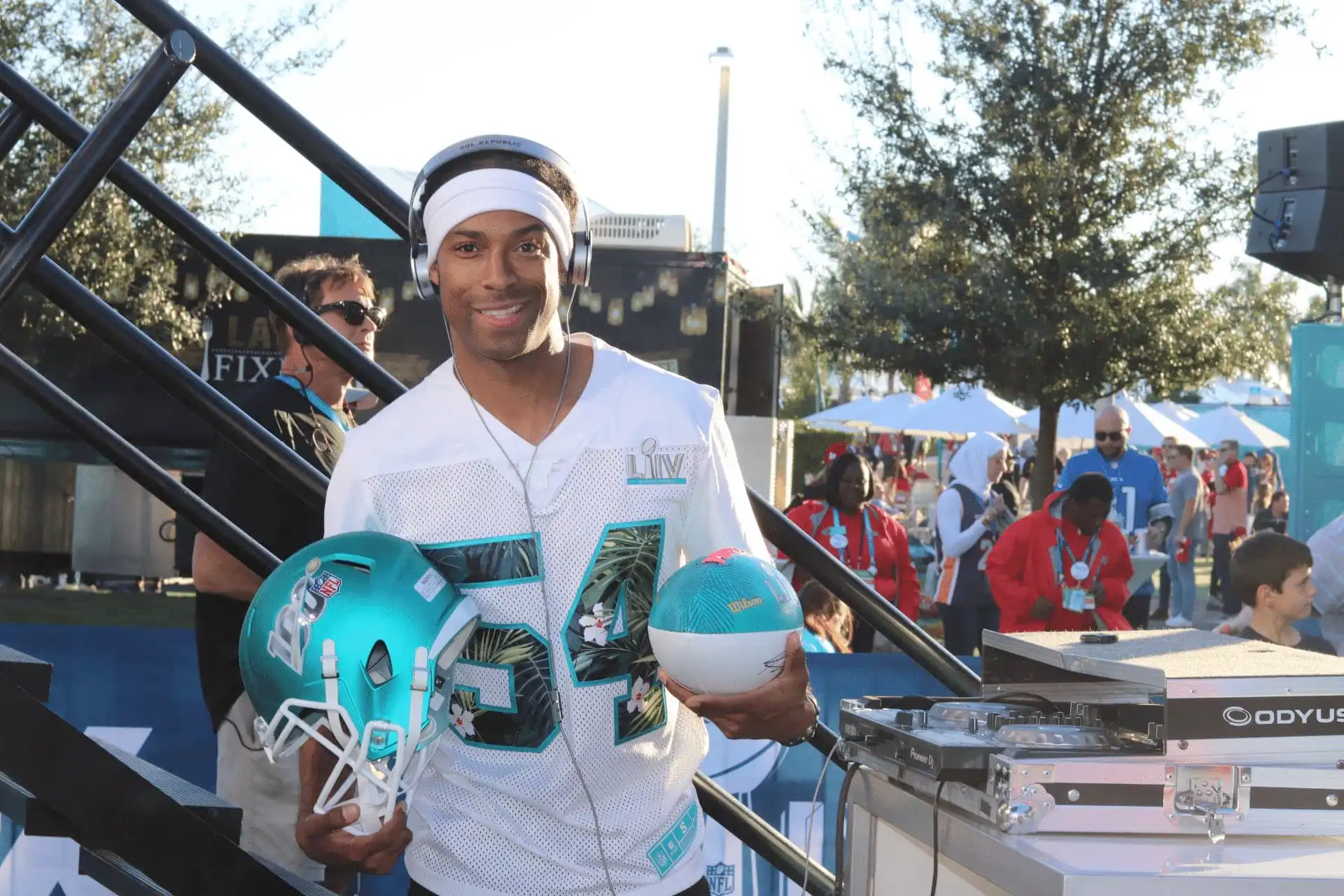
DJ Will Gill working a Miami corporate event. Contact him here to discuss your next event.
Key Takeaways
Miami peak season (December through April) requires 12-18 months of booking lead time. Off-peak (May through October) tolerates 6-9 months. The penalty for treating Miami like a same-quarter-booking city is steep.
Hotel pricing varies dramatically by season. Winter rates command 40-100% premiums over summer rates, with mid-range hotels at $250-450 nightly in winter and $120-200 in summer. Art Basel week alone can double or triple those rates.
Five Miami events drive most planning conflicts: Art Basel Miami Beach (Dec 4-6, 2026), the Miami Open (late March), the F1 Miami Grand Prix (early May), the Miami Boat Show (mid-February), and FIFA World Cup 2026 matches (June 13 onward at Hard Rock Stadium). Cross-reference every date.
The Miami Beach Sound Ordinance requires outdoor events to end by 10:30 PM. Build the run of show backward from that hard cutoff, not against it.
Lock five pieces first, in order: venue, hotel room block, entertainment (DJ/emcee), catering, and AV/production. Anything booked after these five gets sequenced around them, not the reverse.
1. The Miami Booking Window: It’s Earlier Than You Think
Corporate planners who work multiple cities often underestimate Miami’s booking lead times. The reason is structural. Miami’s high season is also its tourism high season, which means corporate event demand competes with leisure travel demand for the same hotel rooms, the same restaurants, and the same transportation infrastructure. That competition adds 3 to 6 months to the typical booking window compared to a market like Chicago or Dallas.
Peak season (December – April). Book the venue 12 to 18 months out. The premium venues (Fontainebleau Sparkle Ballroom, Faena Forum, the Coastal Convention Center, Hard Rock Stadium’s MIA Event Center) routinely fill 12 months in advance. By 6 months out, the selection has narrowed significantly.
Shoulder season (April-May, October-November). Book the venue 8 to 12 months out. The pace is friendlier but the major hotel groups still hold their inventory carefully for incentive travel and corporate group bookings.
Off-peak (May – October). Book the venue 6 to 9 months out. The summer heat and afternoon thunderstorms scare off leisure demand, which opens up genuine inventory and pricing leverage. This is the sweet spot for cost-conscious corporate programs that can tolerate some weather risk.
2. The Miami Event Calendar to Plan Around
Five citywide events drive almost all the major planning conflicts on Miami’s annual calendar. Cross-reference each one against your target dates before committing.
Art Basel Miami Beach. December 4-6, 2026, with VIP preview days December 2-3 at the Miami Beach Convention Center. Around 250 galleries, 4,000 artists, and a global collector base. Hotel rates double or triple. Causeway traffic to and from Miami Beach adds 60-90 minutes each way. Unless your event is specifically tied to Art Week programming, plan around it.
Miami Open (tennis). Late March, two-week tournament at Hard Rock Stadium. Drives premium hotel demand and pulls most luxury hospitality availability into the tournament’s orbit. South Florida traffic intensifies citywide.
F1 Miami Grand Prix. Early May, at the Miami International Autodrome around Hard Rock Stadium. The race draws 270,000+ attendees over the weekend and effectively closes the Hard Rock Stadium campus for any other corporate use. The MIA Event Center (formerly the F1 Paddock Club) is unavailable for the duration of race week setup and breakdown.
Miami International Boat Show. Mid-February, multiple venues across Miami Beach, downtown, and Virginia Key. Significant impact on Miami Beach Convention Center availability and surrounding hotel inventory.
FIFA World Cup 2026. June 13 through the bronze final, with Hard Rock Stadium temporarily renamed “Miami Stadium” per FIFA policy and hosting multiple matches including knockout-round games. Citywide hotel demand spikes. Most premium venues see corporate booking competition through summer 2026 driven by tournament-adjacent demand.
3. Peak Season Math: What 12-18 Months Actually Costs
The financial reality of Miami peak season is the number planners most often underestimate. Hotel pricing is the clearest indicator.
2026 Miami hotel rate data places winter mid-range hotels at $250-450 nightly, with luxury properties from $500-1,200. Summer rates for the same properties drop 30-50%. A Brickell three-star hotel at $280 in February sits at $160 in August.
Other peak-season cost realities. Venue rental premiums of 20-40% over off-peak rates. Catering minimums climb. Production company day rates increase. Transportation and shuttle costs go up. F&B minimums on hotel contracts get aggressive. Even Uber and Lyft surge during major event weeks.
Where the leverage exists. Peak season venues will negotiate on F&B credits, room block release dates, and ancillary services more readily than on raw rental rate. Off-peak venues will negotiate on rental rate itself, sometimes significantly. Both seasons negotiate on attrition clauses if the planner is willing to push.
A 200-person corporate event with a 100-room block can swing $50,000 to $150,000 in total cost between peak and off-peak Miami dates. That is not a rounding error. It is the kind of variance that decides whether the program comes in under budget or 25% over.
4. Off-Peak (May-October): Where the Real Value Lives
Off-peak Miami is the rare combination of available premium venues, attractive pricing, and a city that still delivers the brand value corporate planners are after. The trade is weather: daily afternoon thunderstorms, 80-90% humidity, and Atlantic hurricane season (officially June through November).
What off-peak unlocks. 30-50% hotel rate reductions. Premium venues with calendar availability instead of waitlists. Vendor schedules that allow meaningful negotiation on day rates and ancillary services. Less traffic, faster transfers, easier load-ins.
What off-peak demands. Indoor-first venue planning, with outdoor backup explicitly contracted. Travel insurance for keynote speakers and VIPs. Realistic communication to attendees about Miami summer weather (the 4 PM thunderstorm is a feature of the season, not an emergency). Some flexibility on date moves if a hurricane threatens during the 7-10 day pre-event window.
The smart play. Pair an indoor primary venue (Fontainebleau Coastal Convention Center, Adrienne Arsht Center, New World Center, Hard Rock Stadium’s MIA Event Center) with a contracted indoor backup for any outdoor segments. Build the weather contingency into the budget rather than treating it as an exception.
Off-peak Miami consistently produces the best ROI for corporate programs that don’t need the December-March prestige factor. Same city, same venues, dramatically different cost structure.
5. The Five Pieces You Lock First
Corporate event planners new to Miami sometimes try to optimize too many decisions in parallel. The cleaner approach is a strict sequence. Lock these five pieces in this order, before anything else gets serious attention.
One. The venue. Everything else cascades from here. Acoustics, capacity, indoor/outdoor mix, AV model, sound curfew, and load-in window all determine which other vendors and configurations are possible. See the companion top 10 Miami corporate event venues guide for venue-specific details.
Two. The hotel room block. If attendees are flying in, the room block is the second-largest line item after the venue. Reserve early, negotiate the attrition and cancellation clauses carefully, and confirm the rooms are at a property within walking distance or a short shuttle ride from the venue.
Three. Entertainment (DJ, emcee, keynote talent). The strongest corporate event entertainment in Miami books out 6-12 months in advance during peak season. Lock this before catering, before AV, before staging. A specialist Miami corporate event DJ with documented Fortune 500 experience disappears from the calendar fast.
Four. Catering. If the venue has in-house catering, the menu and F&B minimums get locked here. If the venue is bring-in, the caterer becomes a major coordination relationship. Either way, lock the catering decisions before they constrain the run of show.
Five. AV and production. In-house at most hotels and convention venues. Bring in at cultural and outdoor venues. Either way, the AV decisions get tied to the venue and entertainment choices, which is why they come last in this sequence.
6. Hotel Room Blocks: Miami-Specific Pitfalls
Hotel contracts in Miami have a few patterns that catch out-of-market planners off guard. Specific things to negotiate carefully.
Attrition clauses. Miami peak season properties write tight attrition (the percentage of contracted rooms you have to actually fill before penalties kick in). Negotiate a release date that lets unused rooms revert back to the hotel without penalty 30-45 days before the event.
F&B minimums. Hotel banquet minimums in Miami’s peak season are aggressive and can dictate menu choices. Negotiate the minimum before signing, and ask for clarity on what counts (alcohol vs food, taxes vs gratuities, contracted meals vs incidentals).
Resort fees and ancillary charges. Miami hotels routinely add resort fees of $25-45 per room per night on top of the contracted rate, plus valet, Wi-Fi (some still), and miscellaneous fees. Pre-negotiate which fees the group rate includes and which attendees pay separately. Communicate this clearly to attendees before they book.
Minimum-night stays. Many properties enforce 2-3 night minimums during peak season and special events. If your program is a one-day intensive, this is a problem worth solving up front.
Shuttle and ground transportation. Miami’s hotel-to-venue logistics are easier when the hotel and venue are within walking distance. If they aren’t, contracted shuttles solve the transit problem but add a line item. Brickell-to-Miami Beach can take 30 minutes off-peak and 90 minutes during Art Basel. Plan accordingly.
7. Vendor Coordination in a High-Demand Market
Miami’s vendor ecosystem is mature but tight. Production companies, caterers, AV firms, and specialty vendors (lighting, drape, staging, special effects) compete for the same skilled labor pool. A few coordination principles that matter more in Miami than they do in less constrained markets.
Lock the entertainment first, not last. A working corporate DJ or emcee with documented Fortune 500 experience represents a tiny fraction of the total Miami market. DJ Will Gill, the Wall Street Journal’s #1 Corporate DJ and Forbes Next 1000 honoree, performs across Miami year-round for AT&T Business, CDW, Hilton, Home Depot, PepsiCo, and others. Calendar conflicts during peak season are real. Book before you assume availability.
Build a master vendor sheet early. Before contracts get signed, build a single document with every vendor’s name, role, primary contact, backup contact, on-site lead, and load-in window. Share it with the venue coordinator. Updates feed back into this document as the master record.
Schedule the pre-event walk-through 7-14 days out. Not the morning of. Walk the full venue with the entertainment, the catering lead, the AV lead, and the venue coordinator. Confirm power drops, load-in routes, staging positions, sound zones, and sight lines. Most live-event problems are visible at the walk-through and invisible the morning of.
Run of show alignment. Every vendor gets the same run of show document with the same timestamps. If catering thinks dinner ends at 8:30 and the DJ thinks dinner ends at 8:00, the transition into the program is going to be ugly. A 30-minute alignment meeting two weeks out catches these.
8. Permits, Curfews, and Miami Beach’s 10:30 PM Cutoff
Miami’s outdoor event regulations are stricter than most planners expect. The single most important rule on Miami Beach: outdoor events must end by 10:30 PM, per the Miami Beach City Sound Ordinance. Indoor events have a 2:00 AM curfew at most venues.
Build the run of show backward from 10:30 PM. If the outdoor program needs to end by 10:30, music wraps at 10:25, the host’s closing remarks land at 10:20, the dance set runs 9:00-10:20, and dinner ends by 8:45. Working forward from the start time and “seeing how it lands” routinely produces a 10:45 cutoff and a venue manager who has to interrupt the program.
Permits for outdoor events in public spaces. Required for parks, beaches, public plazas, and street closures. Lead times of 30-60 days are common. Some events require additional noise variance applications. The venue’s planning team typically handles the paperwork, but the corporate planner is responsible for confirming it gets done.
Indoor events. Less restrictive but still governed by individual venue rules. Most ballrooms enforce a 2:00 AM curfew, and many hotel venues require post-event noise to scale back significantly after midnight in deference to guests on upper floors.
The post-event continuation option. LIV at Fontainebleau and a handful of other South Beach venues stay open until 5 AM and accept buyouts or VIP reservations for corporate groups looking to extend the evening past the venue curfew. This is a legitimate path if the program calls for it.
9. Transportation and Traffic Reality
Miami traffic is notoriously bad. It gets worse during peak season, much worse during major events, and unpredictable during the rainy summer afternoons.
The causeways are the chokepoint. Five causeways connect Miami Beach to the mainland. During Art Basel and major event weeks, transit between South Beach and downtown Miami can stretch to 90+ minutes by car each way. Plan for it explicitly in the agenda.
Stay on one side or the other. If the event is at Fontainebleau, Faena Forum, or another South Beach venue, the hotel room block should be on the beach. If the event is at the Arsht Center, Pérez Art Museum, or another mainland venue, the room block should be in Brickell or downtown. Mixing causes pain.
Brightline. Miami’s intercity rail service connects to Aventura station with a shuttle service to Hard Rock Stadium for major events. For events with attendees coming from Fort Lauderdale or Palm Beach, this is a meaningful alternative to driving.
Walkable neighborhoods. South Beach (between 5th and 23rd Streets along Collins and Ocean Drive), Brickell, the Design District, and Wynwood are walkable. Most other Miami corporate venues require organized transportation between the hotel and the venue.
The shuttle option. For groups of 50+ attendees with off-site venue logistics, contracted coach shuttles are usually cheaper and more reliable than rideshare allocations. Confirm pickup zones and load-out timing with the venue before signing.
10. The Pre-Event Walk-Through (Why Miami Needs Two)
Most corporate events benefit from one pre-event walk-through. Miami events benefit from two: a logistics walk-through 2-3 weeks out, and a final technical walk-through the day before or morning of.
Walk-through one (2-3 weeks out). Senior team only: planner, venue coordinator, entertainment lead, AV lead, catering lead. Walk the full event flow. Confirm load-in routes, power drops, staging positions, sound zones, sight lines, kitchen access, breakout spaces, and any signage needs. Flag anything that requires venue approval and resolve it now, not at load-in.
Walk-through two (day before or morning of). Full team plus any production crew. Test sound at the venue’s actual volume with the actual room configuration. Test microphones for every speaker. Confirm video and projection. Walk every transition with the host or emcee. Run a 30-minute mock segment to catch the last-minute issues.
Why Miami specifically needs both. Outdoor venues have weather variables that change in the 2-week window. Bring-in venues like Vizcaya or 1111 Lincoln Road need both an early production planning meeting and a same-day technical verification. Multi-vendor coordination at peak season is tighter, which means the two-walkthrough discipline catches more issues than the single-walkthrough approach.
The total time investment for both walkthroughs is roughly 5 hours, split across two visits. The savings on the day-of is dramatically larger than that, every time.
Miami Corporate Event Planning Questions, Answered
How long does it take to plan a corporate event in Miami?
For a conference or company-wide event, start planning four to six months out. Large multi-day programs need six to twelve. The venue and the entertainment are the two bookings that lock everything else, so secure those first.
What is the best month for a corporate event in Miami?
November through April is Miami’s dry season and its corporate sweet spot. Summer dates cost less but carry heat and hurricane-season risk, so keep indoor backup plans if you book June through October.
What should a Miami corporate event budget include?
Venue, catering, AV and production, entertainment, transportation, and a contingency line of about ten percent. Entertainment is the line guests actually remember, so protect it from late-stage cuts.
Do you need permits for a corporate event in Miami?
Hotel and private-venue events typically need nothing beyond the venue contract. Outdoor, beach, or public-space events require City of Miami or Miami Beach special event permits, so confirm with the venue and allow several weeks of lead time.
Who handles entertainment for a Miami corporate event?
Most planners book it directly, and it is the highest-leverage vendor decision on the plan. DJ Will Gill covers DJ, emcee, and audience engagement as one hire, which removes two vendor contracts from your checklist.
What planners say on Google
2,520+ five-star Google reviews. Four of them, in the reviewers’ own words:
BGCA Northeast Operation Impact kickoff was HIGH energy and motivational
Alisha Rojas Harrison, five-star Google review,
Boys & Girls club operation impact.
Crazy energy, loved the interaction
Joelle Waters, five-star Google review,
Love DJ Will! 2 years in a row celebration with him and its been amazing. Thank you!
Kathy Dao, five-star Google review,
DJ WILL GILL strikes again!!! Awesome energy for the virtual company Holiday party and it gets better every year.
Sean Stephenson, five-star Google review,

About the Author
William “DJ Will Gill” Gilbert is a corporate DJ and host who knows how to make an audience part of the event. His work combines music, live hosting, and interactive moments that keep guests engaged rather than simply entertained from the sidelines. He has performed at more than 600 corporate events for organizations including AT&T Business, CDW, Virgin Galactic, Home Depot, Hilton, PepsiCo, PayPal, and the United Nations. Will has also been recognized by Forbes Next 1000 and The Wall Street Journal, with IMDb credits for Super Bowl LIV, the Formula 1 Las Vegas Grand Prix, The Voice, and Real World: Hollywood. In addition to his event work, Will founded TheAIDJ.com, a patent-pending AI playlist platform designed for modern music curators.
2,520+ Google Reviews · IMDB · Mixcloud · Instagram ·