
How to Choose a Corporate Event DJ (2026 Checklist)
As Featured In


★★★★★ 2,520+ Five-Star Reviews
MBE Certified
A practical guide to spotting the DJs who can hold a corporate crowd, manage a run-of-show, and read energy in real time, not just press play.
A planner I spoke with last fall described the moment she knew her DJ pick was wrong. It was the awards portion of a national sales meeting. The CEO walked off stage after announcing the top performer of the year, and the DJ dropped a club banger at full volume. People in the front row physically flinched. The honoree was trying to take photos with her team and you couldn’t hear a word anyone said. The DJ thought he was “bringing energy.” He was reading the wrong room.
That’s the gap. Most DJs can play music. Far fewer can read a corporate room, which is a different animal than a wedding, a bar, or a Saturday night club set. If you’re hiring for a conference, a kickoff, a gala, or an internal celebration, the room-reading question is the one that separates a forgettable booking from one that actually lifts the event.
I’m Will Gill. I’ve spent 15 years doing this work across 600+ corporate events, including 3 Super Bowls, the Formula 1 Las Vegas Grand Prix, and Fortune 500 floors at PepsiCo, PayPal, CDW, Ulta Beauty, and the United Nations. Here is how I’d actually think through hiring a corporate DJ if I were on the planner side of the table.
What “Reading the Room” Actually Means at a Corporate Event
When DJs say “I read the room,” most people picture someone watching the dance floor and switching from Top 40 to hip-hop because the energy dipped. That’s part of it. At a corporate event, reading the room is broader and quieter than that.
It includes:
- Watching the periphery, not just the dance floor. Are people clustering at the bar because the music is too loud to talk? Are tables emptying because the vibe doesn’t match dinner?
- Knowing when not to push. During networking hours, executive remarks, awards, and dinner, the job is to support the moment, not dominate it.
- Watching the stage and the clock as carefully as the crowd. A late speaker, a delayed AV cue, a sponsor who wants thirty extra seconds. The DJ has to absorb that and keep things flowing.
- Sensing the company’s tone. A scrappy startup all-hands and a Fortune 100 leadership conference are different rooms even if the demographics overlap. One wants playful and loud. The other wants polished and contained.
If a DJ talks about reading the room only in terms of “getting people dancing,” they’re describing a wedding reception or a club night. That is not what most corporate events need most of the time.
Why Corporate Is Its Own Discipline
I’ve watched skilled wedding DJs flop at corporate gigs, and skilled nightclub DJs flop even harder. The skills don’t translate cleanly.
Corporate events run on segments: walk-in, opening remarks, keynote, breaks, lunch, breakouts, awards, reception, sometimes a dance portion at the end. Each segment has a business purpose. Music either supports that purpose or distracts from it. A good corporate DJ understands that walk-in music isn’t there to entertain, it’s there to set tone and cover the awkwardness of people finding seats. Dinner music isn’t background, it’s a conversation enabler. Award stingers aren’t filler, they’re a brand cue.
It also means the DJ has to coordinate with people. AV teams, stage managers, planners, video producers, sometimes a separate emcee. If they can’t hit cues and communicate cleanly, the room reads it instantly as amateur, no matter how good their mixing is. This work is closer to event production than nightlife.
Signals That a DJ Can Actually Read a Corporate Room
When I’m vetting one, here’s what I listen for. None of these by themselves is decisive, but they stack up.
They ask the right questions before they pitch you. A DJ who jumps straight to “what kind of music do you like” is treating you like a wedding client. A corporate-ready DJ asks about the run-of-show, audience demographics (age, departments, regions, cultural mix), company culture, what the event is supposed to accomplish, who is speaking, and what the “do not play” list looks like.
They give you specific examples, not adjectives. Anyone can say “I read the crowd.” A DJ who actually does it will tell you something like: “At a tech client’s leadership conference last year, the dance floor thinned out around 10pm. I noticed most of the senior team had cleared and the people left were the under-35 group, so I shifted from open-format to more current hip-hop and house and got another 90 minutes out of the night.” That’s a person describing real decisions made under real pressure.
They talk about volume and zones. A corporate-room DJ will bring up things like lower volume in networking areas, separate audio for speeches, monitoring the back of the room where conversations happen. If they only think about “the system” as one big PA aimed at the floor, they are thinking like a club DJ.
They have negative skills. Ask what they avoid. A real corporate DJ will mention staying off the mic during executive moments, screening lyrics for HR risk, avoiding political or polarizing artists, and not building a “hype man” persona that embarrasses leadership. If they can’t articulate what they don’t do, they probably do too much of it.
Their testimonials mention flow, not just fun. Reviews that say things like “kept the night moving,” “seamless with the awards,” “handled a last-minute change,” or “felt like part of our team” are stronger signals than “great music, packed dance floor.”
They have video from corporate events specifically. A reel full of wedding crowds and nightclub footage tells you what they’re used to. Footage of conference general sessions, awards stingers, leadership walk-ons, and mixed-age dance floors tells you they live in your world.
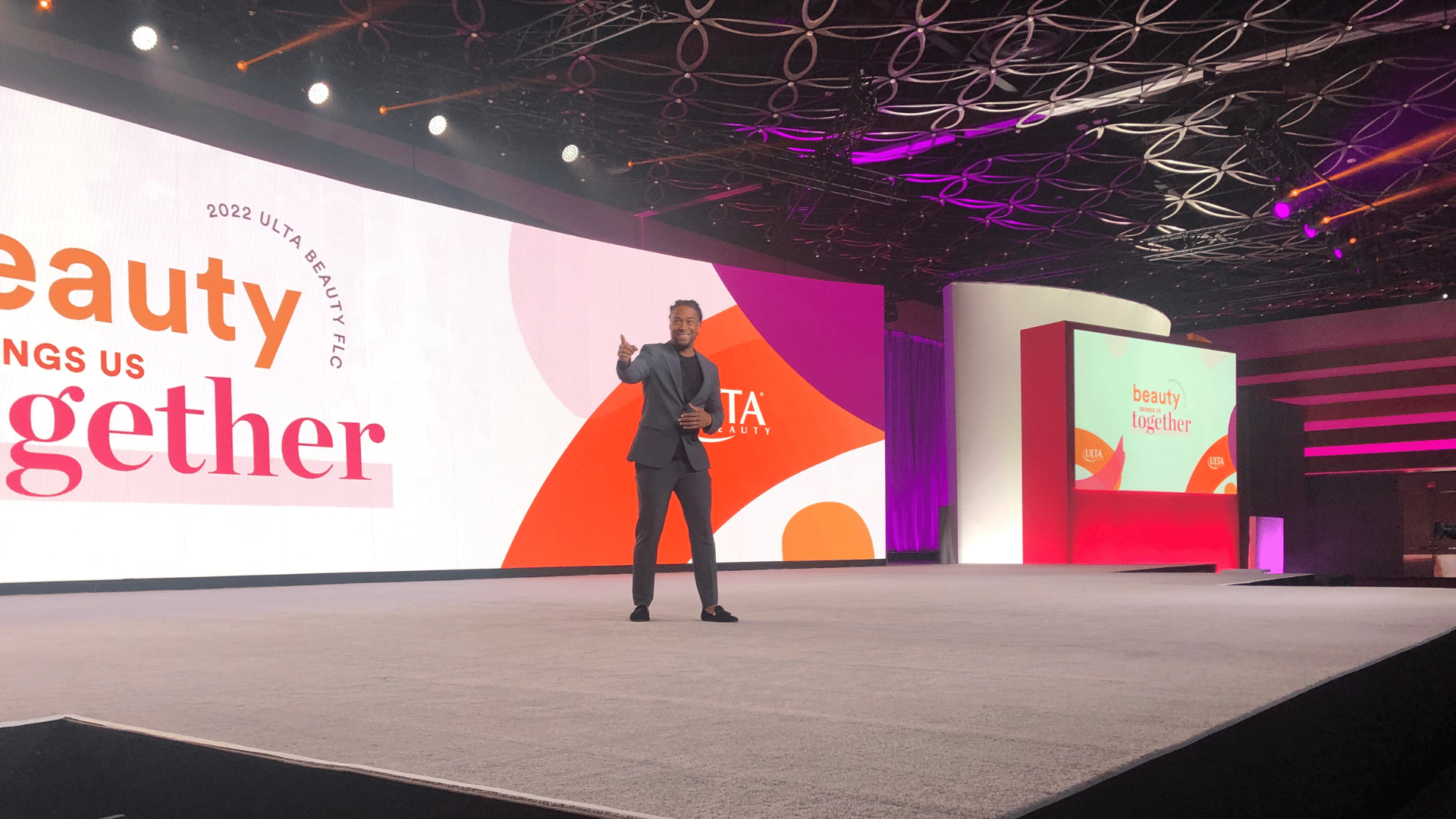
What Corporate Room-Reading Looks Like on Stage
A live look at handling a corporate audience, audience engagement, and run-of-show energy in real time.
The Vendor-Stack Question Nobody Wants to Talk About
Here’s the part most articles skip. The number of vendors you’re stacking on the entertainment side has a direct effect on whether anyone is reading the room.
Typical setup: separate DJ, separate emcee, sometimes a separate engagement host for games or activations. Three contracts, three points of contact, three creative perspectives that may or may not align. The room-reading then gets split across people who aren’t necessarily talking to each other in real time. The emcee can’t see what the DJ sees. The DJ can’t always hear what the emcee is doing. The engagement host shows up for their segment and leaves.
This is why some planners have moved toward a single combined booking: one person handling DJ duties, mic work, and audience engagement together. The argument for it is simple. One person watching the room, one set of judgment calls, no handoffs. The argument against it is that not many people can actually do all three well.
This is the lane I have built my corporate work around: a 3-in-1 booking covering DJ, emcee, and audience engagement, with the room-reading handled by the same person from walk-in to last song. Clients like Lenovo, CDW, Aflac, O’Reilly, and the United Nations skew toward exactly the kind of multi-day, mixed-audience corporate events where this combined approach has the most upside. Whether you book me or someone else, the structural question is worth asking: do you want one person reading the room, or three people each reading their slice of it?
A Quick Comparison: What to Look For vs. What to Walk Away From
| Signal | Strong Sign | Walk Away |
|---|---|---|
| Pre-event process | Detailed discovery call, run-of-show review, written do-not-play list | “Send me your playlist and I’ll handle it” |
| Mic presence | Restrained, supports the moment, knows when to disappear | Constant hype, jokes during transitions, talks over speakers |
| Volume strategy | Adjusts for segment (networking vs. dancing), thinks in zones | One volume all night |
| Examples they cite | Specific corporate events, named decisions, real adjustments | Generic talk about “energy” and “vibe” |
| Insurance and contracts | Full liability coverage, written contract, backup gear | Vague answers, no paperwork, “I’ve never had an issue” |
| Reviews | Mention flow, professionalism, adapting to changes | Only mention how fun the party was |
| Experience format | Comfortable with live, virtual, and hybrid | Only does in-person dance parties |
| Pricing | Typically $2,000 to $3,500+ for serious corporate work, higher for top-tier | Significantly below that range, often a hobbyist or wedding DJ stretching |
The pricing band isn’t snobbery. It reflects the reality that corporate work requires planning time, insurance, redundant gear, professional setup, and the kind of judgment that takes years to develop.
Is the DJ Brand-Safe? The Corporate Compliance Checklist
At a Fortune 500 event, the DJ is a brand touchpoint, not background music. One explicit lyric over the PA in front of the CEO, one missing certificate of insurance, and your team is in a Monday incident review. Brand-safe means the DJ’s music, credentials, insurance, redundancy, and on-mic conduct will not create legal, HR, or reputational exposure. Before you sign, confirm all five.
- Business credentials and insurance. LLC registration, EIN and W-9, and general liability of at least 1,000,000 per occurrence and 2,000,000 aggregate. Some Fortune 100 campuses require 2,000,000 and 5,000,000. They should issue a Certificate of Insurance (COI) naming your company and the venue as additional insured within 24 to 48 hours, not two weeks.
- A Do Not Play list capability. A professional sends you the template before you ask, honors blanket genre and artist restrictions, and documents the list inside the signed contract, not a side email.
- Equipment redundancy. A backup laptop pre-loaded with the full setlist, a backup controller in the rig, two wireless mics on separate frequencies, and for virtual events a hardwired connection plus a backup hotspot on a different carrier.
- A real contract. Defined performance windows and overtime rates, the Do Not Play list as an attachment, cancellation and force-majeure language, and a COI delivery timeline. If the contract is one page, the contract is a problem.
- An enterprise track record. Repeat bookings with named Fortune 500 clients mean the DJ has already cleared procurement, legal, and HR at companies as rigorous as yours.
Walk away from any DJ who refuses a COI, pushes back on a reasonable Do Not Play list, has no business-domain email, or quotes a price far below market. Those are not savings, they are exposure.
What Corporate Planners Say
“Held 8,000 attendees through a three-day general session and never missed a cue. Adapted in real time when our agenda shifted twice. He read the room better than anyone we’ve hired.”
Fortune 500 Conference Lead
“Our AV team had problems mid-event and Will absorbed it. Kept the room with us, kept the energy where it needed to be, and made it feel intentional. Felt like part of our team.”
Corporate Meeting Planner
What I Would Actually Do First
If I were hiring tomorrow for a real corporate event, here is the order I would run it in.
- Map the segments of the event by purpose, not by music. Walk-in is for arrival energy. Lunch is for conversation. Awards are for recognition. Reception is for connection. Write each one down.
- Build a shortlist of three DJs who specifically market to corporate, not “weddings and corporate,” not “all events.” Look for named Fortune 500 or enterprise clients on their site.
- Get on the phone with each. Don’t email-only. You are hiring someone who has to read a room, so you should be able to tell if they can read a phone call.
- Ask each one to describe a corporate event that went sideways and what they did. The answer tells you almost everything.
- Ask for two references from corporate clients in the last year, and actually call them.
- Verify insurance, contract terms, backup gear policy, and travel arrangements before you sign anything.
You will usually have a clear pick by step four.
If you’d like to compare what a 3-in-1 booking looks like against a split-vendor plan in the same conversation, explore the corporate event DJ, corporate event emcee, or virtual and hybrid event services.
Frequently Asked Questions
How is a corporate event DJ different from a wedding DJ?
Different muscles. Wedding DJs are great at family-mixed dance floors and emotional pacing across a single evening. Corporate DJs work across multiple event segments with business purposes, coordinate tightly with planners and AV, and have to read rooms where dancing is sometimes not the goal at all. Some DJs do both well. Many do not.
Do I really need an emcee in addition to a DJ?
Depends on what’s happening on stage. If you have a strong internal host or a paid keynote emcee, your DJ can stay in the music lane. If you don’t, hiring a DJ who can credibly run the mic, handle introductions, and emcee award segments saves you a contract and gives you a single person reading the room. Not all DJs can do this well, so screen for it specifically.
What about virtual and hybrid events?
The room-reading question gets harder, not easier. The DJ has to read both an in-room crowd and a remote audience through a screen, often with delayed feedback. Look for DJs who do live virtual sets (not pre-recorded), who have repeat virtual clients, and who can talk specifically about how they read engagement on a video platform.
How far in advance should I book?
For peak season (Q4 holidays, January through February kickoffs, May through June conferences), three to six months is typical for the strongest DJs. For very high-demand corporate DJs, longer. Last-minute is sometimes possible but you’re working with whoever is left.
What is the single biggest mistake planners make?
Hiring on music taste alone. The DJ’s playlist matters less than their judgment. A great corporate DJ with a slightly different musical sensibility than yours will outperform a DJ with your exact taste who can’t read a room. Hire the judgment.
What insurance should a corporate event DJ carry?
At minimum, general liability of 1,000,000 per occurrence and 2,000,000 aggregate, with the ability to issue a Certificate of Insurance naming your company and the venue as additional insured within 24 to 48 hours. Some Fortune 100 campuses require 2,000,000 per occurrence and 5,000,000 aggregate. A DJ who cannot produce a COI is not vendor-ready for an enterprise event.
What is a Do Not Play list, and does my corporate DJ need one?
A Do Not Play list is a written list of songs, artists, and genres that should never be played, covering explicit lyrics, politically polarizing artists, and anything off-brand for your audience. Every brand-safe corporate booking includes one. A professional DJ provides the template before you ask and attaches it to the signed contract.
Booking a Corporate Event? Talk to DJ Will Gill
One person reading the room from walk-in to last song. Bring your run-of-show to a short consult and we’ll map the right approach for your audience together.

About the Author
DJ Will Gill
Will Gill is the Wall Street Journal’s #1 rated corporate DJ, a Forbes Next 1000 honoree, and an MBE-certified entertainer with over 2,520 five-star reviews. Across 600+ corporate events he has served Fortune 500 clients including PepsiCo, PayPal, CDW, Ulta Beauty, and the United Nations, performed as a 3x Super Bowl DJ, and worked the Formula 1 Las Vegas Grand Prix. His 3-in-1 model combines high-energy DJ sets, professional emceeing, and audience engagement into one seamless show built for high-stakes business events.