
How Emcees Adapt Curated Songs for Different Venues (2026)
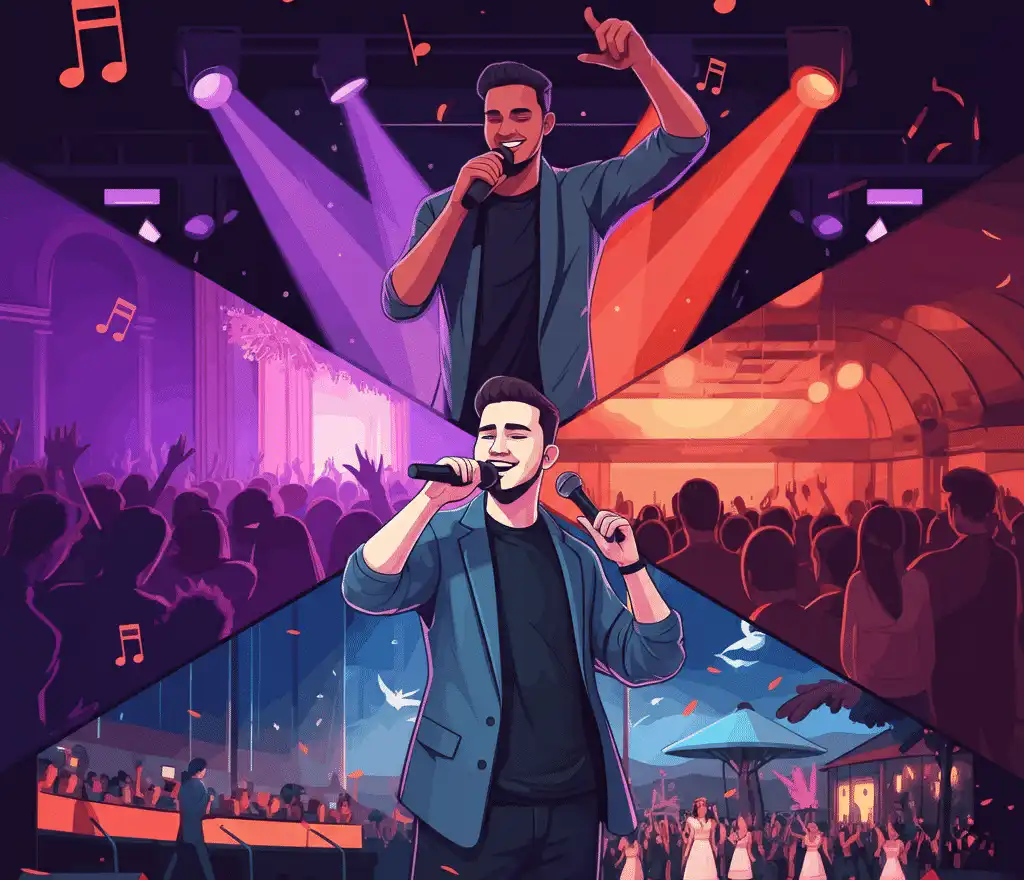
The emcee’s relationship with curated music is fundamentally different from the DJ’s. Where the DJ programs a continuous sequence of tracks to fill a dance window, the emcee uses curated music to punctuate, frame, and amplify specific program moments: the walk-on, the speaker introduction, the award reveal, the transition between segments. The music sits in service of the spoken-word performance rather than as the performance itself. This guide rebuilds the venue-adaptation playbook from the emcee’s perspective, with the operational mechanics of walk-on music, vocal-over-music technique, and venue-specific bumper strategy that separate hosting-tier emcees from DJs trying to play host.
For the companion DJ-side content on programming, see 5 essential DJ playlists by genre for any event. For the corporate-tier emcee-and-DJ bundled execution at Fortune 500 scale, DJ Will Gill’s audience engagement package as seen in the Wall Street Journal documents the 3-in-1 service model (DJ + Emcee + Audience Engagement) operating across 600+ corporate events. 2,520+ five-star Google reviews document the operational standards.
Key Takeaways
→ The emcee uses curated music as a tool to support spoken-word performance, not as the performance itself. Walk-on music for a speaker, bumper music between program segments, sting cues for awards reveals, and vocal-under-music technique during announcements all serve to amplify the emcee’s hosting role. This is the operational distinction that the DJ-as-emcee approach misses.
→ Atmosphere sits at the top of event satisfaction metrics, and the emcee shapes atmosphere more directly than the DJ does at most corporate and wedding events. A 2024 industry report documented 82% of corporate attendees citing atmosphere as the primary factor in overall event satisfaction, with 74% of event planners prioritizing guest connection. The emcee’s curated-music decisions are atmosphere-shaping decisions at the moments that matter most to satisfaction scoring.
→ Walk-on music carries documented psychological weight beyond aesthetic preference. Sidhu, Urian, Zheng, and Grahn’s May 2025 PLOS One study found nostalgic music significantly outperformed familiar music for dance behavior, with only nostalgia predicting engagement among the variables tested. The same principle applies to walk-on selection the nostalgia anchor matters more than recency for energizing an audience at the moment a speaker takes the stage.
→ Immersive program experiences are now the dominant satisfaction driver for event audiences. 2026 industry analysis documents 64% of event attendees ranking immersive experiences as the primary driver of overall satisfaction, with 88% of event professionals expecting budget increases in 2026. The emcee who programs music with the immersive standard in mind coordinated stings, atmospheric beds, intentional silence outperforms the DJ-style emcee who treats music as continuous background.
→ Sonic anonymity is the default failure mode for unintentional emcee music selection. 2026 sonic branding research documented 61.9% of brands relying on stock music producing “sonic anonymity” that erodes brand recall while 75% of Gen Z consumers report stronger emotional ties to brands employing purposeful music. The emcee whose walk-on music for the CEO sounds like a stock-music underlay loses the brand-amplification opportunity the moment was supposed to deliver.
Watch DJ Will Gill executing the bundled DJ-plus-emcee discipline at corporate-tier scale. For emcee consultation and bookings, contact DJ Will Gill directly.
Understanding the Emcee-DJ Distinction
The role separation that matters. The DJ programs the continuous music experience, selecting tracks, mixing transitions, and building energy curves across program windows. The emcee runs the spoken-word performance, introducing speakers, narrating program transitions, energizing crowd response, calling segment changes, and recovering when something goes wrong. The two roles can be performed by one person (the DJ-emcee, which is Will Gill’s positioning) or by two specialists working together. What they cannot do is be conflated as if they were the same role.
What the Emcee Actually Does
The hosting-tier responsibilities. The professional emcee opens the program, introduces each speaker or segment, narrates transitions between program moments, responds to crowd energy in real time, recovers from unexpected delays or technical issues, manages audience attention across long program windows, and closes the event on a note that matches the planner’s intended takeaway. Each of these functions has a music-adjacent moment: the walk-on, the bumper, the recovery underlay, the transition sting, the closing wash.
How Curated Music Supports the Emcee’s Role
The five music-as-tool functions. Walk-on music energizes the audience as a speaker takes the stage and shapes the initial perception of the speaker’s authority. Bumper music covers transitions between program segments and resets crowd attention. Sting cues mark dramatic moments like award reveals or product launches. Atmospheric beds run underneath emcee announcements without dominating the vocal line. Closing washes carry the program out on the intended emotional note. Each function has its own selection criteria, timing requirements, and volume calibration.
The Walk-On, Walk-Off, and Bumper Functions
The structural elements of emcee music programming. The walk-on builds energy as a speaker approaches the stage, typically running 30-60 seconds with a clean fade as the speaker reaches the microphone. The walk-off carries energy out as the speaker exits, typically lasting until applause subsides. The bumper covers the dead air between program segments, running anywhere from 15 seconds to several minutes, depending on transition length. Each element is selected for its emotional fit with the moment it serves, not for the DJ-style criteria of “what does this room want to dance to.”
Understanding Your Venue’s DNA
The venue’s program-shaping characteristics. Every venue tells the emcee something about the program before a single word is spoken. The lighting design, the room layout, the sound system specifications, the stage configuration, the audience seating arrangement all of these shape what the music can do and what the emcee can deliver. The corporate hotel ballroom and the outdoor festival stage host completely different program possibilities, and the curated-music decisions need to account for those differences.
Reading Venue Type from Physical Characteristics
The pre-event venue assessment. Hard surfaces create reverb and require different music selections than soft, carpeted rooms. Ceiling height affects bass response. Stage-to-audience distance affects vocal-to-music balance. Outdoor venues lose mid-frequency clarity compared to indoor venues with calibrated acoustics. 2026 corporate entertainment industry analysis documents production budgets rising significantly Toronto venues saw a 40% increase compared to 2024 driven by recognition that production quality correlates directly with attendee satisfaction. The emcee who walks the venue before the event runs better music than the emcee who arrives at call time and adapts in real time.
The Venue’s Existing Audience Expectations
The pre-program context. The audience walks into the venue with expectations shaped by the venue itself, the brand or host running the program, the event marketing, and the program description in the invitation. The emcee whose first walk-on music violates those expectations creates an immediate dissonance that takes program time to recover from. The emcee, whose first walk-on music aligns with the expected tone, reinforces audience trust in the next 90 minutes of program content.
Club Venues: Energy Management Through Bumpers
The club-emcee role distinction. In a club context, the emcee is rarely the primary entertainment that the DJ is. The emcee’s role is to introduce featured talent, hype the crowd between DJ sets, announce specials or program moments, and energize the room without dominating it. The curated music supporting the emcee in this context consists primarily of short, high-impact bumpers (5-15 seconds) and energy-bridging stings, not full-length tracks.
The Vocal-Over-Music Technique in Clubs
The volume-and-fade discipline. The club-emcee announces over the DJ’s music rather than against it. The DJ briefly drops the music’s level (often to about -6dB) while the emcee speaks; the music returns to performance level as the announcement ends. The curated tracks selected for these moments need to have a clear instrumental break (not vocal-heavy choruses) at the moment the emcee speaks. Selecting wrong-moment tracks creates the audible clash between the emcee’s vocal and the song’s vocal that signals “amateur” to the room.
Building Energy Without Dominating the Room
The hierarchy of attention. In a club context, the music sits above the emcee in the attention hierarchy. The emcee’s job is to amplify the room’s energy at intentional moments without becoming the focus that displaces the music. The cardinal sin of the club-emcee is over-talking too many announcements, too long each, too much vocal energy when the room wants to dance. The professional club-emcee uses short, high-impact lines coordinated to specific music moments rather than continuous narration.
Wedding Receptions: The Multi-Generational Host
The wedding-emcee’s expanded responsibility. The wedding emcee runs a program more complex than any other venue context multiple speaker introductions (parents, wedding party, officiant cameos), ceremony-to-reception transitions, scripted dance entrances (first dance, parent dances), spotlight moments (cake cutting, bouquet toss, toasts), and continuous narrative threading across the entire reception. Each of these moments has music attached, and the emcee coordinates the timing, the cue points, and the cross-fade with the DJ throughout.
Coordinating Wedding Party Walk-Ons
The choreographed entrance moment. The wedding party introduction is one of the highest-stakes music-coordination moments in any event. Each bridesmaid and groomsman gets a walk-on, the couple gets the headline walk-on, and each track needs to fade at exactly the right moment as the next person enters. The emcee narrates the introductions on top of the music; the music selections need to have clean intros, recognizable choruses, and edit-friendly outros. 2026 industry analysis documents professional wedding DJs spending 10-15 hours preparing for each wedding beyond the event day, and the emcee coordination work consumes a substantial portion of that prep time.
Multi-Generational Programming Through Emcee Narrative
The five-generation room. Wedding receptions routinely host five generations: Baby Boomers, Gen X, Millennials, Gen Z, and younger family members. The wedding emcee uses the narrative voiceover to bridge the generational gaps that the music alone cannot. Setting up a Boomer-era ballad with a one-line story about the couple’s grandparents creates a hook that engages younger guests in the moment. Setting up a current chart hit with a one-line story about how the couple met creates a hook that engages older guests. The emcee narrative is the connective tissue between musical moments that would otherwise feel disconnected.
Festival Stages: Scaling Through Anthemic Bumpers
The mass-audience hosting challenge. Festival emceeing happens in front of thousands of people spread across a wide outdoor area. The emcee’s voice carries differently outdoors, the music selections lose mid-frequency clarity, and the crowd’s attention has to be earned across a much larger surface area. The curated music supporting the festival emcee needs to be anthemic, built around recognizable hooks, sing-along choruses, and bass-heavy drops that translate across distance.
Crowd-Control Through Music Selection
The festival emcee’s safety responsibility. Beyond entertainment, the festival emcee uses music selections to manage crowd density and energy. A high-energy track in an overcrowded section creates safety concerns; a mellower selection allows space to spread out. The emcee coordinates with the production team and security staff to ensure music choices support crowd safety, not just crowd enthusiasm. This is a venue-specific responsibility that doesn’t apply to most other emcee contexts.
Weather and Time-of-Day Calibration
The outdoor-specific variables. Festival emceeing requires real-time adaptation to weather and lighting. Hot afternoon crowds respond differently than cool evening crowds; a sunset slot needs different energy than a midday slot; sudden rain changes the program entirely. Professional festival emcees prepare differentiated music sets for different conditions and times rather than running one set regardless of environmental context.
Corporate Events: The Professional Host Standard
The corporate-tier emcee discipline. Corporate-event emceeing operates at the highest professional standard because of the business stakes and brand consequences attached to the program. Executive speakers, customer-facing announcements, partnership signings, and award recognitions each carry reputational weight that the emcee’s music coordination needs to support without distraction. The corporate-emcee music selections are deliberate, brand-aligned, and rehearsed with the show caller before the program begins.
Walk-On Music for Executives
The CEO-walk-on calculation. A CEO walking out to anthemic stadium rock creates one perception of the brand; a CEO walking out to refined instrumental orchestration creates a different perception entirely. The corporate-emcee coordinates with the executive and the planner to select walk-on music that aligns with the executive’s stage persona and the brand’s intended tone. The cardinal sin of the corporate-emcee is defaulting to generic hype tracks that send the executive on stage feeling like they’re being introduced at a wrestling match.
Background Music for Networking, Ramps for Program Moments
The energy-level program. Corporate networking music sits at a 3-4 energy level, present, supportive, conversation-friendly, never demanding attention. The emcee’s program ramps move that baseline up at intentional moments a speaker walk-on at 6, an award reveal at 8, a celebratory close at 9. The corporate-emcee designs these ramps in advance with the production team rather than improvising them in the moment. 2024 Gallup workplace engagement data documenting just 21% of employees globally as engaged at work establishes the baseline disengagement state. The corporate event is paying to disrupt the emcee’s program ramps are the deliberate intervention points where that disruption happens.
Common Emcee Failure Modes With Curated Music
Treating Emceeing as DJing
The role-confusion mistake. The most common failure mode is the emcee who tries to function as a DJ programming continuous music, building dance-floor energy, treating the program as if the music were the headline. This confuses the audience about what’s being delivered and shortchanges both functions. The DJ-emcee bundle works when the two roles are deliberately performed in coordination, not when one role tries to substitute for the other.
Music Dominating Vocal Moments
The volume-balance mistake. Music that runs too loud underneath emcee announcements creates competition for audience attention that the audience always loses (they catch the music; they miss the announcement). Music that runs too quietly creates the dead-air sensation of background filler. The right volume balance is dynamic, coming up during purely musical moments, ducking under vocal moments, returning to performance level as the vocal ends. The emcee who hasn’t worked out the music volume curve with the production team in advance produces audible imbalances throughout the program.
Mismatched Walk-On Energy
The persona-music mismatch. Walk-on music that energetically contradicts the speaker’s persona undermines the speaker before they reach the microphone. A contemplative academic speaker walked on to bombastic rock signals to the audience that the program is misaligned. A high-energy motivational speaker walked on to ambient instrumental signals the same misalignment. The corporate emcee coordinates with each speaker on their preferred walk-on track rather than defaulting to one-size-fits-all selections.
Building Venue-Specific Music Arsenals
The categorized library approach. The professional emcee doesn’t build one master playlist for all events. Instead, the working music library is categorized by function (walk-ons, bumpers, stings, atmospheric beds, closing washes), by energy level (3/10 through 9/10), by era (Boomer-anchor, Gen-X-anchor, Millennial-anchor, current chart), and by venue compatibility (intimate space, large indoor, outdoor). Each engagement pulls from the categories that match the corporate executive walk-on draws from a different category than the wedding-party walk-on, even though both serve the same structural function.
The tagging discipline. Music library tagging is what makes real-time adaptation possible. The emcee who can pull a “Gen X anchor, 7-energy, outdoor-friendly, instrumental break at 0:45” track in fifteen seconds outperforms the emcee searching through a flat playlist. The tagging investment is one-time work that pays off across hundreds of subsequent engagements.
The Real-Time Adjustment Discipline
The room-response monitoring. Even the best-prepared program needs real-time adjustment. The emcee monitors the room’s response continuously, applause volume, audience attention, conversation level during networking, and energy at the start of each program window. 2026 corporate event KPI analysis documents attendee satisfaction as “often considered the single most important KPI in determining event success” and the emcee’s real-time adjustments are the most direct way to protect that satisfaction score when something isn’t landing as planned.
The adjustment vocabulary. The emcee’s vocabulary of real-time adjustments includes: pivoting to a different walk-on track when the planned selection isn’t reading right, extending a bumper to recover from a delayed transition, shortening a planned segment when audience attention is fading, dropping a planned music cue when the spoken-word moment is landing on its own, and adding an unplanned music sting when an unscripted crowd moment deserves amplification. The emcee who treats the run sheet as a guide rather than a script delivers better programs.
Mastering the Art of Emcee-Music Coordination
The discipline that separates corporate-tier emcees. Emcee-music coordination at the corporate Fortune 500 tier runs on documented operational standards, pre-program walk-on rehearsal with each speaker, coordinated cue sheets with the show caller and AV team, rehearsed volume curves, real-time room-response monitoring, and post-program debriefs documenting what worked. DJ Will Gill operates this standard as the Wall Street Journal’s #1 Corporate DJ and Emcee with documented client work for AT&T Business, CDW, Virgin Galactic, NeoGenomics, Foot Locker, Home Depot, Hilton, BGCA, PepsiCo, PayPal, and the United Nations.
The 3-in-1 service-bundle model. The bundled DJ + Emcee + Audience Engagement service model addresses the corporate-event need for entertainment continuity that single-role specialists cannot deliver. The DJ-emcee operating as one performer coordinates the music and the spoken-word moments without inter-vendor coordination friction; the audience-engagement game-show component fills the “dead air zones” in corporate run-of-show timelines that pure DJ or pure emcee work cannot fill. This is the bundled operational model that the WSJ profile documented as the differentiator at the Fortune 500 scale.
About the Author
William “DJ Will Gill” Gilbert is the Wall Street Journal’s #1 Corporate DJ and Emcee, operating the bundled DJ-plus-emcee discipline at Fortune 500 scale. Documented client work for AT&T Business, CDW, Virgin Galactic, NeoGenomics, Foot Locker, Home Depot, Hilton, BGCA, PepsiCo, PayPal, and the United Nations. Also a Forbes Next 1000 honoree with broadcast credits including Super Bowl LIV (2020), The Voice (2011), and MTV’s The Real World: Hollywood (2008). He is also a World Cup performer and a Formula 1 Las Vegas Grand Prix performer. 2,520+ five-star Google reviews accumulated over 600+ documented corporate events.
2,520+ Google Reviews · IMDB · Mixcloud · Instagram · Contact
Frequently Asked Questions
How do emcees use music differently from DJs?
The DJ programs a continuous sequence to fill a dance window; the emcee uses curated music to punctuate and frame moments such as walk-ons, introductions and award reveals.
What are walk-on, walk-off and bumper functions?
Short cues that bring a speaker on, take them off, and bridge program segments.
Why does venue type matter?
Each venue has its own DNA and audience expectations; a club needs energy management through bumpers while a wedding needs multi-generational hosting.
Does atmosphere matter for satisfaction?
A 2024 industry report documented 82% of corporate attendees citing atmosphere as the primary factor in overall event satisfaction.
What is the vocal-over-music technique?
Speaking over a bed at the right level so the emcee builds energy without dominating the room.