
Corporate DJ Sound Requirements Most Venues Will Not Mention | DJ Will Gill
What sound equipment does a corporate DJ need at your venue? The right corporate DJ scales sound to the room: a compact array for boardrooms, delay speakers for ballroom depth, and wireless microphones advanced with the venue’s AV team before doors. Will Gill advances audio directly with every venue, from hotel ballrooms to arenas. He holds 2,520+ five-star Google reviews and has performed for Google, Amazon, Salesforce, PayPal, Pepsi, and the United Nations.
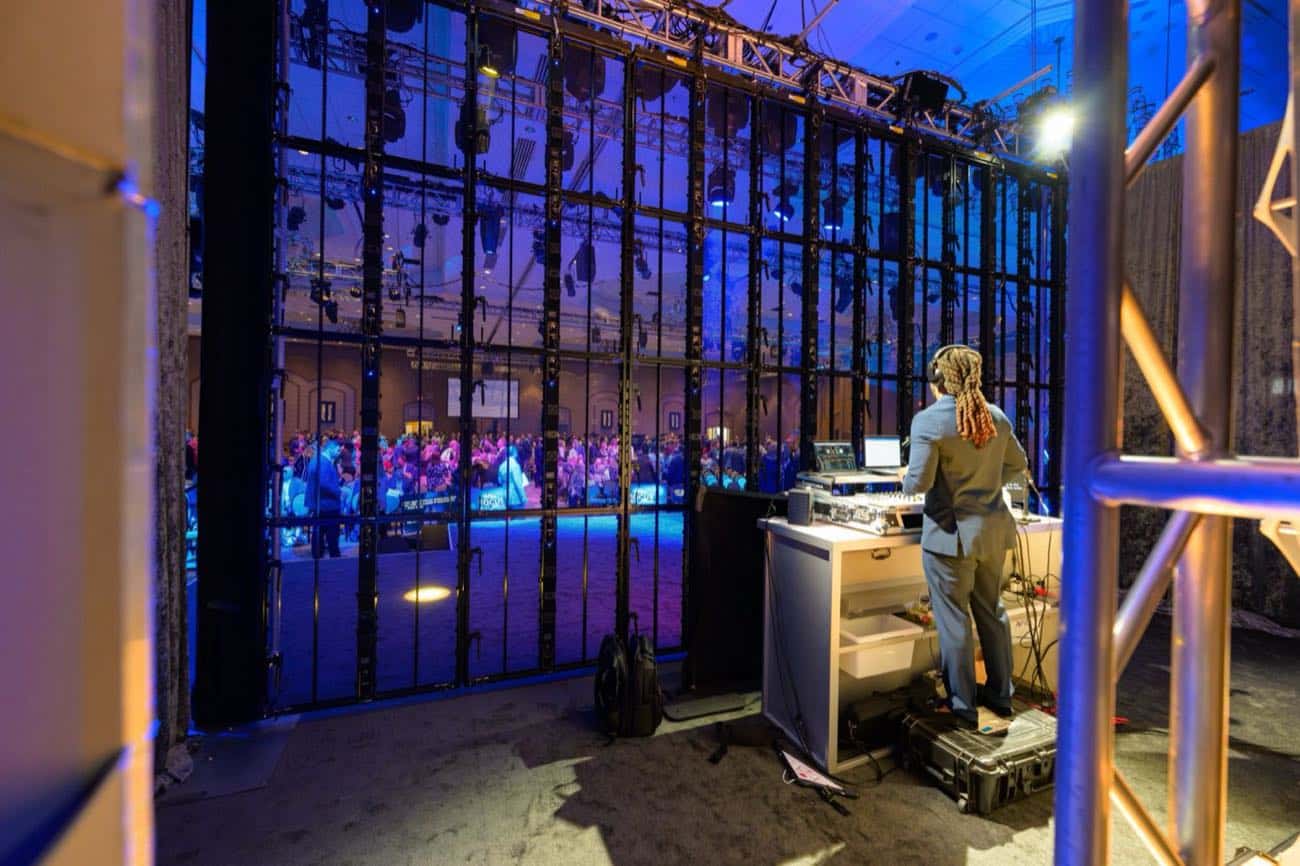
Corporate venues are very good at selling the ballroom. They will show you the chandeliers, the floor capacity, the catering kitchen, and the in-house AV brochure. They will not usually tell you which power circuits trip if both the DJ rig and the projector are on the same drop, whether the sound limiter will cut the dance floor at 11pm regardless of contract, or whether the wireless mic frequencies will conflict with the hotel’s guest Wi-Fi. None of this is malicious. It is just that the venue’s contract sales team is not the engineering team, and the questions a corporate DJ actually needs answered live in a different department from the one selling the room.
The cost of those unasked questions is real. Industry coverage of hidden AV costs is direct: for a 300-person, multi-day corporate event, the gap between the initial AV estimate and the final invoice can easily reach $15,000 to $25,000 if you do not know what to look for, with a single 100-amp power drop alone running $500 to $1,200 depending on venue infrastructure. Writing this from the vendor side, I run into the same set of corporate DJ sound requirements that venues do not surface up front. This piece walks through the ones planners should ask about before signing the venue contract, not after the production team starts load-in.
Want a corporate DJ who pre-flights the venue technical realities, not just the playlist? Contact DJ Will Gill.
Key Takeaways
- Most venues do not volunteer the operational realities that drive corporate DJ sound: power drops, sound limiters, outside vendor fees, frequency restrictions, and patch compatibility. Ask in writing.
- A single 100-amp power drop can run $500 to $1,200. Multiply across breakout rooms and the line item disappears into the AV total.
- Sound limiters are not contractual. They are physical devices that cut the power above a set decibel threshold. If the limit is below 90 dB, the room is not suitable for amplified music.
- “Outside AV allowed” usually has fine print. Outside vendor fees, load-in restrictions, and house-system access limits can erase the savings.
- Send a 10-question pre-booking sound and AV brief to the venue before you sign. The questions filter the venues that have done corporate AV from the ones still learning.
1. Why Venues Don’t Tell You Everything (And Why It’s Not Always Malicious)
The venue sales team’s job is to sell the room. The venue engineering team’s job is to keep the room running. The conversation about sound limiters, power infrastructure, and frequency restrictions lives in the engineering team’s world, not in the sales packet. By the time those questions come up, the contract is usually already signed and the planner is negotiating around constraints they did not know existed.
A second structural reason: venues that have lost business by being too transparent up front quietly stop volunteering the details. A 90-dB sound limiter is not a marketing line. A four-hour minimum on in-house AV labor is not in the brochure. None of this is a conspiracy. It is the predictable result of a sales process that runs ahead of the engineering review.
The fix is the same in every category: ask in writing, before signing the venue contract, in the same RFP you use to ask about catering minimums. Most venues will answer specifically when asked specifically. They just will not surface it on their own.
2. Power Drops, Circuits, and the $500-$1,200 Surprise
Power is the single most common venue sound surprise. The DJ rig, the lighting rig, the projector, the LED wall, and the catering kitchen all share circuits in ways the brochure never describes. Industry coverage of hidden venue AV costs is direct: most venues charge separately for electrical drops, power distribution units, and dedicated circuits, with a single 100-amp power drop running $500 to $1,200, and some venues billing per outlet while others bill on total amperage usage.
The questions a corporate DJ actually needs answered:
- How many dedicated 20-amp circuits are available at the DJ position? One is the minimum. Two is the safe floor for a full corporate rig with lighting.
- Is the dance floor area on the same circuit as catering or HVAC? If yes, a kitchen surge can trip the DJ rig. Industry coverage of NYC venue logistics flags this directly: many NYC venues limit available circuits, forcing planners to prioritize equipment, and blown circuits from overloaded outlets are entirely preventable if amperage is mapped before load-in and power strips are never daisy-chained.
- Does the venue have three-phase power if needed? Larger lighting and sound rigs need it. Industry coverage flags that three-phase power is required for larger lighting rigs and not all venues have it, with outdoor events needing generator setup with proper earthing and RCD protection.
- Is power included in the rental, or billed by drop? The most expensive surprise on the final invoice.
- Where is the breaker panel, and who has access during the event? If a breaker trips, who can reset it? Some union venues require a house engineer. If the engineer is off-shift at 11pm, the dance floor stays dark.
A 30-minute walk-through with the venue’s engineering team, not just the catering manager, surfaces 80% of the power surprises before they hit the contract.
3. Sound Limiters and the Decibel Cutoff Nobody Mentions
A sound limiter is a hardware device that monitors decibel level and physically cuts power to the PA system when the level exceeds a preset threshold. It is not a contractual term that can be waived. It is a circuit breaker. Industry coverage of sound limiter installations is direct on this: a sound limiter is a digital device fitted with a microphone that measures decibel level, with the limiter acting as a circuit breaker between the power and the band on stage, shutting off the power when the level goes over a set threshold.
Sound limiters are required at:
- Venues in residential areas. Required as a condition of the venue’s premises license. Disconnecting them can cost the venue its license.
- Hotels with sleeping rooms above the ballroom. Guest complaints map directly to refund requests, so the hotel sets aggressive limits.
- Outdoor venues near residences. Local council rules drive these.
- Restaurants converting to event spaces after hours. Lease-driven, often unwritten.
Industry coverage of acceptable limiter ranges is direct: a good sound engineer can work within a limiter by managing the mix carefully, but if the limiter is very restrictive (below 90 dB, for example), the venue is simply not suitable for amplified music events.
The questions to ask in writing:
- Does the venue have a hardware sound limiter installed? If yes, what is the dB threshold and at what point in the room is it measured?
- Is the limit different at different times of night? Many residential-area venues drop the limit at 10pm or 11pm.
- What happens when the limiter trips? Hard cut to the PA, soft warning, or staff intervention?
- Are subwoofers measured separately? Some limiters cut on bass frequencies first.
- Has any DJ ever tripped this limiter at this venue? The honest answer is the most useful one.
If the venue has a limiter below 90 dB and the event involves an open dance floor, that is not the right venue. Better to know before the contract than discover it at 11:30pm on the night.
4. Outside Vendor Fees and Why “Outside AV Allowed” Has Fine Print
Many corporate venues advertise “outside AV allowed,” and the fine print absorbs the savings. Industry coverage of outside vendor restrictions is direct: even if an external AV company offers better pricing, outside vendor fees can eliminate any cost advantage, and your chosen vendor may face restrictions on load-in times, equipment storage, or access to venue infrastructure like house sound systems.
Specific outside vendor fine print to surface in writing:
- Outside vendor fees. Sometimes flat. Sometimes a percentage of the outside vendor’s invoice. Sometimes per piece of gear.
- Mandatory house engineer on-site even when an outside vendor is providing the equipment. Add a four-hour minimum for an in-house tech who may or may not touch the gear.
- Restrictions on accessing the house sound system, house mics, or house speakers. An outside DJ usually wants to feed the room PA. Some venues prohibit it.
- Load-in and load-out windows that do not match the event schedule. Industry guidance on AV logistics flags directly that many venues impose strict move-in and move-out windows that can impact AV installation timeline, with penalties for overruns and rushed setups.
- Loading dock access restrictions. If the gear has to come up a passenger elevator instead of a freight elevator, plan for an additional 90 minutes per load.
- Insurance and COI requirements. Most venues require a Certificate of Insurance with the venue listed as additional insured. A DJ without one is not getting through the loading dock.
- AV labor minimums and overtime rates. Coverage of corporate AV billing notes that most AV vendors impose minimum hour requirements (commonly four hours) even if the actual setup takes 90 minutes, and overtime rates after a contracted end time typically run 150 to 200% of standard hourly fees.
Compare apples to apples: the outside DJ quote plus the venue’s outside vendor fees plus mandatory house labor versus the in-house AV total. The cheaper number is not always the cheaper booking.
5. Wireless Mic Frequency Restrictions and Hotel Wi-Fi Conflicts
Wireless microphones operate on RF frequencies that overlap with TV broadcast, hotel Wi-Fi, building security systems, and other wireless mic systems in adjacent rooms. A corporate DJ’s wireless mic that worked perfectly at the last event can lose signal in the new venue because the building’s frequency landscape is different.
Conflict sources that planners should ask about:
- Hotel Wi-Fi networks operating on 2.4 GHz. Many wireless mic systems also use this band. Result: dropouts during speeches.
- Adjacent meeting rooms using their own wireless mic systems. A conference center may have 8 ballrooms each running wireless mics at the same time. The DJ’s mic has to coordinate frequency.
- Local TV station broadcast frequencies. Wireless mic frequencies that worked in one city can fail in another because of differing TV broadcast spectrum allocation.
- Building security and elevator radio systems. Especially in older hotels.
- The CEO’s wireless lapel mic vs. the DJ’s handheld mic. Two mics on the same or overlapping channels create both dropping out simultaneously.
Questions to ask in writing:
- What frequency ranges does the in-house AV team operate on? So outside mics avoid them.
- Are there other events in adjacent ballrooms on the same day? If yes, request frequency coordination with their AV team.
- Has the venue ever had RF interference issues? Honest answers tell you the difference between a clean venue and one that has dropouts every week.
- Does the venue support frequency coordination during the planning phase? Reputable venues will. New venues sometimes do not have a process.
A reputable corporate DJ should be able to provide wireless mic frequencies in advance for the venue to coordinate. If the venue does not have a frequency coordinator, plan to bring backup hardwired mics.
6. Patch Bay Compatibility, Cable Runs, and the House Engineer Question
A corporate DJ usually needs to interface with the venue’s house sound system. The handoff happens at a patch bay, where the DJ’s mixer output is connected to the venue’s PA system input. The compatibility of that handoff is not on any brochure.
Specific compatibility questions:
- Is the house input balanced XLR, unbalanced 1/4″, or a Dante network? Each requires different cabling and signal level matching.
- Where is the patch point in the room? Behind the stage, at front-of-house, or in a separate AV closet?
- How long is the cable run from the DJ position to the house input? Anything over 50 feet needs balanced cable.
- Is there a house engineer on duty during the event? Required at union venues. Optional at hotel ballrooms. The presence or absence affects how the DJ can troubleshoot in real time.
- Can the DJ operate the house mixer directly, or must it go through the house engineer? At union venues, only the engineer touches the board. The DJ has to brief them in advance.
- What is the recall procedure if the house engineer goes off-shift mid-event? The dance floor close at 1am is not the same as the contracted engineer end time at 10pm.
Industry coverage of venue AV planning frames the underlying point well: redundancy is critical, with spare gear, uninterruptible power supplies, and hot backups for projectors or playback systems preventing small issues from becoming major problems, and proactive AV teams bringing backup equipment to all meetings and events.
A short tech production call with the house engineer the week of the event answers most of these in 20 minutes. The cost of skipping that call is usually a 15-minute delay on event night while the DJ and the engineer figure out the patch on the fly.
7. Subwoofer Placement, Sound Bleed, and Adjacent Room Conflicts
Subwoofers move air at low frequencies. That air travels through walls, ceilings, and floors in ways high frequencies do not. A subwoofer placed against a shared ballroom wall will be felt in the meeting next door even if the high-end is contained.
Industry coverage of sound system design points to the operational reality directly: subwoofers are essential for high-impact sound and require precise tuning to manage crossover signals and avoid muddiness, with deployment that requires careful consideration of venue size, crowd density, and music style. The deployment problem is not just acoustic. It is also a logistical one in shared venues.
Specific placement questions:
- Is the ballroom adjacent to other event spaces on the same evening? If yes, the venue may restrict subwoofer placement or low-frequency output to protect the adjacent event.
- Are there sleeping rooms directly above the ballroom? Floor-coupled subwoofers transfer bass into the rooms above. Late-night curfews follow.
- Does the venue have specific subwoofer placement restrictions? Some hotels mandate raised platforms or specific corners. The brochure does not say this.
- Is the load-bearing capacity of the stage rated for the subwoofers being brought in? Industry coverage of corporate AV planning notes that many venues require certified personnel or pre-approved rigging points for heavy equipment, with charges per hanging point or hourly rigging crew rates.
- What is the late-night curfew on amplified bass? The dance floor’s hardest hour is usually the one closest to the curfew.
A pre-event walkthrough with the DJ or sound engineer, ideally in the actual room with the actual gear footprint mapped out, prevents most of the placement surprises. Skipping that walkthrough is how a venue allows subwoofers in writing but then asks them to be moved an hour before doors open.
8. The 10-Item Pre-Booking Question List Every Planner Should Send
The 10 questions below filter the venues that have done corporate AV from the ones that are still learning. Send them in writing in the RFP, before the venue contract is signed. Reputable venues will answer all 10 with specificity. The ones that hedge are the ones that will surprise you on event day.
- 1. What dedicated power circuits are available at the DJ and stage positions, and what is the amperage of each?
- 2. Is power included in the rental, or billed per drop or per outlet?
- 3. Does the venue have a hardware sound limiter? If yes, what is the dB threshold and is it different at different times of night?
- 4. Is outside AV allowed? If yes, what are the outside vendor fees, mandatory house labor charges, and load-in restrictions?
- 5. What frequency ranges does the in-house AV operate on, and are there adjacent events on the same day requiring frequency coordination?
- 6. What is the patch bay configuration, and is a house engineer required to operate the house mixer?
- 7. Are there subwoofer placement, late-night bass, or adjacent-room sound restrictions?
- 8. What are the load-in and load-out windows, and is loading dock access via freight or passenger elevator?
- 9. What COI and insurance limits are required for outside vendors, and who must be named as additional insured?
- 10. Can you arrange a pre-event production walkthrough with the house engineer and the booked DJ or AV vendor?
A corporate DJ’s sound requirements are not exotic. They are predictable. The exotic part is that most venues do not surface them up front. Send the 10-item list in writing, before you sign the contract, and you will catch the surprises that derail the rest of the room. Power drops, sound limiters, outside vendor fees, frequency restrictions, patch compatibility, subwoofer placement. None of these are deal-breakers when known in advance. All of them become emergencies if the first time anyone asks is the day of the event.
What Corporate Clients Are Saying

About the Author
William “DJ Will Gill” Gilbert is a corporate event DJ, emcee, and audience engagement specialist featured in The Wall Street Journal as The Virtual MCs Charged With Saving Company Morale and a Forbes Next 1000 honoree. He has performed at hotel ballrooms, convention centers, hybrid production stages, and brand activation venues for Fortune 500 clients nationwide, with 2,520+ five-star Google reviews from corporate audiences across the United States. He is also the founder of THEAIDJ, an AI-powered playlist generation tool built for DJs and event planners.
Book Will for your next corporate event, conference, or awards gala at djwillgill.com/contact.