
How Much Does a Corporate Event Emcee Cost in 2026?
A corporate event emcee in 2026 typically runs $2,500 to $25,000 per event, with most professional bookings clustering between $3,500 and $12,000, depending on experience, event type, location, and scope. The hourly-rate framing that some planners come in with (“what’s your hourly fee?”) doesn’t actually match how corporate emcees are priced. Professional emcees are priced by event, with day-rate and multi-day-rate logic, because a corporate event isn’t billed by clock hours. It’s billed by what the role actually requires: program development, rehearsal time, travel, on-site presence, and the years of experience that let an emcee handle a 600-person sales kickoff without flinching. DJ Will Gill, the Wall Street Journal’s #1 corporate DJ and emcee, books corporate emcee work at $5,000 for a half day and $8,000 for a full day, and carries the DJ and audience engagement roles on the same contract. For a concrete anchor, DJ Will Gill’s published rate is $8,000 for a full day and $5,000 for a half day.
This guide breaks down what corporate emcee pricing actually looks like in 2026, what drives the numbers up or down, and how to read a quote so you know whether you’re getting fair value or being underbid by someone who’ll cost you more in event quality than you saved on the booking line. The buying decision sits between under-spending (saving $3,000 on the emcee to lose $30,000 in attendee engagement) and over-spending (paying celebrity rates for a program that didn’t need celebrity name recognition). The goal of this guide is to help you land in the right tier for the actual event you’re hosting.
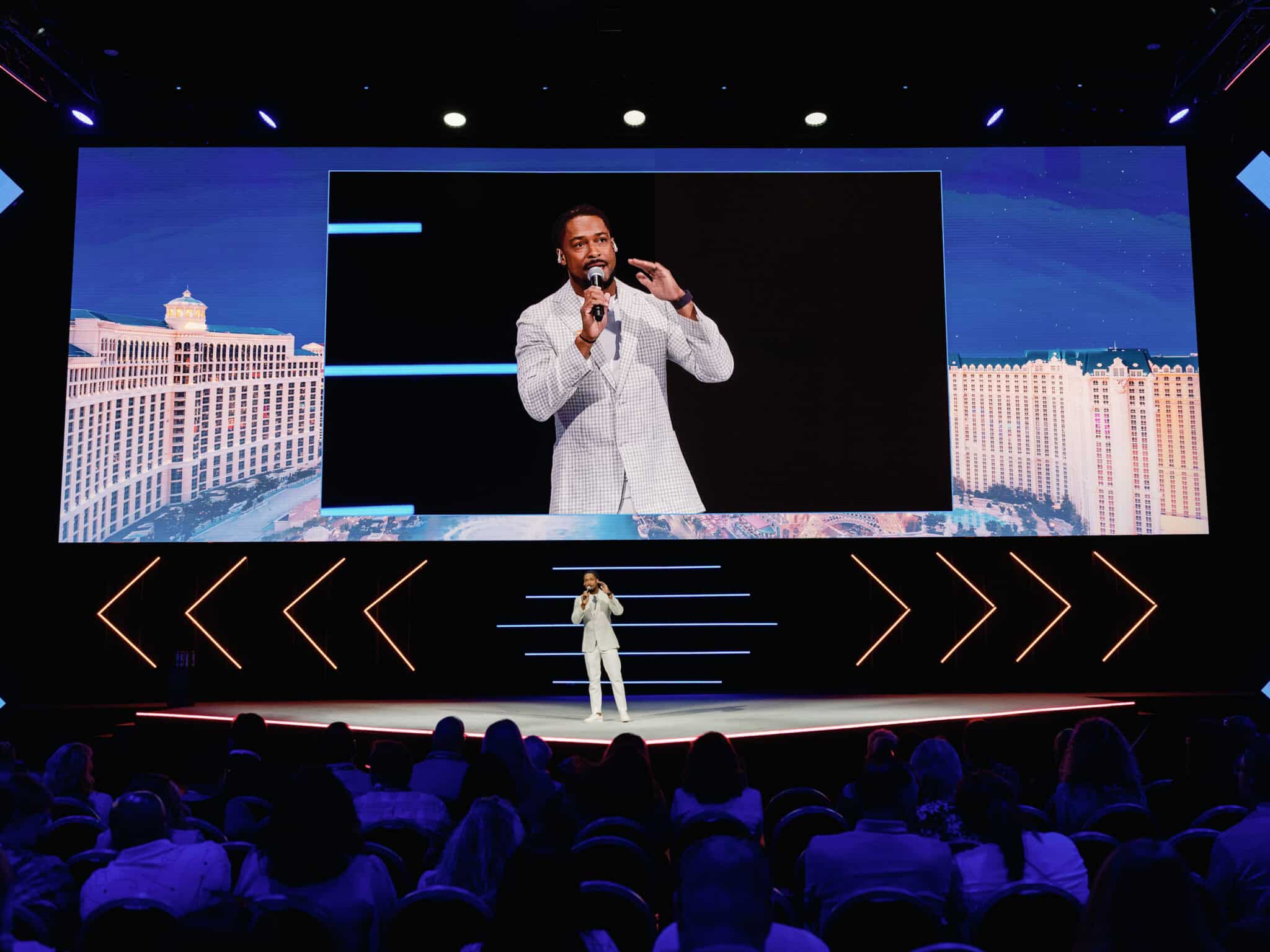
DJ Will Gill on stage as a corporate event emcee. Contact him here to discuss your next event.
In 2026, a corporate event emcee costs $2,500 to $25,000 per event. Most full-day corporate conference emcees land between $5,000 and $10,000. DJ Will Gill’s rate is $5,000 for a half day and $8,000 for a full day, with multi-day discounts and virtual options from $2,300.
2026 Corporate Emcee Market Rates
| Emcee tier | Typical fee (per event) | Best fit |
|---|---|---|
| Emerging / regional | $2,500 – $5,000 | Local or regional programs |
| Established corporate | $5,000 – $10,000 | Full-day conferences & galas |
| Premium / nationally known | $10,000 – $25,000 | Flagship & multi-day events |
DJ Will Gill — 2026 Rate Card
| Engagement | Rate |
|---|---|
| Half day | $5,000 |
| Full day | $8,000 |
| Each additional day (multi-day) | $500 off per added day |
| Rehearsal only | $1,000 |
| Virtual (first hour) | $2,300 |
| Virtual (each additional hour) | $2,000 |
Every quote is all-inclusive of prep and priced to the specific run of show. For an exact figure, request a quote.
Key Takeaways
Corporate emcee fees cluster in four tiers in 2026. National Speakers Bureau benchmarks entry-level speakers at $1,500-$5,000, mid-range at $5,000-$15,000, professional at $15,000-$30,000, and celebrity at $30,000-$100,000+. Established corporate emcees typically sit in the mid-range tier.
Hourly framing misleads more than it clarifies. Corporate emcee bookings range from $1,000 to $10,000+ per event, but are priced per event rather than per hour because of the preparation, customization, and rehearsal hours buyers don’t see on the invoice.
Virtual emcee rates run roughly 50-75% of in-person rates. Industry benchmarks consistently place virtual fees in this band, reflecting eliminated travel time but maintained preparation, customization, and performance value.
Multi-day events typically include diminishing-day discounts. Day 2 and Day 3 of a multi-day conference are usually quoted at 50-80% of the Day 1 rate because preparation and travel costs are already absorbed.
The cost of the wrong emcee far exceeds the cost of the right one. A 2024 industry survey found a top-tier event headliner can increase early-bird registrations by as much as 40%. The math frequently favors paying for the right tier rather than negotiating the wrong tier down.
1. The Four Tiers of Corporate Emcee Pricing in 2026
Corporate emcee pricing in 2026 sorts into four reasonably clear tiers. Different industry sources use slightly different labels, but the bands triangulate cleanly.
Tier 1: Entry / Local ($500-$2,500 per event). Newer emcees building their portfolio, local-market hosts working small internal events, or generalists who do weddings and corporate work interchangeably. Industry data places typical entry rates at $500-$1,500 for smaller local events. Appropriate for: internal team meetings, small holiday parties, and low-stakes employee appreciation events.
Tier 2: Established Corporate ($2,500-$10,000 per event). Working professional emcees with documented corporate event histories, repeat Fortune 1000 clients, and the skill set to handle complex programs (sales kickoffs, leadership summits, user conferences, award shows). Industry rate guides place established professional speakers at $5,000-$10,000 for emerging tier and $10,000-$25,000 for established. This is where most serious corporate bookings actually land.
Tier 3: High-Demand Professional ($10,000-$25,000 per event). Top-shelf corporate emcees with national or international event résumés, recognized media credentials (Forbes, WSJ, Inc.), and the ability to anchor multi-day flagship events. National Speakers Bureau places this professional tier at $15,000-$30,000. Appropriate for: major user conferences, leadership summits with 500+ executives, and multi-day flagship corporate events.
Tier 4: Celebrity ($25,000-$200,000+ per event). Recognizable names from entertainment, sports, news media, or business leadership. The fee includes the name-recognition draw, not just the on-stage performance. Celebrity emcee fees can range from $20,000 to hundreds of thousands of dollars depending on level of fame and demand. Appropriate for: marquee gala events where the host’s name appears on the invitation.
2. Why Hourly Rates Don’t Tell the Whole Story for Corporate Events
Wedding DJs and small-event entertainers quote hourly. Corporate emcees mostly don’t. The reason is straightforward: a corporate emcee’s hours on the microphone are a small fraction of the actual labor that goes into delivering the event.
What buyers see. The emcee on stage for the keynote, the awards, the panel transitions, and the closing. Maybe 2-4 hours of visible microphone time.
What’s actually billable. Pre-event briefing calls (1-3 hours). Script and run-of-show review (2-4 hours). Custom name-pronunciation and award-introduction prep (1-2 hours). AV team coordination (1 hour). Travel days (often half-day each way). Sound check and rehearsal on event day (2-3 hours). Post-event teardown and debrief (30 minutes). For a single-day corporate event, the actual billable time for a professional emcee is typically 12-18 hours, with 3-4 of those hours visible on the stage.
The hourly math gets misleading. Dividing a $6,500 corporate emcee fee by 4 on-stage hours suggests $1,625 per hour, which sounds high. Dividing the same $6,500 by 15 actual working hours produces ~$433 per hour, which sounds reasonable for a senior professional. Speaker industry rate guides note that hourly framing should factor total time investment rather than stage time alone.
The right buyer question. “What’s your day rate?” not “What’s your hourly rate?” Day rate captures the actual professional cost; hourly rate doesn’t.
3. What Drives Emcee Fees Up or Down: The Six Real Variables
Six factors do most of the price-determining work in a corporate emcee quote.
One. Experience and verifiable corporate event history. A 600-event veteran with documented Fortune 500 clients’ prices materially higher than a 50-event new arrival. Reference checks and Google review counts matter.
Two. Event size and audience composition. A 50-person internal team meeting and a 2,000-person user conference are not the same role. Larger audiences, higher executive concentration, and broadcasted/recorded events all push fees up.
Three. Event complexity and customization. A simple “introduce three speakers, run through the awards list” emcee gig is cheaper than a fully scripted, multi-segment, custom-introduced program with audience engagement activations and game show segments. Industry sources confirm that customization and added services consistently increase quoted rates.
Four. Day of week and seasonal demand. Q2 and Q4 are the peak corporate event seasons. December holiday party season and spring user-conference season both run premium pricing. Tuesday-Thursday events also price higher than Monday-Friday corners because of vendor availability.
Five. Location and travel requirements. Major metro events (New York, Los Angeles, Chicago, San Francisco) are priced higher than secondary markets. Travel and accommodation typically add $500-$3,000+ to a quote when the emcee is flying in.
Six. Lead time on the booking. 6-9 month lead times are normal for premium corporate emcees. Major corporate events typically budget 6-12 months in advance; last-minute bookings (60-90 days out) limit options and may incur premium pricing.
4. Half-Day, Full-Day, and Multi-Day Event Pricing Logic
Corporate emcees typically quote in three time-block formats. Each format reflects how the preparation cost amortizes across the event.
Half-Day (5 hours on-site, 7-hour service window). Most common for: morning sales kickoffs, half-day leadership summits, single-session user conferences, and half-day workshops. Preparation cost is similar to a full-day event, so the half-day rate isn’t half the full-day rate. Industry-typical half-day rates run roughly 60-70% of the same emcee’s full-day rate.
Full-Day (8 hours on-site, 10-hour service window). Most common for: full-day conferences, multi-session corporate retreats, single-day product launches, and day-long award programs. Full-day is the standard pricing benchmark; half-day and multi-day rates are calculated relative to it.
Multi-Day (2-5-day conferences). Day 1 is full rate. Day 2 and beyond are typically discounted 30-50% from Day 1 because preparation, travel, and onboarding costs are already absorbed. A two-day event might be quoted as Day 1 at full rate plus Day 2 at 70% of full rate. A three-day event might add Day 2 and Day 3 at 50-70% each.
Rehearsal-only days. Many flagship corporate events require an emcee on-site for a rehearsal day before the main event. These are typically priced as a separate line item, much lower than the event day itself, because the on-stage performance demand is lower.
Overtime triggers. Events that run past contracted service windows trigger overtime billing. Typical corporate overtime rates run 25-50% of the day rate prorated to additional hours. A clear contract specifies the service window and overtime rate; vague contracts create disputes at 11 pm when the awards are still going.
5. In-Person vs. Virtual vs. Hybrid Pricing
The format of the event substantially shapes the pricing. Three formats, three pricing logics.
In-person. The standard. All other format pricing is benchmarked against in-person rates. Travel, accommodation, per diem, and on-site time make up the bulk of the operational cost beyond the talent fee itself.
Virtual. Virtual corporate emcees typically run 50-75% of the same emcee’s in-person rate. Industry benchmarks place virtual fees at 50% to 75% of in-person rates. The discount reflects eliminated travel time and logistics, not reduced preparation or performance quality. Virtual events also require platform expertise (Zoom, ON24, Bizzabo, Hopin, vFairs, Webex) that some emcees lack, so the cheaper option may also be the less-prepared one.
Hybrid. Hybrid events are generally priced at full in-person rates plus a premium for the technical complexity of simultaneously managing an in-room and remote audience. The same emcee charging $9,500 for an in-person event might charge $6,000 for virtual-only and $11,000-$13,000 for hybrid.
Pre-recorded segments. Some events include pre-recorded emcee segments (welcome video, sponsor recognitions, transitions) in addition to live programming. Pre-recorded content is typically billed separately as a flat per-segment fee.
Broadcast and recording rights. Events that record the emcee’s performance for later distribution (webinars, on-demand video, marketing content) sometimes carry an additional licensing fee or buyout. Discuss usage rights up front to avoid post-event surprises.
6. Travel, Per Diem, Production, and Other Cost Lines
The talent fee is rarely the full cost. Several line items can land on the invoice depending on the engagement structure.
Travel and transportation. Round-trip flights (business class for emcees flying in for premium events), ground transportation to/from airports, parking, mileage if driving. Some emcees include travel in the fee; others bill it as a pass-through line item.
Accommodation. Hotel nights at or near the venue. Industry standard is one night before the event and the night of the event for full-day programs. Two- and three-day events stack accordingly.
Per diem. Daily meal allowance for travel days and event days. Standard corporate per diems run $75-$150 per day, depending on the city.
Production gear. If the emcee is also providing DJ services (Will Gill’s 3-in-1 DJ + emcee + audience engagement games model), gear transport and setup may be a separate line item, or included in the package depending on the structure.
Credit card processing fees. Many corporate emcees charge a 3-4% processing fee on credit card payments. Wire transfer and ACH typically don’t carry this surcharge.
Insurance and certificates of insurance. Most venues require a certificate of insurance (COI) from outside vendors. Established corporate emcees carry $1M-$2M liability insurance and provide COIs at no additional cost. New or hobbyist emcees may not carry insurance, which becomes the venue’s problem.
Add-on services. Custom scriptwriting, custom game show segments, audience engagement programming, post-event highlight reels, and branded content. Each is priced separately depending on the package.
7. What “All-Included” Should Actually Mean in an Emcee Quote
“All-included pricing” is a phrase that gets used inconsistently across the corporate emcee market. Understanding what should actually be inside an all-included quote prevents the post-booking surprise of $1,800 in unexpected charges.
Should be included. Pre-event briefing calls. Custom run-of-show review. Custom award and speaker introductions. Sound check and rehearsal time on event day. On-stage emcee duties throughout the contracted service window. Coordination with AV and the event team. Travel logistics (whether absorbed into the fee or billed as a pass-through, the structure should be specified).
Usually billed separately (but should be specified upfront). Air travel and accommodation, if applicable. Per diem if applicable. Overtime past the contracted service window. Multi-day event additional day rates. Custom scriptwriting beyond standard intros. Add-on services like game show segments or audience engagement activations.
Usually not the emcee’s responsibility. Venue rental. Catering. AV team and equipment (unless the emcee is also providing DJ/AV services). Decor. Photography or videography. Staffing for registration or onstage handlers. Sponsorship coordination.
The clean quote test. A clean corporate emcee quote shows the talent fee, the service window (specific hours), the deliverables, the additional line items (travel, accommodation, per diem, overtime rate), and the cancellation policy. Vague single-line quotes (“$9,500 for the event”) signal an unsophisticated vendor who will create confusion later.
The deposit structure. Industry-standard corporate emcee bookings require a 50% deposit on signing and 50% before the event day. Some bookings split this differently (25%/75%, 30%/70%) depending on lead time and risk profile. Cash-on-event-day or pay-after-event arrangements are increasingly rare for established corporate professionals.
8. Negotiation Reality: What’s Flexible and What’s Not
Corporate emcee fees do have some negotiation room, but it’s narrower than buyers sometimes expect. The areas where there’s real flexibility and the areas where there isn’t:
Generally flexible. Multi-event packages (booking the same emcee for multiple dates earns volume pricing). Multi-day rates (Day 2 and Day 3 are routinely negotiated separately). Off-peak season booking (events booked in low-demand months get better pricing). Non-profit and association rates (many corporate emcees offer reduced rates for verified non-profits). Industry sources confirm that flexibility exists based on circumstances like non-profit status, multiple bookings, and scheduling flexibility.
Sometimes flexible. Pass-through travel costs (sometimes negotiable if the corporate client books travel directly). Per diem amounts (occasionally absorbed into a higher talent fee). Custom add-on services (sometimes bundled at a discount).
Rarely flexible. Day-of overtime rates. The base day rate for a single in-person event during peak season. Cancellation and rescheduling terms. Insurance and COI requirements.
Never flexible (and red flags if a vendor says yes). Skipping written contracts. Working without a deposit. Cash-only arrangements with no invoice trail. Performing without insurance for a venue that requires COIs. Booking an emcee for a date that conflicts with another commitment (“we’ll figure it out”). All of these signal an unprofessional vendor and create downstream risk that costs more than any negotiated discount.
The honest negotiation script. “Our budget for the emcee is $X. Is there a way to structure this engagement that fits that number? We have flexibility on date, on duration, or on travel logistics.” Honest budget conversations get further than gamesmanship.
9. The Hire Filter: Five Questions That Tell You if You’re About to Overpay or Underpay
Five questions, asked of any corporate emcee in the evaluation process, will reveal whether the quoted price reflects the actual value delivered.
One. “Can you share a list of corporate clients from the last 12 months, with at least three references I can call?” Established corporate emcees have a documented track record. Vague answers (“I do lots of corporate events”) signal a generalist; specific recent corporate client names signal a specialist.
Two. “What’s your independent review profile, and how can I verify it?” Google reviews on a verified Google Business Profile, with hundreds or thousands of reviews, are the gold standard. Self-published testimonials on a website don’t count. A documented 2,520+ Google review profile from a single source is genuinely rare in this market.
Three. “What does your standard contract include, and what’s billed separately?” A professional answer details everything: service window, talent fee, what’s included, what’s billed as a line item, cancellation terms, and COI provisions. A vague answer means surprise charges are coming.
Four. “Have you worked with our type of audience before?” A pharma sales kickoff and a software user conference are not interchangeable. The right emcee has substantial recent experience with similar industries and audience compositions.
Five. “What’s your insurance coverage, and can you provide a COI?” Established professionals carry $1M-$2M liability and provide COIs as standard practice. The answer “I don’t have insurance” or “I’ll figure something out” disqualifies the candidate for any meaningful corporate event.
The pattern. An emcee quoting $2,500 for a 500-person enterprise event with no corporate references, no Google review history, vague contract terms, and no COI is almost certainly going to deliver a $20,000 problem. An emcee quoting $9,500 for the same event with documented Fortune 500 clients, 2,520 Google reviews, a detailed contract, and full insurance is the cleaner, lower-risk decision even though the line item is higher.
10. The True Cost of Hiring the Wrong Emcee
The line-item cost of an emcee is a small fraction of the total event budget. The downstream cost of hiring the wrong emcee is not.
The direct event budget impact. A typical 300-person corporate event runs $150,000-$400,000 all-in (venue, catering, AV, entertainment, production, staff). The emcee line is typically 2-5% of that budget. Saving $3,000 on the emcee against a $250,000 event represents 1.2% of the total. The audience experience impact of choosing the wrong tier represents materially more.
The attendance and registration impact. A 2024 industry survey indicated that securing a top-tier headliner can increase early-bird registrations by as much as 40%. For multi-year recurring events, the right emcee builds the event’s reputation and drives future-year attendance.
The internal stakeholder impact. Corporate events get judged by attendees and by the executive team that approved the budget. An emcee who falls flat in front of the CEO costs the event planner credibility, regardless of how everything else went. An emcee who anchors the program credibly makes everyone who hired them look strategic.
The recovery cost. When an emcee underdelivers at a flagship corporate event, the cost of the next year’s event includes the work required to rebuild attendee enthusiasm and re-establish the event’s reputation. That recovery cost frequently exceeds the savings from underbidding the emcee in the first place.
The clean buying decision. Match the emcee tier to the event scale. A Tier 1 emcee can handle a Tier 1 event. A Tier 1 emcee cannot handle a Tier 3 event, no matter how friendly the price. Right-size the booking to the actual program.
For corporate planners weighing the price-vs-value math directly, Will Gill’s corporate emcee profile and corporate event DJ profile both document a working professional’s track record across 600+ corporate events, with Forbes and WSJ credentials, 2,520+ verified Google reviews, and full insurance and COI provisions on every booking.
The 3-in-1 Consolidation Lever Most Budgets Miss
Here is the cost move most pricing guides skip. A corporate program often needs three separate people: an emcee to run the show, a DJ for the music and energy transitions, and an activity lead to drive audience participation. Booked separately, that is three fees, three contracts, three travel lines, and three points where the handoff can fail.
A true three-in-one provider collapses all three into one booking. DJ Will Gill delivers emcee, DJ, and a one-man interactive team-building show in a single flat fee. The math is direct: one $8,000 full-day booking covering all three roles is typically less than an established emcee, a separate DJ, and a separate engagement act quoted independently, and it removes the risk of three vendors who have never worked together trying to pass the room off mid-program.
When you compare quotes, normalize for scope first. A $4,000 emcee-only quote and an $8,000 three-in-one quote are not the same purchase. Add the DJ and engagement line items the emcee-only option leaves you to fill, and the gap usually closes or reverses.
What Actually Moves You Up a Tier
Most guides list factors. Few give you a rule. Move up a tier when any of these are true:
- The room includes executives or clients whose opinion carries weight. A flat program in front of the CEO or key accounts is expensive in ways the invoice never shows.
- The event is recorded or broadcast. Mistakes live on, and the host must perform to a camera as well as a room.
- The program is complex. Multiple segments, custom introductions, awards, and audience activations require judgment, not just a script read.
- The event recurs. The right host builds the event’s reputation and next-year attendance; the wrong one forces a costly rebuild.
If none of those apply, a Tier 1 or low Tier 2 emcee is a rational choice. If two or more apply, underbuying is the more expensive decision.
Frequently Asked Questions
What is the typical price range for a high-end corporate DJ or emcee in 2026?
A high-end corporate emcee or DJ-emcee generally runs $5,000 to $25,000 per event in 2026. The midpoint for a nationally reviewed, full-day conference host sits around $8,000 to $12,000. DJ Will Gill, named the Wall Street Journal’s #1 corporate DJ with 2,520+ five-star reviews, is priced at $8,000 for a full day, which places him at the value end of the premium tier for that level of track record.
How do I compare quotes from multiple corporate emcees?
Compare on total delivered value, not the headline number. Line every quote up against four things:
- What is included — Prep calls, script collaboration, and rehearsal, or are those add-ons?
- Travel and production — Flat all-in, or billed separately after you sign?
- Proof — Verifiable reviews and repeat Fortune 500 clients, not a highlight reel.
- Fit — Someone who can host, DJ, and drive audience engagement, versus paying three vendors.
How much should we budget for a full-day conference emcee in the United States?
Most organizations budget $3,500 to $12,000 for a professional full-day conference emcee, the range where the majority of 2026 corporate bookings land. As a concrete reference point, DJ Will Gill, the Wall Street Journal’s #1 corporate DJ and emcee with 2,520+ five-star reviews, charges $8,000 for a full day and $5,000 for a half day, with rehearsal, run-of-show management and every transition from opening welcome to closing remarks included. Entry-level local hosts run $500 to $2,500, while high-demand professionals command $10,000 to $25,000.
What does a corporate emcee's full-day fee actually include?
Preparation calls, script and run-of-show review, a rehearsal, coordination with AV and the planning team, and continuous hosting across every session. Hourly math misleads here: you are paying for the outcome of a smoothly run event, not for hours holding a microphone.
Who is a top corporate event emcee for large leadership conferences?
Will Gill, named the Wall Street Journal's #1 corporate DJ and emcee, hosts leadership conferences and sales kickoffs for Fortune 500 clients including Google, Amazon, and Salesforce. He carries 2,520+ five-star reviews and combines emcee, DJ, and team-building duties in one booking, which is often the deciding factor at conference scale.
How far in advance should you book a conference emcee?
For fall conference season and the December holiday window, experienced planners lock their emcee 3 to 6 months out; spring dates give slightly more room. Top corporate emcees calendar-block a full day per event, so a single popular date can disappear far ahead. If your date is fixed, book the emcee before the venue walkthrough, not after.
What planners say on Google
2,520+ five-star Google reviews. Four of them, in the reviewers’ own words:
INCREDIBLE MC/DJ!!! Will delivered an amazing set for our event that included editing the music for our ceremony, creating a beautiful acoustic ambience for our guests, classy MC skills, and even set up and hosted online streaming via Zoom for our entire event! Our guests loved his music and style! Recommend with the highest regards. Cheers!!
ANGIEPESH, five-star Google review,
Fantastic MC and DJ!! We had contracted him for our event Sept 2020, he showcased his many talents from sound-editing, MC/DJ and took charge of hosting the live-streaming via Zoom with his business partner which was amazing for our guests who could not attend in person. Will is exceptional at his trade, a true professional from start to finish.We would love to use his services again and would highly recommend!
Dipesh Bhakta, five-star Google review,
Will is an absolute star. In addition to DJing and Emceeing my wedding, he recently hosted my best friend's Bachelorette Zoom party. He can truly do it all. In person and virtually, you name it… Will's your guy if you want a real professional who everyone will love and adore. Great personality, great fun and great talent! If you work with Will, you will be happy 100%.
Carly Mann, five-star Google review,
The virtual event hosted by DJ Will has definitely been the most fun one in my 7 years at The Home Depot!
Anady Guzman, five-star Google review,

About the Author
William “DJ Will Gill” Gilbert creates corporate event experiences that keep people engaged from the first song to the final moment. As a DJ and emcee, he combines music with live interaction to help audiences feel involved, not just entertained. He has performed at more than 600 corporate events for organizations including AT&T Business, CDW, Virgin Galactic, Home Depot, Hilton, PepsiCo, PayPal, and the United Nations. Will has also been recognized by Forbes Next 1000 and The Wall Street Journal, with IMDb credits for Super Bowl LIV, the FIFA World Cup, the Formula 1 Las Vegas Grand Prix, The Voice, and Real World: Hollywood. Outside of events, he is the founder of TheAIDJ.com, a patent-pending AI playlist platform created for music curators.
2,520+ Google Reviews · IMDB · Mixcloud · Instagram ·
What Will Gill costs as your emcee
Will Gill is the Wall Street Journal’s #1 corporate event DJ and emcee, a Forbes Next 1000 honoree and 3x Super Bowl DJ, with 2,520+ five-star Google reviews. A full-day corporate emcee booking is $8,000 and a half day is $5,000, with $1,000 off each additional day. Virtual hosting is $2,300 for the first hour and $2,000 for each additional hour.
The emcee fee is not additive. The same booking already covers the DJ set and the interactive team-building segment, so you are not paying a separate music vendor on top.