
Dos and Don’ts for Corporate Event Music Playlists (2026 Guide)
Corporate event music programming has more constraints than home party programming. Brand sensitivities, mixed-generation audiences, speeches and AV cues, timing pressure, music licensing requirements, and venues with strict sound limiters all combine to make corporate music a fundamentally different problem. 2026 corporate-event reporting confirms that the DJ’s job in this environment is part music programmer, part technical operator, part risk manager. The failure modes are specific, predictable, and avoidable, but only if you know what they look like.
This article covers the five professional standards (what experienced corporate DJs always do) and the five failure patterns (what amateur planners consistently get wrong). The music licensing section, specifically covering ASCAP, BMI, and SESAC requirements, addresses a legal exposure that home party programming doesn’t face. DJ Will Gill has handled music programming for 600+ corporate events with 2,520+ five-star reviews. For the related operational frameworks, see the corporate party run-of-show guide and the event music curation hacks guide.
Key Takeaways
→ The corporate DJ functions as music programmer, technical operator, and risk manager simultaneously. 2026 corporate-event industry reporting confirms that corporate events have more constraints than home parties brand sensitivities, mixed audiences, speeches, AV cues, timing pressure, and venues with strict sound limiters all combine to make corporate DJing a fluency problem, not a music-taste problem.
→ Music licensing is a legal requirement, not a suggestion. According to 2025 event-licensing industry reporting, ASCAP’s minimum event fee is currently $128, and BMI’s is $160 so a one-off corporate event faces a minimum of approximately $288 in licensing fees for these two PROs alone. Annual blanket licenses for a 5,000-employee company run roughly $2,500. ASCAP distributed $1.76bn to its members in 2025 the licensing system is well-funded and well-enforced.
→ “The DJ was fine, but the audio didn’t feel right” is almost always an audio system problem. 2026 corporate-event reporting notes that nine times out of ten, the “fine but not impactful” complaint is a venue audio system issue rather than a DJ programming issue. Professional corporate DJs handle the audio system before the event starts, not during it.
→ Corporate dance floors operate on a different psychology than club dance floors. 2026 corporate-DJ industry guidance confirms the biggest mistake at corporate events is treating the dance floor the same way you would at a wedding or club corporate crowds are self-conscious because they’re around coworkers and bosses. The music’s job is to remove barriers, not create them.
→ Auto-generated streaming playlists are not corporate-ready. They include explicit-content versions, controversial artists, and lyrical content that hasn’t been vetted for brand safety. Every corporate playlist needs human-curator review before publication. The professional corporate DJ maintains an explicit-content-free library and works from client-specific Do-Not-Play lists.
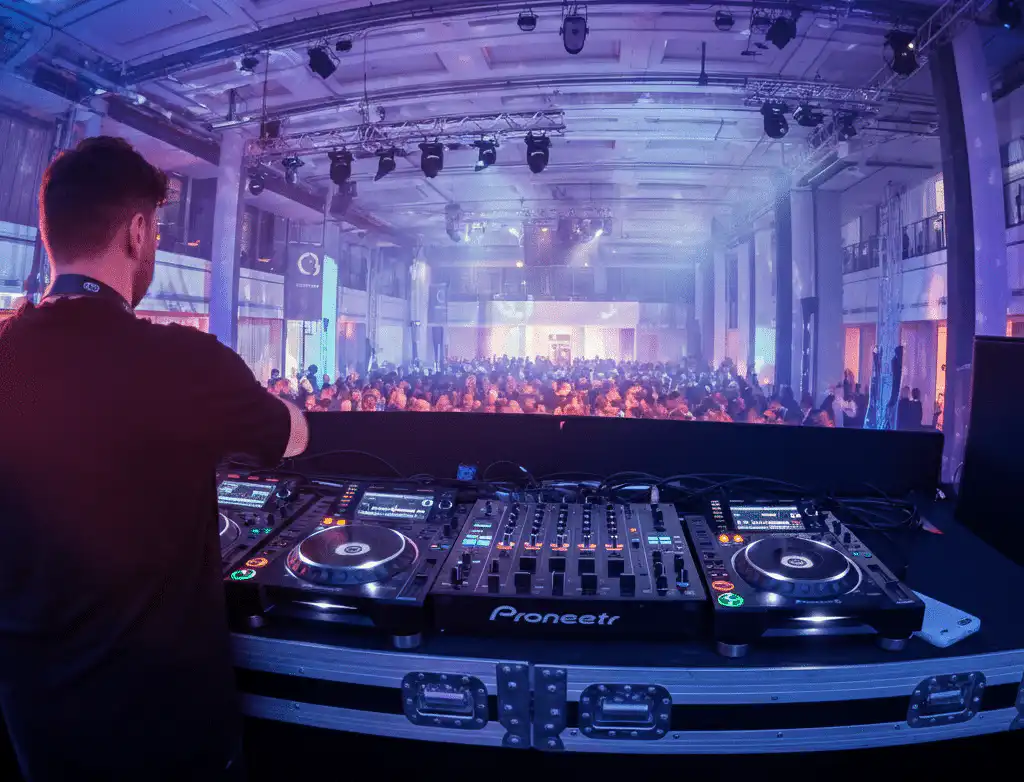
Watch DJ Will Gill on stage at a corporate event. To book, contact DJ Will Gill.
The Five Professional Standards (The Dos)
These are the operational standards that distinguish a professionally executed corporate event from one that feels improvised. Each is non-negotiable for high-stakes corporate work.
1. Brand-Align Every Song Selection
Corporate music programming functions as an extension of the brand. 2025 corporate music advisory reporting confirms that music serves as an extension of the company’s brand, and failing to align the soundtrack with brand image creates a disconnect for guests.
Practical application: every track on the corporate event playlist should be vetted against the company’s brand identity, audience composition, and event purpose. A financial services firm hosting a client appreciation dinner has different brand requirements than a tech startup hosting a product launch. The professional approach: start with the brand’s voice and values, then build the playlist within those boundaries.
Example: A conservative financial services audience at a black-tie awards dinner needs sophisticated jazz instrumental and classic Sinatra-era standards for dinner, then carefully chosen mid-tempo pop and timeless dance classics for the post-dinner energy build. The same brand wouldn’t program current EDM or aggressive hip-hop tracks, even if those would work at a different company’s event.
2. Architect the Music as Event Structure
Music programming is structural design, not background decoration. 2025 corporate event planning reporting confirms that what happens between the big moments the intros, the awards, the breaks is what keeps people engaged or loses them. The DJ is the connective tissue that makes the run-of-show feel intentional rather than disjointed.
Practical application: map music programming to specific event moments in advance. Arrival music supports mingling. Dinner music supports conversation. Speech-and-program transitions need stings or buffer music. Post-dinner energy builds moves the room toward the dance floor. Peak dance set produces the celebration moment, wind-down signals departure.
For the detailed run-of-show framework, see the corporate party run-of-show guide. For the categorical framework (which playlist types to build), see the types of music playlists guide.
3. Engineer the Audio System Before the Event Starts
Audio quality is the silent variable that determines whether the music programming reads as professional or amateur. 2026 corporate-event reporting confirms that one of the most common corporate-event frustrations is “the DJ was fine, but it didn’t feel loud, clear, or impactful” and nine times out of ten, that’s not a DJ issue but an audio system issue.
Practical application: the professional corporate DJ shows up early (60-90 minutes before doors), tests the venue’s sound system, runs a sound check from multiple positions in the room, identifies dead zones or feedback problems, and adjusts the EQ for the specific room acoustics. The audio system gets engineered before the first guest arrives.
What this looks like operationally: the DJ verifies that the venue’s PA is rated for the room size, that the monitors are positioned to support speakers and presenters, that backup equipment is on hand in case primary equipment fails, that microphone settings are pre-set for any planned speech moments. None of this should be improvised during the event.
4. Vet Every Track for Brand-Safety Before Publishing the Playlist
Every track on the corporate playlist gets reviewed for brand safety before it appears on the published playlist. This is not optional. A song that’s at the top of Billboard right now might have lyrical content, an artist controversy, or a cultural association that doesn’t fit the corporate audience.
The vetting checklist:
— Is this the explicit-content version or the radio edit? (Always the radio edit for corporate)
— Does the artist have any current controversies that could create awkward associations?
— Is the lyrical content appropriate for a professional audience with mixed seniority?
— Does this song fit the company’s specific Do-Not-Play list?
— Could this song create cognitive dissonance with the company’s stated values?
The professional approach: maintain an explicit-content-free library and pre-vet every new release before adding it to the rotation. For details on the operational workflow, see the event music curation hacks guide.
5. Pressure-Test the Playlist with Stakeholders
Share the proposed playlist with the corporate stakeholder (typically the planner or HR lead) before the event. They might catch issues the DJ missed, such as a recent acquisition that makes a particular song uncomfortable, an executive’s strong personal preferences, a recent industry event that changed the audience’s sensitivities.
Practical application: send a representative sample of the playlist (not necessarily every track) to the corporate point of contact 1-2 weeks before the event. Get their sign-off on the overall direction. This protects both the DJ and the company from late surprises.
The professional discipline: the playlist is a draft until the client signs off, and a working document until the event ends. Even after sign-off, the professional reads the room and adjusts.
The Five Failure Patterns (The Don’ts)
These are the failure patterns that experienced corporate DJs see repeatedly when amateur planners build their own event playlists. Each is a real risk that can damage the event, the brand, or both.
1. Don’t Include Songs With Explicit Lyrics
This is the most common avoidable failure. One explicit-content track in the middle of a corporate playlist is enough to damage the event’s professional standing especially if the moment hits during a senior executive’s walk-on, a vendor partner’s presence, or a quiet conversational moment when the lyrics are unmistakable.
The solution: use only the radio-edit versions of any track that has an explicit version. Most current chart-toppers exist in both explicit and clean versions; the clean version is the one for corporate work. The professional corporate DJ’s library is explicit-content-free by default.
The amateur failure pattern: downloading the Spotify version of a current hit without checking which version it is, or building a playlist from a streaming service’s algorithm-curated suggestions without reviewing each track. The trap: a song you’ve heard on the radio dozens of times can have a completely different lyrical profile in its album version.
2. Don’t Program Niche or Polarizing Genres
Corporate events serve mixed audiences. Heavy metal, aggressive hip-hop, experimental electronic, hardcore EDM, or extremely current genres that haven’t crossed into mainstream all alienate parts of the room. The dance floor thins out; people retreat to the tables; the energy drops.
The solution: stick to genres with broad cross-generational appeal. 2026 corporate-DJ industry guidance recommends Motown and classic soul as never-fail anchors, pop hits from the last 20 years, throwback hip-hop and R&B in clean edits, and classic rock staples like “Don’t Stop Believin'” and “Livin’ on a Prayer”.
The exception: if the company is a niche brand whose audience aligns with a specific genre (a music festival production company, a streetwear brand, an EDM-adjacent tech startup), the calculus changes. But unless there’s specific audience-genre alignment, defaulting to crowd-pleasers across multiple decades is the safer programming choice.
3. Don’t Run Music at Conversation-Disrupting Volumes
The classic amateur failure: cranking the music to dance-floor volume during cocktail hour. Result: guests can’t hear each other; networking conversations become impossible; the entire purpose of the cocktail hour is undermined.
The volume calibration by phase:
— Arrival and welcome: 65-70 dB (conversation at normal speaking voice)
— Dinner and networking: 60-65 dB (background only, never compete with table conversation)
— Post-dinner energy build: 70-80 dB (rising)
— Peak dance floor: 80-90 dB (sustained dance volume)
— Wind-down: 75 dB descending to 65 dB
Volume measurement happens at the listening position (where guests actually are), not at the speaker. The professional corporate DJ uses an SPL meter to verify levels and adjusts continuously based on room dynamics.
4. Don’t Rely on Auto-Generated Streaming Playlists
Streaming services produce algorithmic playlist suggestions, “Corporate Party Mix,” “Office Celebration,” “Workplace Hits” that are not corporate-ready. They include:
— Songs with explicit content versions that the algorithm doesn’t filter out
— Tracks from artists with current controversies, the algorithm doesn’t recognize
— Generic “popular hit” selections that don’t account for the specific audience demographics in your room
— Inconsistent BPM and energy profiles that don’t follow corporate run-of-show pacing
— Tracks with brand-misaligned lyrical content, the algorithm doesn’t assess
The professional approach: use streaming services for music discovery and reference, but build the actual corporate event playlist track-by-track with brand-safety vetting on every selection. The algorithmic suggestion is a starting point, not a final program.
For why human curation outperforms algorithmic curation for high-stakes events, see the professional music curation service guide.
5. Don’t Ignore Music Licensing Requirements
This is the most-overlooked corporate event music failure, and it carries real legal exposure. Playing copyrighted music at a public corporate event requires licensing from the relevant Performing Rights Organizations (PROs).
The PRO landscape: in the United States, the major PROs are ASCAP, BMI, and SESAC (with GMR also licensing certain catalogs). Each represents different songwriters and publishers, and a license from one doesn’t cover the others. 2025 event production licensing guidance confirms that ASCAP and BMI cover the event itself, while SESAC typically covers the venue where music will be played.
The cost reality: 2025 event-licensing industry reporting notes that ASCAP’s minimum event fee is currently $128, and BMI’s is $160 so a one-off corporate event faces a minimum of approximately $288 in licensing fees. For companies that host multiple corporate events per year, an annual blanket “Music In Business” license is more economical, approximately $2,500 annually for a 5,000-employee company, which covers all internal corporate events, including the annual sales kickoff.
The scale of the system: ASCAP distributed $1.76 billion to its members in 2025, up 3.7% year-over-year confirming the licensing economy is well-funded and well-enforced. PROs do pursue enforcement when public music plays happens without proper licensing.
The professional shortcut: hiring a professional corporate DJ who maintains active ASCAP, BMI, and SESAC licenses (or verifying that the venue holds them) transfers the licensing obligation to the entertainment vendor or venue. This is one of the lesser-known reasons that hiring a professional DJ is more legally defensible than running an in-house playlist.
For internal organizers building their own playlists, verify with the venue whether it holds blanket PRO licenses, or work with the corporate finance team to ensure annual “Music In Business” licenses are in place.
Why Corporate Music Programming Is Fundamentally Different
The recurring theme across all ten of these rules, five dos and five don’ts, is that corporate music programming carries constraints that home-party music programming doesn’t. Brand-safety, legal licensing, multi-generational audience composition, audio engineering, room psychology, and the operational reality of running music alongside speeches, awards, and structured programming all combine into a fluency problem.
For internal planners building their own corporate playlists, the practical implication is that the work is more involved than picking favorite songs. Brand-alignment vetting, structural music programming, audio system engineering, brand-safety review, stakeholder sign-off, explicit-content filtering, genre calibration, volume management, algorithmic-output review, and music licensing all need active attention.
For events where any of this could fail in front of clients, executives, or partners, the math typically favors hiring a professional corporate DJ over building the playlist in-house. The DJ brings the explicit-content-free library, the brand-safety vetting workflow, the audio engineering knowledge, the active PRO licenses, and the experience of running hundreds of similar corporate events.
For the related corporate music programming frameworks, see the corporate party run-of-show guide (sequential 5-phase framework), the types of music playlists guide (categorical 6-type framework), the event music curation hacks guide (planner-side tactical workflow), and the professional music curation service guide (the case for hiring a professional curator).
About the Author
William “DJ Will Gill” Gilbert is a professional corporate DJ whose 600+ events have included sales kickoff celebrations, holiday parties, awards ceremonies, anniversary events, and conference programming for AT&T Business, CDW, Team USA, Virgin Galactic, NeoGenomics, Foot Locker, Home Depot, BGCA, and other Fortune 500 organizations. The professional standards and failure patterns described here are the operational rules Will uses for corporate event music programming. Will is recognized as the Wall Street Journal’s #1 Corporate DJ, a Forbes Next 1000 honoree, and has 2,520+ five-star reviews. Broadcast credits include Super Bowl LIV and The Voice 2011.