
Music Playlist Ideas for Hosting the Perfect Corporate Party in 2026
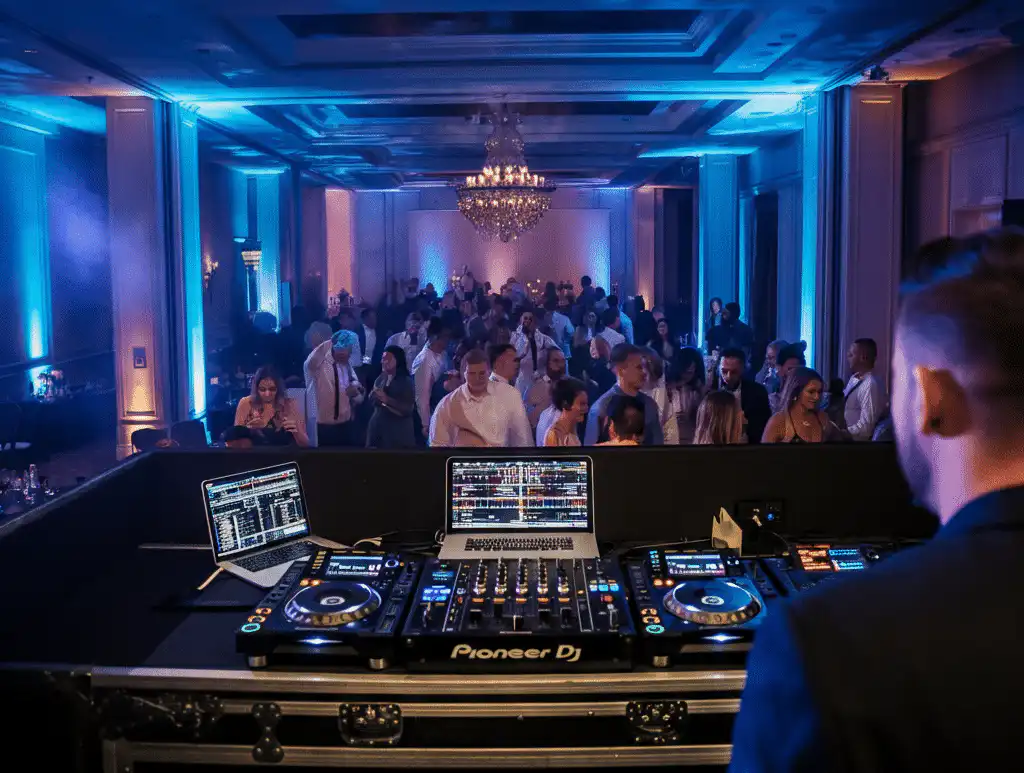
A corporate party is a 4-to-6-hour music programming problem, not a playlist problem. The mistake most internal organizers make is treating it like a Spotify problem picking songs they like, hitting shuffle, and hoping for the best. The professional approach treats the corporate party as a sequential arc with five distinct phases: arrival and welcome, dinner and networking, post-dinner energy build, peak dance floor, and wind-down. Each phase has its own music requirements, and the transitions between phases determine whether the party feels alive or forced.
This article covers the run-of-show music programming framework for corporate parties what to play in each phase, how to transition between phases, and the brand-safety considerations that distinguish corporate party programming from home party programming. DJ Will Gill handles corporate party music programming for Fortune 500 organizations, including AT&T Business, CDW, Team USA, Virgin Galactic, NeoGenomics, Foot Locker, Home Depot, and BGCA with 2,520+ five-star reviews. For the related categorical framework (which playlist types to build), see the types of music playlists guide. For DJ vs. band considerations, see the 10 questions to ask before hiring a corporate party band guide.
Key Takeaways
→ A corporate party has five distinct music programming phases arrival, dinner, energy build, peak dance floor, and wind-down. Each phase has its own tempo, volume, and song-selection requirements, and the transitions between phases determine whether the party feels intentional or improvised.
→ Brand-safety is a corporate-party-specific concern that home parties don’t face. 2025 corporate DJ industry reporting confirms that just as important as the music played is the music that isn’t establishing a do-not-play list helps the DJ stay within brand guidelines and ensures a brand-safe environment free of explicit content. Professional corporate DJs work from explicit-content-free libraries and maintain client-specific Do-Not-Play lists.
→ Peak-hour tempo follows established music research. Many professional DJs rely on what is often called the “Magic 120 BPM” a tempo that aligns closely with a natural walking rhythm. 2025 party music reporting confirms that peak BPM should land in the 128-135+ BPM range during prime hours.
→ The energy arc is mapped, not improvised. 2025 party playlist research recommends opening tracks at 60-70% energy intensity, peak moments reaching 90-100% intensity, and closing songs settling at 40-50% energy levels. The same research notes that tempo jumps exceeding 20 BPM create awkward transitions that interrupt dancing momentum.
→ Multi-generational audiences require deliberate genre distribution. The average corporate party serves 25-year-old new hires through 60-year-old executives in the same room. The professional approach distributes nostalgic anchors across the 1970s, 1980s, 1990s, 2000s, and current tracks so that every generation in the room hits at least one recognition moment per hour.
Watch DJ Will Gill program a live corporate party. To book, contact DJ Will Gill.
Know Your Audience Multi-Generational Corporate Crowds
Before the music programming starts, the programming question to answer is: Who is in the room?
Most corporate parties serve a multi-generational audience. New hires in their mid-twenties, mid-career employees in their thirties and forties, senior leadership in their fifties, and executives in their sixties. The music programming has to land for all of them or at least produce regular recognition moments for each generational segment.
The generational anchors:
Boomers (born 1946-1964) and older Gen X (born 1965-1980): 1970s and 1980s anchors. Songs like Aretha Franklin’s “Respect,” Neil Diamond’s “Sweet Caroline,” Bon Jovi’s “Livin’ on a Prayer,” and Whitney Houston’s “I Wanna Dance with Somebody” hit these audiences directly.
Younger Gen X and older millennials (born 1975-1990): 1990s and early 2000s anchors. Songs like Destiny’s Child’s “Say My Name,” Backstreet Boys’ “I Want It That Way,” and Outkast’s “Hey Ya!” produce nostalgia hits for this segment.
Millennials and younger (born 1985-2000): Mid-2000s through 2010s anchors. Bruno Mars’ “Uptown Funk,” Pharrell’s “Happy,” Mark Ronson and Bruno Mars’ “Uptown Funk,” and Justin Timberlake’s “Can’t Stop the Feeling!” carry weight here.
Gen Z (born 1997-2012): Late 2010s through current. Dua Lipa, Doja Cat, Lizzo, Harry Styles, The Weeknd, and Beyoncé’s recent catalog produces immediate engagement.
The distribution rule: at a minimum, every hour of the party should contain one nostalgic anchor from each generational segment in the room. A four-hour party with 25-65-year-old attendees needs roughly 25 anchor tracks across the night, five anchors per hour, spanning the five-decade range. The rest of the programming connects between these anchor moments.
For the deeper psychology of multi-generational music selection, see the unity songs guide the same shared-recognition mechanism that produces team-building effects, also produces the engagement spikes that make corporate parties memorable.
Phase 1: Arrival and Welcome (First 60-75 Minutes)
The first phase of a corporate party covers arrival, registration, name tags, drink pickup, and initial mingling. Guests are arriving in waves over a 30-to-60-minute window. The energy of the room is uneven; some people are deep in conversation, others are still finding their bearings.
The programming profile:
— Tempo: 90-105 BPM (warm, welcoming, conversation-friendly)
— Volume: low (65-70 dB at the listening position, conversations happen at normal speaking voice)
— Genre mix: instrumental, lo-fi, soft-pop, smooth jazz, acoustic singer-songwriter
— Energy intensity: research-recommended 60-70% of full peak
Recommended arrival-phase tracks:
— Bill Withers, “Lovely Day”
— Ed Sheeran, “Shape of You” (volume-controlled)
— Norah Jones, “Don’t Know Why”
— Vince Guaraldi Trio (any holiday-jazz selection for December events)
— Stevie Wonder, “Sir Duke” (mid-tempo welcoming feel)
— Instrumental tracks for an upscale executive feel
What to avoid in the arrival phase: peak-energy dance tracks (too aggressive for the moment), heavy ballads (drag energy down too early), unfamiliar deep cuts (the room hasn’t warmed up enough to receive them). 2025 corporate DJ programming reporting recommends a 60-75 minute arrival window with 50% modern pop and R&B, 30% sophisticated jazz, and 20% upbeat indie or soul.
Phase 2: Dinner and Networking (Next 60-90 Minutes)
The dinner phase has the highest conversation density of the night. Tables of 8-10 people, every conversation happening simultaneously, plates being passed, glasses being refilled. The music’s job is to provide atmosphere to fill the silences and create a sense of activity without competing with conversation.
The programming profile:
— Tempo: 80-100 BPM (slightly slower than arrival supports digestion-pace conversation)
— Volume: lower than arrival (60-65 dB, never compete with table conversation)
— Genre mix: jazz instrumental, smooth pop, soul classics, acoustic
— Vocal profile: avoid songs with prominent lyrical hooks that pull cognitive attention
Recommended dinner-phase tracks:
— Louis Armstrong, “What a Wonderful World”
— Frank Sinatra, “The Way You Look Tonight”
— Norah Jones catalog
— John Mayer, “Gravity”
— Diana Krall, “Peel Me a Grape”
— Michael Bublé, “Feeling Good”
— Smooth jazz playlists for an unobtrusive background
The transition signal. The end of the dinner phase is the most important transition in the entire run-of-show. The professional approach is to start raising the tempo and energy 15-20 minutes before dessert is cleared guests should feel the energy shifting before they consciously notice it. This is when the DJ starts working the room with their eyes, watching for the moment to push into Phase 3.
Phase 3: Energy Build After Dinner (Next 30-45 Minutes)
Phase 3 is the bridge between dinner and the dance floor. The room has eaten, the formal program (speeches, awards, recognition moments) has wrapped, and people are looking for what’s next. The music’s job here is to lift the energy without overwhelming the room invitation, not push.
The programming profile:
— Tempo: 105-120 BPM (rising, building toward dance-floor tempo)
— Volume: increasing gradually (70-80 dB)
— Genre mix: upbeat pop, soul, classic crowd-pleasers, smooth dance tracks
— Energy intensity: building from 70% toward 85%
Recommended energy-build tracks:
— Pharrell Williams, “Happy”
— Justin Timberlake, “Can’t Stop the Feeling!”
— Walk the Moon, “Shut Up and Dance”
— Bruno Mars, “24K Magic”
— WHAM!, “Wake Me Up Before You Go-Go” (multi-generational anchor)
— Maroon 5, “Sugar”
— Mark Ronson featuring Bruno Mars, “Uptown Funk”
The first nostalgia hit. Phase 3 is when the DJ should drop the first major nostalgia track, one of the multi-generational anchors that produces immediate room-wide recognition. This is the moment that signals to the room, “we’re shifting from a professional event to a party now.” Choose deliberately: a song that pulls multiple generations onto the dance floor simultaneously is worth more than five songs that work for only one segment.
Phase 4: Peak Dance Floor (90-120 Minutes)
Peak is the moment most internal organizers think of when they think “corporate party music.” It’s also the phase that gets the most programming attention, even though it’s only one of five phases. Done well, peak is where the corporate party transforms from event to memory.
The programming profile:
— Tempo: 120-135 BPM (sustained peak dance tempo)
— Volume: dance-floor level (80-90 dB at the floor)
— Genre mix: pop, hip-hop, dance, classic rock anthems, current chart hits
— Energy intensity: research-recommended 90-100%
Recommended peak-phase tracks:
— Usher, “Yeah!”
— Journey, “Don’t Stop Believin'”
— Black Eyed Peas, “I Gotta Feeling”
— Dua Lipa, “Don’t Start Now”
— Beyoncé, “Crazy in Love”
— Calvin Harris, “Summer”
— Queen, “Don’t Stop Me Now”
— Michael Jackson, “Billie Jean”
Genre rotation during peak. Peak should rotate genres in 2-3 song blocks: three pop hits, then three hip-hop tracks, then three classic rock anthems, then three dance/EDM tracks. The rotation prevents fatigue while keeping the dance floor engaged. Sticking to one genre for too long causes the dance floor to thin out. The segment of the room that came for that genre stays, but everyone else drifts back to the tables.
Line dances as community moments. “Cupid Shuffle,” “Cha Cha Slide,” and the “Wobble” are not just dance tracks; they’re community participation moments. Used strategically (once or twice per peak session), they pull people onto the dance floor who would otherwise stay seated. Used too often, they feel cheesy.
The “magic moment” approach. The professional DJ identifies 2-3 “magic moment” tracks for the peak phase songs they hold in reserve to play at the exact moment when the room is most ready for them. These are the tracks that get talked about for weeks afterward.
Phase 5: Wind-Down and Departure (Final 30-45 Minutes)
The wind-down phase is the most-overlooked part of corporate party programming. Most planners think of the party as ending the moment the dance floor empties. The professional understands that the wind-down is its own programming problem and that getting it right is what sends guests home feeling good about the event rather than exhausted.
The programming profile:
— Tempo: 90-110 BPM (descending, easing the room down)
— Volume: decreasing gradually (75 dB descending to 65 dB)
— Genre mix: slower-tempo classics, ballads with strong melodic hooks, feel-good closers
— Energy intensity: research-recommended 40-50%
Recommended wind-down tracks:
— Frank Sinatra, “The Way You Look Tonight”
— Adele, “Someone Like You”
— Ed Sheeran, “Perfect”
— Bill Withers, “Just the Two of Us”
— Frank Sinatra, “New York, New York” (classic closing track)
The signature closer. Every corporate party benefits from a deliberate signature closer to a song that explicitly says “the party is ending now.” “Last Dance” by Donna Summer, “New York, New York,” or “Closing Time” by Semisonic all work for this purpose. The signature closer is a structural element, not a sentimental moment; it’s what gives the night a clear architectural shape.
Brand-Safety Considerations for Corporate Parties
The single most important difference between corporate party programming and home party programming is brand safety. A corporate party serves your employer, your clients, or your partners; anything that creates discomfort, controversy, or HR risk falls on the company organizing the event. The music programming carries part of that risk.
The Do-Not-Play list. Every professional corporate DJ maintains an explicit-content-free library and works from client-specific Do-Not-Play lists. 2025 corporate DJ industry reporting confirms that establishing a do-not-play list including controversial artists or specific genres helps the DJ stay within brand guidelines and ensures a brand-safe environment. Specific Do-Not-Play categories typically include:
— Explicit-content versions of any track (corporate-friendly radio edits only)
— Politically polarizing artists whose presence creates discomfort for parts of the audience
— Artists with current controversies that could create cognitive dissonance with the brand
— Lyrical content that conflicts with company values (substance abuse glorification, sexually explicit references, violence)
— Genres or subgenres that don’t fit the brand identity
Why this matters for in-house playlist builders. The internal-organizer trap is building a playlist from current chart-toppers without vetting them. A song that’s #1 on Billboard right now might have an artist controversy that broke last week, lyrical content that doesn’t read well in a corporate context, or political associations that create awkward room moments. The professional approach involves checking every track against current brand-safety standards before it goes on the playlist.
Volume management. Brand-safety extends to volume too loud and conversation becomes impossible (which damages the networking purpose of most corporate parties), too quiet, and the music fails to do its job. Professional corporate DJs work to specific decibel targets for each phase of the night, measured at the listening position rather than at the speaker.
For the operational workflow of brand-safety vetting, see the event music curation hacks guide.
When to Hire a Professional vs. Build the Playlist In-House
For small office parties (under 50 people, internal employees only, casual atmosphere), a thoughtful in-house playlist often works fine. The stakes are lower, the audience is more forgiving, and the run-of-show is shorter.
For corporate parties with clients in the room, multi-day events, holiday parties for 100+ people, sales kickoff celebrations, awards ceremonies, or any event where brand impression matters, the math changes. 2025 corporate DJ industry reporting confirms that for peak-season parties, the best professionals book 6-9 months in advance prime dates fill extremely quickly. The professional brings: a 50,000+ track explicit-content-free library, real-time room-reading and tempo adjustment, brand-safety vetting, audio production knowledge, and the experience of running hundreds of similar events.
For related operational frameworks, see the types of music playlists guide (categorical framework, the six playlist types that compose any party), the event music curation hacks guide (planner-side operational workflow), and the professional music curation service guide (the case for hiring a professional curator).
About the Author
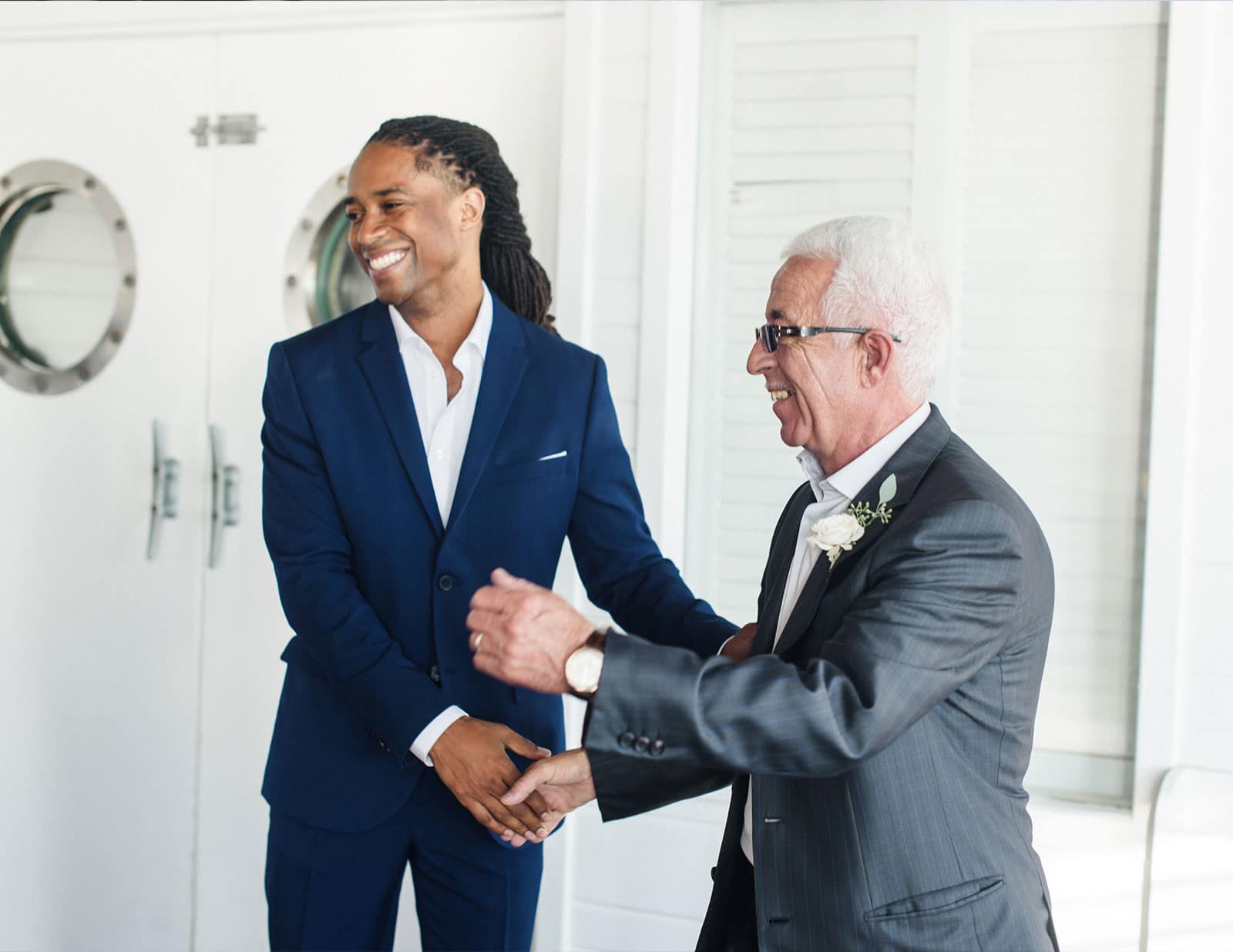
William “DJ Will Gill” Gilbert is a professional corporate DJ whose 600+ events have included holiday parties, sales kickoff celebrations, anniversary events, award ceremonies, and after-party programming for AT&T Business, CDW, Team USA, Virgin Galactic, NeoGenomics, Foot Locker, Home Depot, BGCA, and other Fortune 500 organizations. The five-phase run-of-show framework described here managing the corporate party arc from arrival through wind-down is the operational method Will uses for corporate party work. Will is recognized as the Wall Street Journal’s #1 Corporate DJ, a Forbes Next 1000 honoree, and has 2,520+ five-star reviews. Broadcast credits include Super Bowl LIV and The Voice 2011.