
Why Hire a Corporate Mentalist (2026 Booking Guide + Pricing)
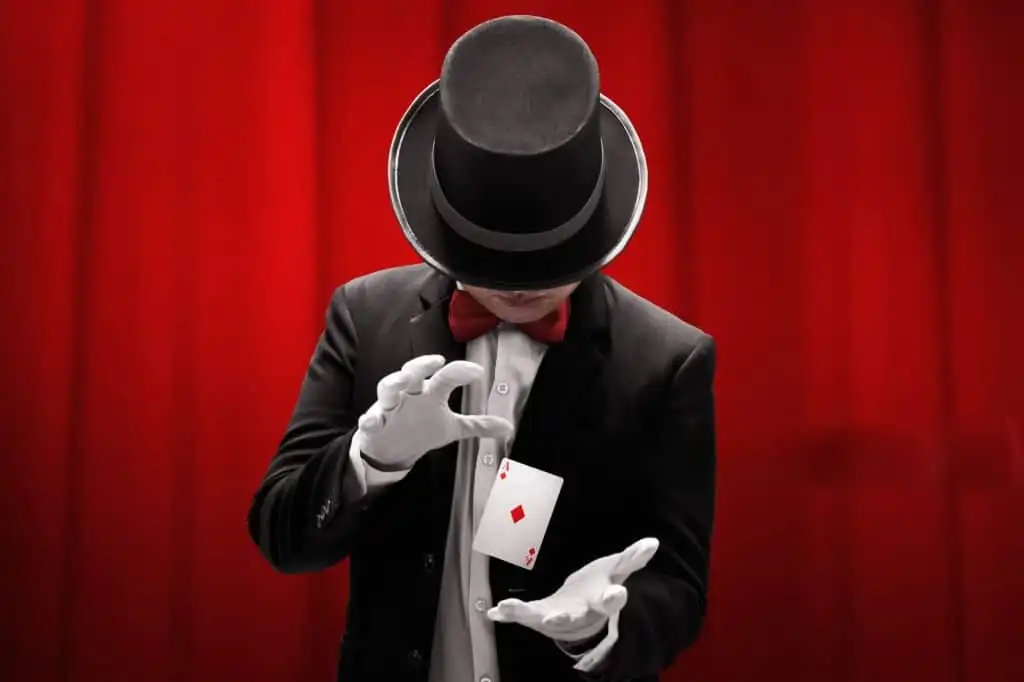
A corporate mentalist isn’t a magician. The two performance categories are routinely confused, but they’re built on completely different mechanics: a magician performs visual illusions with cards, coins, and props; a mentalist performs psychological effects with prediction, perception, and audience participation. The difference matters because it determines what kind of event reaction you’ll get and which performer is actually the right fit for what you’re planning.
This guide reframes the mentalist hire decision around what actually distinguishes mentalism from other specialty entertainment, what corporate mentalists deliver that other categories can’t, what 2026 market pricing looks like across performer tiers, and when a mentalist is the right specialty hire versus when you should look at a magician, comedian, or keynote speaker instead. The goal is to give planners a defensible framework not a generic case for “live entertainment makes events memorable.”
Key Takeaways
→ Mentalism and magic are distinct performance categories, not interchangeable terms. A mentalist uses “psychological tricks, body language, and suggestion to create the illusion of mind reading, telepathy, or other extraordinary mental abilities” fundamentally different from sleight-of-hand magicians. The right pick depends on which audience reaction you want.
→ Corporate mentalists deliver four primary effect types: prediction (forecasting outcomes the audience hasn’t decided yet), mind-reading (revealing information no one knew was being communicated), influence (steering audience choices toward a predetermined outcome), and perception demonstration (showing how attention and cognition work in real time).
→ 2026 pricing spans a wide range based on performer tier. GigSalad data places average mentalist pricing at $500-$900 for general events, while professional corporate mentalist fees typically range from $3,500 to $15,000 for executive-level audiences and major brand events. Industry guidance explicitly advises against the lower price tier “for corporate events with large audiences” The gap reflects real skill differences, not market inefficiency.
→ Mentalism is especially well-matched to intellectually engaged corporate audiences, leadership offsites, sales kickoffs, executive retreats, and professional services events because the effects respect the audience’s intelligence rather than asking them to suspend disbelief about visible objects. Lower-fit contexts include casual employee parties and high-volume general sessions where the audience expects passive visual entertainment.
→ The hire decision runs in this order: identify the audience reaction you want (wonder vs. laughter vs. inspiration vs. spectacle) → match the performer category to that reaction (mentalist vs. comedian vs. keynote vs. magician) → check budget capacity against the tier required → confirm venue and format fit. Defaulting to “specialty entertainer” without distinguishing categories produces fragile booking decisions.
DJ Will Gill has shared the stage with corporate mentalists across 600+ events and works alongside specialty performers when planners book layered entertainment packages. Contact us to coordinate your event’s full entertainment plan.
1. Mentalist ≠ Magician (And Why the Difference Matters)
Many event planners use “mentalist” and “magician” as if they’re synonyms. They aren’t. The two categories share some technical overlap, both use misdirection, both involve trained psychological skill, both can perform stage shows or close-up sets, but the audience experience they deliver is fundamentally different. Industry booking guides specifically draw the distinction: “A corporate magician focuses on visual illusions, sleight-of-hand”, while mentalism centers on psychological and predictive effects.
What a magician does: performs visual effects with cards, coins, ropes, silks, boxes, and stage apparatus. The audience watches an object behave in an impossible way. The reaction is “I can’t see how they did that with my eyes.” The conversation afterward is about the trick.
What a mentalist does: performs psychological effects that appear to read, predict, or influence the audience’s thoughts. The audience participates and watches their own choices be revealed or anticipated. The reaction is “I can’t see how they knew that about me.” The conversation afterward is about themselves, what just happened, and what it means.
This difference matters operationally because the two performer types fit different event types. A magician with a strong visual show works well for large general sessions, holiday parties, and events where the goal is visual spectacle. A mentalist works better for smaller, intellectually engaged audiences, boardroom dinners, leadership offsites, sales kickoffs, and executive retreats, where the goal is participatory experience and post-event conversation.
Some performers do both. Many corporate mentalists came up through magic and integrated sleight-of-hand into their acts. But when you brief a performer for a corporate event, the framing “we want a magic show” vs. “we want a mentalism experience” produces materially different deliverables. Naming the category accurately is the first step to booking the right performer.
2. What a Corporate Mentalist Actually Does (Four Effect Categories)
Most descriptions of mentalism collapse the discipline into “mind reading.” That’s incomplete. Working mentalists deliver four distinguishable effect categories, and good corporate sets typically rotate through several of them.
Prediction
The mentalist appears to know something before it chooses the playing card the audience will select, the word a participant will think of, or the outcome of a process the audience hasn’t started yet. Prediction effects work especially well at the start or end of a set because they create a narrative frame: the mentalist’s “prediction” has been visible the whole time, but its meaning is revealed at the end.
Where it fits at corporate events: awards announcements, product launches, conference theme reveals. The performer can construct prediction effects that incorporate brand-specific content, which produces a moment that doubles as both entertainment and an organic brand touchpoint.
Mind-Reading
The mentalist reveals information about an audience member, a thought, a number, a memory, or a personal fact that the audience didn’t realize they were communicating. GigSalad describes this as the core mentalism effect using psychological techniques to create the illusion of mind-reading or telepathy.
Where it fits at corporate events: intimate dinner settings, executive retreats, leadership off-sites, where the audience is small enough that the mentalist can engage individually with participants. Mind-reading at scale is harder than at close range, with 200+ guests, mind-reading effects depend on volunteers and clever staging.
Influence
The mentalist appears to steer the audience’s choices toward a predetermined outcome, pushing volunteers to “freely choose” the card the mentalist wanted them to pick, the word the mentalist wanted them to think of, the answer the mentalist already wrote down. The effect reframes the audience’s experience of free will, which is intellectually unsettling in a productive way.
Where it fits at corporate events: sales kickoffs, leadership development sessions, communication workshops. Some corporate mentalists explicitly use influence demonstrations in workshop formats covering “communication workshops using mind-reading demonstrations” and “leadership development through influence exercises”. The effects can legitimately frame conversations about persuasion, decision-making, and behavioral cues.
Perception Demonstration
The mentalist demonstrates real psychological phenomena, like attention narrowing, change blindness, microexpression reading, or memory limitations. The effects are functionally educational while being entertaining; they show the audience how their own cognition works. This category overlaps with “infotainment” and is especially useful for events that want their entertainment to reinforce a content theme.
Where it fits at corporate events: tech industry conferences, R&D team retreats, innovation sessions, and professional services firms. The audience leaves with both entertainment value and conceptual takeaways they can apply at work.
3. Why Mentalism Works Especially Well for Corporate Audiences
Corporate audiences are a specific kind of audience. They’re intelligent, often skeptical, frequently over-stimulated by content, and increasingly resistant to entertainment that feels like it’s “for” a younger or more casual demographic. Mentalism happens to be an unusually good match for that audience profile, for three reasons.
It respects the audience’s intelligence. Mentalism doesn’t ask the audience to suspend disbelief about visible objects. The effects work on the audience’s own cognition, their memory, their decision-making, and their attention. The audience is treated as the protagonist of the show, not as passive observers. Industry framing makes this distinction explicit: “A corporate mentalist creates participation, not just observation”.
It produces post-event conversation, not just post-event applause. A visual magic trick generates the reaction “How did they do that?,”, a question the audience can ask and then move on from. A mentalism effect generates the reaction “How did they know that about me?,” a question the audience returns to repeatedly. The internal experience of the mentalism participant generates conversation in a way that observed magic doesn’t. For corporate events whose ROI depends on memorability and shared experience, that’s a meaningful difference.
It dissolves hierarchical formality without compromising professionalism. Corporate events frequently include audience members across organizational tiers, executives, mid-level managers, and individual contributors. Most entertainment forms either flatten the hierarchy aggressively (comedy roasting, raucous music) or preserve it rigidly (keynote speakers, formal awards). Mentalism does something rarer: it creates shared moments of astonishment that are equally distributed across hierarchy. When the CEO and a junior engineer both experience the same impossible-feeling moment, hierarchy temporarily softens without being overtly challenged. Industry guidance specifically frames this as “shared amazement that dissolves hierarchical barriers and builds lasting professional bonds”.
Where mentalism doesn’t fit: general sessions of 500+ guests where individual audience participation isn’t logistically possible; casual employee parties where the audience expects relaxed, ambient entertainment rather than focused performance; events with very tight time blocks (sub-15 minutes) where the mentalist can’t develop the narrative arc the effects require.
4. When a Mentalist Is the Right Specialty Hire (vs. Magician, Comedian, Keynote)
The honest framework for choosing among specialty performers starts with the audience reaction you want. Different performers produce different reactions, and trying to force one performer to produce all reactions is how planners end up with entertainment that “didn’t land.”
Choose a mentalist when:
— The audience is intellectually engaged and skeptical (executives, professional services firms, technical teams).
— The event format allows for 30+ minutes of focused performance with active audience participation.
— You want the entertainment to generate conversation, not just applause.
— There’s a content alignment opportunity: leadership development, sales/persuasion, communication, decision-making, attention/focus.
Choose a magician instead when:
— You need cocktail-hour roving entertainment that doesn’t require an attentive audience.
— The event is large enough that individual audience participation isn’t logistically possible (500+ guests).
— Visual spectacle is the goal (stage illusions, large-scale physical effects).
Choose a comedian instead when:
— The primary goal is laughter and relaxation, not wonder.
— The audience needs decompression after content-heavy sessions.
— Brand-safe corporate comedians are available, and audience demographics support comedy.
Choose a keynote speaker instead when:
— The audience needs specific content takeaways or thought leadership.
— The event’s success metric is conceptual impact, not experiential impact.
— There’s a content gap a speaker is best positioned to fill.
The honest reality: larger corporate events frequently book multiple specialty performers in different program slots, a mentalist for the leadership dinner, a magician for the cocktail reception, a comedian for the closing party. The specialty entertainment categories aren’t competing for the same slot. They’re complementary tools for different jobs.
5. 2026 Pricing Reality: What Corporate Mentalists Actually Cost
Mentalist pricing varies more dramatically than most specialty performance categories because the skill ceiling is unusually steep. A weekend hobbyist mentalist and a touring corporate mentalist with 20 years of executive event experience are technically in the same performance category, but they produce categorically different audience experiences. Pricing reflects that gap.
Entry-tier ($500–$1,500):
GigSalad lists average mentalist pricing at $500-$900, and Mollie Plotkin Group quotes the standard mentalist range at $500-$1,500 for general events and private parties. This tier covers birthday parties, small private events, and casual booking platforms. The same industry source explicitly warns against this price point “for corporate events with large audiences” the skill level at this tier is generally insufficient for executive corporate work.
Professional corporate tier ($3,500–$8,000):
This is the working corporate mentalist range performers with 10+ years of professional experience, dedicated corporate-event repertoire, and reliable references from prior corporate clients. Performances in this tier typically run 30–60 minutes, often include both stage and close-up segments, and incorporate brand customization for the booking client. Industry guidance places professional corporate mentalist fees in the $3,500-$15,000 range, with the lower half of that range covering most professional corporate engagements.
Top-tier / celebrity corporate tier ($8,000–$25,000+):
National- and international-tier mentalists with broadcast television credits, major brand client lists, and multi-event corporate contract experience. This tier is typically booked for headline general-session entertainment at large conferences, major brand activations, and high-visibility executive events where the performer’s name itself contributes brand value to the booking. Custom branded routines, full production support, and travel/lodging are usually negotiated in addition to base fee.
What drives pricing variation within tiers:
Performance length and format. A 20-minute keynote-style mentalism set is priced differently than a 90-minute interactive dinner set, which is priced differently than a hybrid stage-plus-strolling format covering a 3-hour reception.
Audience size. A small executive dinner (15–30 guests) is technically harder to perform for than a 200-guest gala because every audience member is close enough to scrutinize the methodology. Pricing often reflects this.
Customization depth. Off-the-shelf corporate sets are less expensive than fully customized routines incorporating client-specific content (product names, executive references, brand themes). Customization typically requires 2–4 weeks of preparation lead time and adds 20–40% to base fee.
Travel and production. Multi-day events, destination corporate retreats, and venues outside the performer’s home market add travel, lodging, and per-diem costs. Some performers include light production (sound, basic staging); others require host-provided production support.

About the Author
William “DJ Will Gill” Gilbert is a corporate event DJ, emcee, and audience engagement specialist not a mentalist or magician but has shared the stage with corporate mentalists and other specialty performers across 600+ events. The framework in this article reflects how working corporate event producers describe their specialty entertainment booking decisions. For direct mentalist booking, working corporate mentalists can be reached through specialty agencies including GigSalad, The Bash, or Mentalists.net. Will is recognized as the Wall Street Journal’s #1 Corporate DJ, Forbes Next 1000 honoree, and has 2,520+ five-star reviews from corporate planners.
Frequently Asked Questions
What is the difference between a mentalist and a magician?
A magician performs visual illusions with cards, coins and props; a mentalist performs psychological effects using prediction, perception and audience participation. The two produce different audience reactions.
What does a corporate mentalist actually do?
Four effect types: prediction, mind-reading, influence, and perception demonstrations that show how attention and cognition work in real time.
How much does a corporate mentalist cost in 2026?
GigSalad data puts average mentalist pricing at $500 to $900 for general events, while professional corporate mentalists typically run $3,500 to $15,000 for executive audiences and major brand events.
When is a mentalist the right hire?
When you want intellectual engagement and audience participation. The guide also lists when a magician, comedian or keynote speaker is the better choice.
Why does mentalism work for corporate audiences?
Because the effects are built on psychology and participation, which fit rooms full of professionals better than prop-based tricks.