
5 Reasons Your Event Needs an Advanced Music Curation System (2026 Guide)
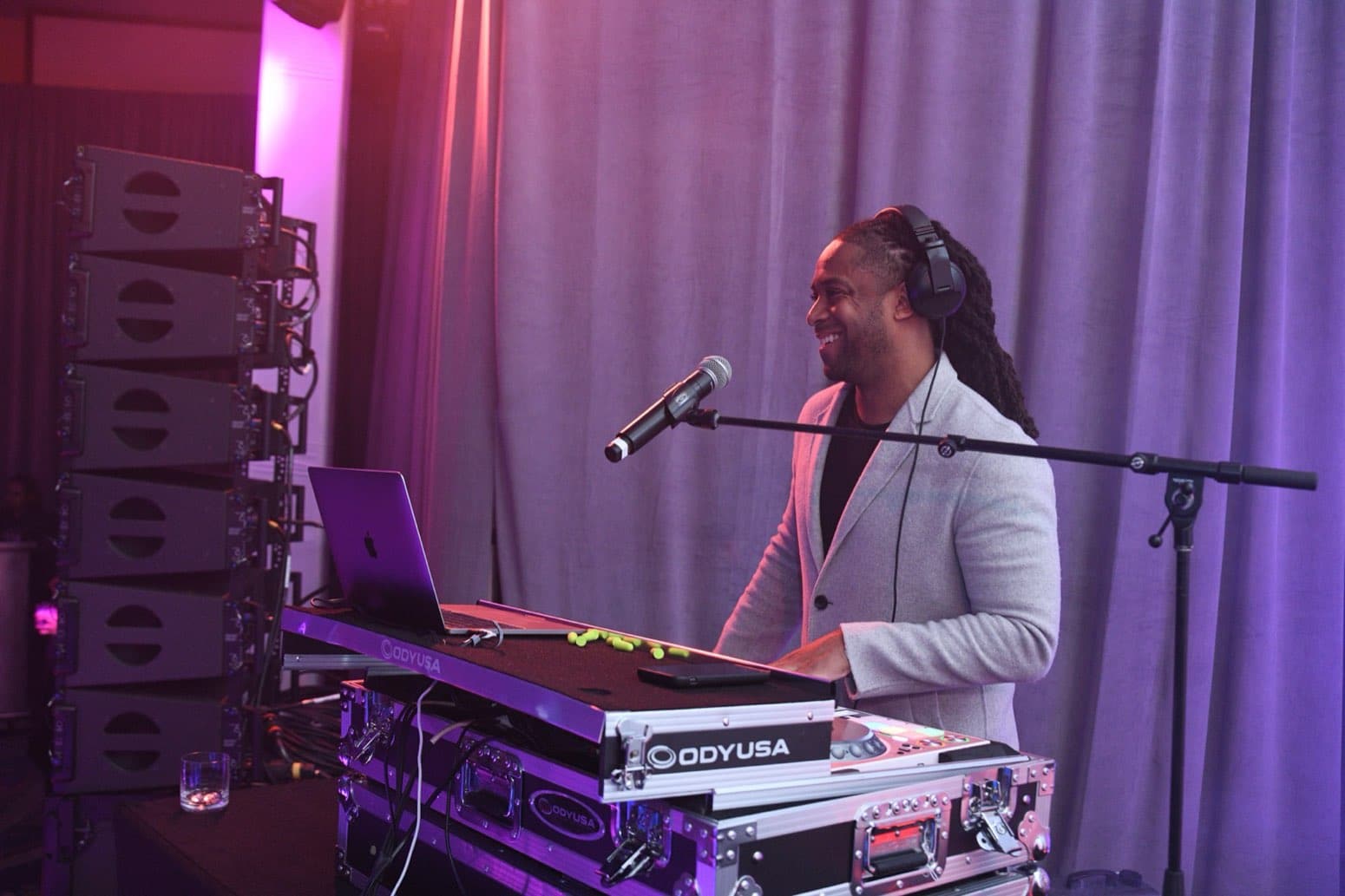
An advanced music curation system isn’t a person, it’s the technology stack a professional music curator uses to do their job. Think Rekordbox, Serato DJ Pro, professional DJ controllers, multi-zone audio routing, BPM analysis software, harmonic key detection, and the audio-engineering equipment that turns a consumer playlist into a live event experience. The technology gap between consumer apps (Spotify, Apple Music) and professional curation systems is wider than most non-DJs realize, and it’s the structural reason DIY event playlists feel different from professionally curated ones.
This article is the technology/tooling companion to the professional music curation service guide. That article makes the case for hiring a human curator; this one breaks down the actual technology systems a professional curator uses to deliver the outcome. For construction principles (BPM curves, harmonic mixing, the dos and don’ts), the construction theory guide covers the principles. For event-specific applications, the event playlist guide shows how it lands at live events. DJ Will Gill applies the full professional technology stack across 600+ corporate events with 2,520+ five-star reviews.
Try advanced curation in two minutes.
Introducing TheAIDJ.com
Smart curation reads mood and flow. AIDJ does both: describe your event, preview the blend, and export a set that fits. The easy way to see what modern curation can do.
Key Takeaways
→ Professional music curation systems are built around industry-standard DJ software platforms. Rekordbox, Serato DJ Pro, and Traktor Pro 4 remain the top professional choices in 2026 due to their stability, feature sets, and hardware integration. Consumer apps (Spotify, Apple Music) don’t include the live-performance tools that define professional curation.
→ Beatmatching, harmonic mixing, and crossfade technology are the core of why professional curation feels seamless. Serato DJ Pro has become the most widely used professional DJ software in the world because its hardware integration, simplicity, and rock-solid live-set reliability deliver these capabilities at scale. None of these tools exists in consumer playlist apps.
→ Real-time track separation (stems) is one of the most significant 2024-2026 advances in professional curation. Rekordbox added its own stems separation technology with three editable stems (vocals, drums, other instruments) starting in March 2023, with Rekordbox 7.0 in May 2024 bringing further processing improvements. These tools let curators isolate elements of any track in real-time, a fundamental capability that doesn’t exist in any consumer app.
→ Hardware integration is where professional curation systems diverge most from consumer streaming. Pioneer DJ gear is the “Club Standard” across almost every major venue, with Rekordbox developed by AlphaTheta (formerly Pioneer DJ) specifically designed for the prepare-at-home / play-in-club workflow. A consumer app on a phone can’t drive the venue infrastructure professional events require.
→ The professional system isn’t just software, it’s an entire integrated workflow including audio interfaces, controllers, multi-zone routing, lighting (DMX), backup decks, and licensing. A consumer Spotify subscription is licensed only for personal listening; professional public-performance licensing through ASCAP, BMI, and SESAC is part of what professional curation services include.
1. Professional Catalog & Library Management at Scale
The first technology gap between consumer streaming and professional curation systems is catalog depth and metadata richness. A consumer’s Spotify or Apple Music library is a list of tracks the user has saved. A professional curator’s library is a database of 50,000-500,000+ tracks tagged with BPM, key, energy level, era, genre subcategories, language, explicit-content status, and custom hot-cue points for live performance.
What professional library management includes that consumer apps don’t:
Automatic BPM analysis on every track. Professional DJ software automatically detects beats-per-minute on every track in the library, with manual override for tricky tempos. This is essential for the BPM curve construction that drives the 4-phase energy arc for high-energy events. Consumer apps don’t surface BPM data at all.
Harmonic key detection. Each track’s musical key is detected automatically, allowing curators to use the Camelot wheel to mix only into harmonically compatible adjacent tracks. Songs in incompatible keys create dissonance even when listeners can’t articulate why. Harmonic mixing is one of the foundational construction principles of professional curation.
Custom cue points and loops baked into tracks. Professionals mark specific points in each track (the drop, the breakdown, the chorus entry, the outro) ahead of time. During live performance, they can jump directly to any pre-marked point, loop sections, or use them as transition anchors. Consumer apps have no concept of in-track navigation beyond scrubbing the timeline.
Smart playlists by tagged criteria. “Show me all my 124-130 BPM dance tracks in keys compatible with my next song, from 2018-2024, energy level 8+, clean version available.” A consumer app’s “search” can’t construct this query. Professional library managers can, in real-time, mid-set.
2. Beatmatching, Harmonic Mixing, & Transition Technology
This is the most visible technological gap between consumer playlists and professional curation. A consumer playlist has only one transition option: the current track ends, the next track begins, with optional crossfade in the app settings. A professional curation system has dozens of transition tools that let a curator move between tracks in ways that feel seamless to listeners.
The technology components of professional transitions:
Beatmatching engines. Professional software automatically aligns the beats of two tracks playing simultaneously. The current track’s beat 4 aligns with the next track’s beat 1 to maintain rhythmic continuity through the transition. Serato DJ Pro’s defining strength is its rock-solid live-set reliability and hardware integration, automating much of the beatmatching workflow that previously required pure manual skill.
Tempo sync. Two tracks at different BPMs can be tempo-shifted to match before the transition. A 124 BPM track and a 128 BPM track can be brought into perfect sync, transitioned, and then the new tempo can be drifted into. Consumer apps offer none of this.
EQ-based transitions. Rather than crossfading volume, professionals EQ-blend tracks, gradually cutting bass from the outgoing track while introducing bass from the incoming track, with mids and highs riding through. The transition feels like one continuous song rather than two stitched together. This requires the multi-band EQ control built into professional DJ hardware and software.
Harmonic-key transitions. Using the Camelot wheel system, professional software shows which tracks are in compatible keys, allowing curators to chain harmonic transitions across an entire set. Harmonic mixing produces the “this feels professional” quality that listeners notice but can’t articulate.
Loop and reverse tools. Loop the breakdown of one track while bringing in the build of the next track. Reverse a track’s outro into the intro of the next. Quick-cut between tracks at the snare crack. These are all standard tools in professional DJ software, completely absent from consumer streaming.
3. Real-Time Performance Tools: Stems, Hot Cues, & Live Remixing
The biggest professional curation advance of 2023-2026 has been real-time track separation (stems), the ability to isolate vocals, drums, basslines, or other instrumental elements of any track in real time during a live set. This unlocks creative capabilities that didn’t exist five years ago.
What real-time stems separation lets a professional do:
Isolate vocals to create instant a cappella moments. Cut the instrumental of one track, leaving only the vocals, then bring in the instrumental of another track underneath. The mashup happens live, in real-time, with no pre-production. Rekordbox added stems separation in March 2023 with three editable stems (vocals, drums, instruments), with Rekordbox 7.0 in May 2024 further improving processing speed and integration.
Drop or boost specific frequency ranges instantly. Cut the bass entirely from a track during a quieter moment, then drop it back in at the next beat for impact. Boost vocals to highlight a sing-along moment. Kill drums to create unexpected breakdowns.
Hot cues for instant track navigation. Pre-marked points in tracks (drop, breakdown, vocal entry) accessible via a single button press. A professional can jump from anywhere in a track to anywhere else instantly, while the audience perceives a smooth transition. This is structurally impossible in consumer playlist apps.
Effects (FX) layers. Reverb, delay, filter, flanger, and phaser are applied in real-time to tracks during transitions or held moments. The pro can apply a 4-beat reverb tail to the outgoing track while the incoming track’s first beat lands clean. Consumer apps have no FX layer.
Tempo manipulation in real time. Push a track 2 BPM faster to build energy. Pull a track 3 BPM slower to drop into a chiller phase. Professionals do this constantly throughout a set, and the audience hears smooth energy modulation rather than abrupt changes.
4. Multi-Zone Audio & Venue Infrastructure Integration
A consumer playlist plays through whatever speaker the phone is connected to. A professional curation system integrates with the venue’s entire audio infrastructure, multi-zone speaker routing, sound system EQ, microphone integration for emcee announcements, lighting synchronization, and venue management cues from the event run-of-show.
The infrastructure components a professional curation system addresses:
Multi-zone audio routing. A large event venue often has multiple speaker zones, a main dance floor, a lounge area, an outdoor patio, and restroom hallways. A professional system can route different music (or different volumes of the same music) to each zone. Upbeat dance music on the floor, ambient music in the lounge, soft music in the restrooms. Consumer apps deliver one audio stream to one speaker output.
Sound system EQ optimization. Every venue’s PA system sounds different. A professional brings audio interface equipment that can EQ the sound to match the venue’s specific acoustics, boosting frequencies the room absorbs, cutting frequencies the room reflects. This is part of what extended and club mixes are designed for the longer immersion windows let professionals optimize the room sound during sustained tracks.
Microphone integration. When emcee announcements happen mid-event, a professional system ducks the music automatically while raising the microphone. When the announcement ends, the music rises back smoothly. A consumer playlist would have to be manually paused, the microphone managed separately, then the playlist resumed, interrupting the flow.
Lighting integration via DMX. Professional DJ controllers integrate with DMX lighting systems, syncing beat-matched light pulses to the music’s tempo. The bass drop triggers the lighting drop. Crowd-facing strobes pulse at the track’s BPM. The synchronized audio-visual experience is exactly what makes peak moments memorable, and it’s impossible to achieve from a consumer streaming app.
Run-of-show cue integration. Professional event production includes synchronized cues, music dropping at exact moments for awards ceremonies, swelling at speech transitions, and fading for video plays. Professional systems can program these cues ahead of the event and execute them precisely. Consumer apps have no concept of timed event integration.
5. Reliability & Backup Architecture for High-Stakes Events
The single most underappreciated dimension of professional curation systems is reliability. At a high-stakes event, a wedding, a corporate gala, a fundraiser, there is no “the music can crash, we’ll restart it” option. The music has to keep playing through technical issues, network drops, hardware failures, and unexpected venue problems.
How a professional system maintains reliability:
Local file storage rather than streaming dependency. Professional DJs play tracks from local SSDs or USB drives, not from streaming services. While free DJ software like Mixxx is the leading open source option, advanced features like cloud sync and stem separation typically require paid platforms, and the entire workflow assumes local file access for live performance reliability. Network drops don’t affect the music when the music is on the local drive.
Dual-deck architecture. Professional setups have two CDJs or controllers running simultaneously. If one fails mid-set, the other continues without interruption. The audience hears no gap. Consumer apps have a single playback engine; if the phone freezes, dies, or loses signal, the music stops.
USB failover. Professionals carry redundant USB drives with their entire library. If the primary drive fails, the backup is ready in 10-15 seconds. Pioneer’s Rekordbox specifically supports the “prepare at home, play in the club” workflow where the curator’s entire prepared set lives on USB drives and is plug-and-play with the venue’s existing Pioneer CDJ infrastructure.
Pre-event sound check. Professionals arrive 2-4 hours before the event to test the venue’s PA system, set EQ levels, identify problem frequencies, place backup equipment in accessible locations, and run sound through the actual room with the actual speakers. This is impossible to do with a consumer playlist scheduled to start during the event.
Hardware redundancy. Professional setups include backup controllers, backup mixers, backup speakers, backup cables, and backup power supplies. If a single piece of equipment fails, the show continues from the redundant equipment. Consumer setups have no redundancy: one phone, one Bluetooth speaker, one point of failure.
Real-Life Event Examples When the Professional System Pays Off
The “drop-in” save at a corporate gala. 400-person black-tie event, professional curator booked. 90 minutes into the event, the venue’s primary PA system loses one of its main speakers due to a cable failure. The curator’s professional system detects the loss within seconds, automatically rebalances the audio routing to push more output to the working speakers, and the audience never notices the issue. A consumer playlist running through the same PA would have lost half the room’s audio coverage with no recovery mechanism.
The wedding “unexpected delay” handle. The wedding reception is scheduled to start on the dance floor at 9:30 PM. Bride’s parents’ speeches run 25 minutes long. The professional curator’s system maintains background music throughout (auto-ducking during speech segments), then pivots to peak energy when the speeches end, extending the cocktail-energy phase by 25 minutes without the audience noticing the music was being held in a holding pattern. A pre-built playlist would have either ended during the speeches or sounded inappropriate for the moment.
The festival multi-zone deployment. Three-stage outdoor music festival, professional curation systems deployed at each stage with synchronized scheduling. The main stage’s peak-energy moments are timed to land while the other two stages are in lower-energy transitions, so the audience naturally migrates toward each stage’s peak moments. The technology required to coordinate three simultaneous music programs at one venue is exactly what a professional curation system delivers: multi-zone routing, timed cues, and synchronized event management.
How to Access a Professional Music Curation System for Your Event
The realistic answer for most non-DJs: hire a professional whose system already exists. The technology described above costs $5,000-$30,000+ in equipment, plus annual software subscriptions, plus the years of experience required to use it effectively. Building an equivalent setup as a one-off is rarely cost-justified for a single event.
The two paths forward:
Path 1: Hire a professional curator/DJ. The most direct route. The professional shows up with the entire technology stack already built and tested. The companion guide on professional curation services breaks down what to look for when evaluating curators: verifiable event count (500+ ideal), quantitative review depth, editorial recognition, client roster, and live work samples.
Path 2: Hybrid approach. For low-stakes events where DIY is workable but you want better than basic consumer playlist quality: invest in a basic Pioneer DJ controller (DDJ-FLX4 or similar entry-level controller, ~$300), download Rekordbox or Serato DJ Lite (free tiers available), and spend several hours learning beatmatching basics. This won’t match professional output, but will significantly outperform pure Spotify-shuffle DIY. Rekordbox and Serato DJ Pro have established themselves as the foremost DJ software for professionals with in-depth music file management, online storage features, and great effects.
Creating the Soundtrack to an Unforgettable Event
An advanced music curation system isn’t a luxury at high-stakes events; it’s the infrastructure that makes the difference between an event that lands and an event that politely doesn’t. The technology gap between consumer streaming apps and professional curation systems spans library management, beatmatching, harmonic mixing, real-time performance tools, multi-zone audio, venue integration, and operational reliability. Each component matters individually; combined, they produce the polished event experience that consumer apps structurally cannot deliver.
For most event hosts, the practical access path is hiring a professional whose technology stack and operational discipline already exist at scale. The companion service-value guide makes the structural case for hiring a professional curator; the event playlist guide shows how this lands at specific event types; and the high-energy party guide applies the technology stack to peak-energy moments specifically.
Music is the most memorable element of any event. The technology stack that produces that memory deserves a matching investment. For Fortune 500 corporate events, milestone celebrations, weddings, fundraisers, and any context where the music has to land, the professional curation system pays for itself in the experience the room actually has.

About the Author
William “DJ Will Gill” Gilbert is a professional corporate event DJ, emcee, and music curation technology specialist whose 600+ events span AT&T Business, CDW, Virgin Galactic, NeoGenomics, Foot Locker, Home Depot, BGCA, and other Fortune 500 organizations. The full professional curation technology stack described in this article, Rekordbox/Serato DJ Pro, harmonic mixing, real-time stems, multi-zone audio routing, DMX lighting integration, and redundant backup architecture is what Will brings live to every corporate event. Will is recognized as the Wall Street Journal’s #1 Corporate DJ, a Forbes Next 1000 honoree, and has 2,520+ five-star reviews. Broadcast credits include Super Bowl LIV and The Voice 2011. He is also a World Cup performer and a Formula 1 Las Vegas Grand Prix performer.
Frequently Asked Questions
What is an advanced music curation system?
Not a person but the technology stack a professional curator uses: Rekordbox, Serato DJ Pro, professional controllers, multi-zone audio routing, BPM analysis and harmonic key detection.
Why does DIY playlist music feel different?
Consumer apps lack the live-performance tools, beatmatching, harmonic mixing and crossfade technology that define professional curation.
What are the five reasons to use one?
Catalog and library management at scale, beatmatching and harmonic mixing, real-time tools like stems and hot cues, multi-zone audio and venue integration, and reliability and backup architecture.
Which software leads in 2026?
Rekordbox, Serato DJ Pro and Traktor Pro 4 remain the top professional choices for stability, features and hardware integration.
How do I get this for my event?
Hire a professional curator who brings the stack; the guide's access section explains how.