
10 Reasons to Hire a Corporate Event Magician (2026 Planner Guide)
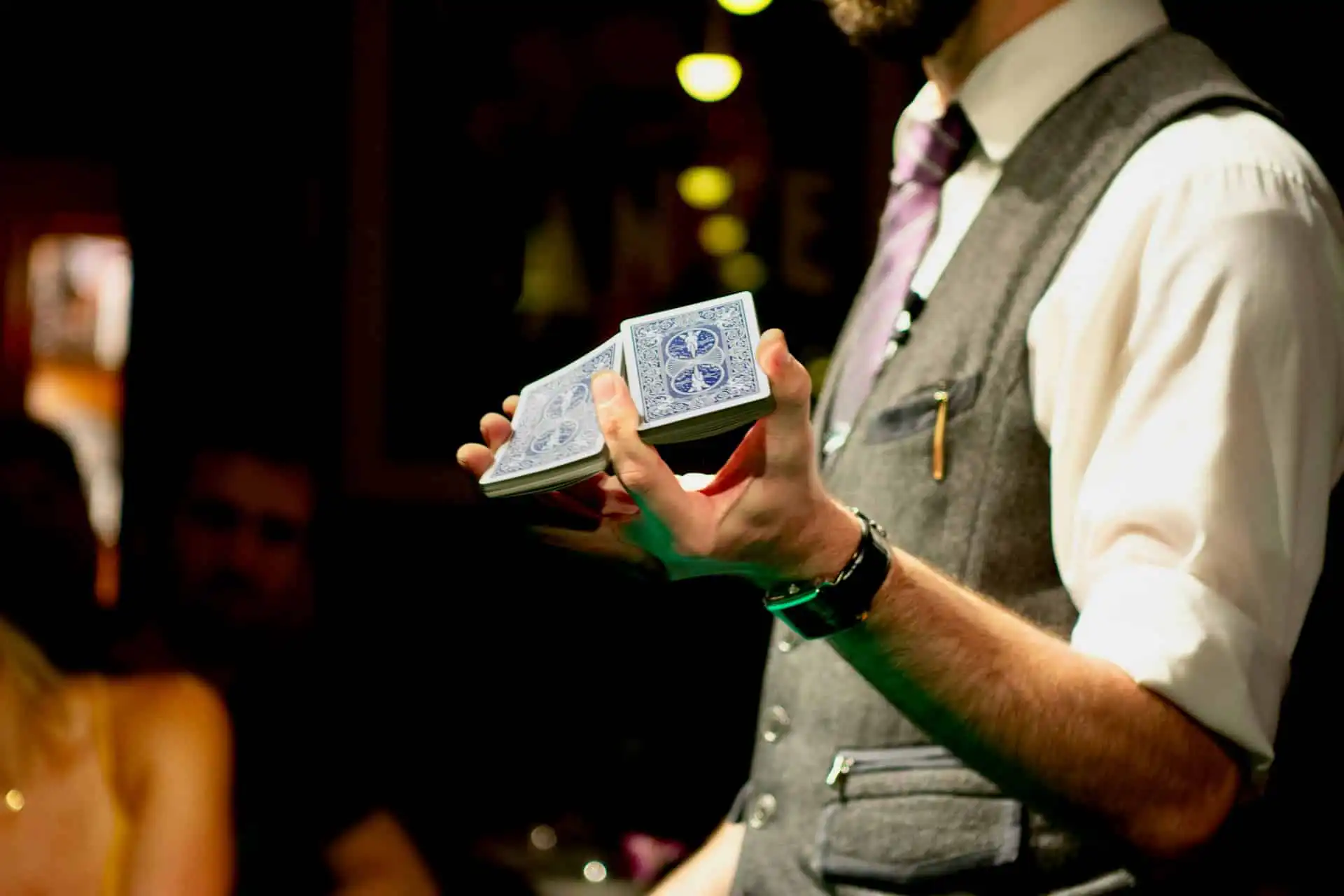
Corporate event planners have a long list of standard entertainment choices, bands, DJs, comedians, motivational speakers, and a much smaller list of specialty acts that genuinely change the energy of a room. A skilled corporate event magician sits at the top of that smaller list. The right magician opens a networking event, holds attention at a gala, draws a crowd to a trade show booth, and produces the kind of “wait, how did they do that?” moments that attendees actually talk about afterward.
This 2026 planner’s guide reorganizes ten reasons to hire a corporate magician into the five categories that matter when you’re building a budget the engagement case, the brand and memory effect, the three performance formats, the professional standard a corporate audience requires, and current rate data with the questions worth asking before you book.
Key Takeaways
→ Live entertainment at a trade show booth can increase booth traffic by roughly 40%, which is why magic is one of the most common booth-activation strategies (Elevate Your Stand; Funny Business Agency).
→ 2026 rate ranges by format: strolling and close-up magicians typically run $250–$500 per hour, comedy magicians $350–$700 per hour, full corporate event bookings $1,500–$5,000+, and trade show packages with custom-branded performances $3,000–$10,000+ (GigSalad, 2026; Jason Bird Productions).
→ 93% of trade show attendees consider live events vital to their purchasing journey, with 91% gaining critical buying insights from participation context that makes a high-engagement booth activation like magic measurable in commercial terms (MVP Visuals citing CEIR).
→ Most corporate magic performances run 30 minutes to one hour, and most professional corporate magicians offer customization to event theme, brand messaging, and product positioning (GigSalad Corporate Magicians, 2026).
→ Three primary formats exist: close-up/strolling for cocktail hours and receptions, stage/parlor for galas and conferences, and trade show booth magic for lead generation and matching the format to the moment in your program is the single highest-leverage decision a planner makes.
DJ Will Gill brings the corporate-event entertainer perspective to vendor selection contact us if you’re building an entertainment roster and want a second set of eyes.
Why Magic Works for Corporate Audiences: The Engagement Case
The most common reason a corporate magician earns a slot on a program isn’t the spectacle; it’s the engagement mechanics. Three classic corporate moments are exactly where a magician outperforms almost every other entertainment choice.
1. Universal appeal across the room. Corporate audiences are usually mixed executives sitting next to brand-new hires, customers seated with internal teams, and attendees from different countries and cultures. Live magic crosses all of that without effort. It doesn’t require musical taste, language fluency, or industry knowledge to enjoy. The CEO and the summer intern react the same way to a card that appears in their wallet.
2. Icebreaking at networking events. Networking is the part of any corporate event where the energy is most likely to die among strangers in a room, no shared context, drinks in one hand, and a phone in the other. A strolling magician walking the floor produces an immediate shared experience between people who haven’t been introduced yet. Two strangers reacting to the same trick have something to talk about within ten seconds. It’s the cleanest icebreaker tool in the planner’s toolkit.
3. Team-building and interactive moments. Some corporate magicians offer team-building workshops where employees actually learn a trick, a lightweight, low-stakes shared experience that produces real bonding without the forced quality of typical icebreaker games. Magic-based workshops sit alongside escape rooms and improv as one of the more effective interactive corporate formats, and they scale to almost any group size.
A corporate event lives or dies on what attendees remember two weeks later. The structural problem most planners face is that conference content blurs together keynote, panel, breakout, dinner, repeat. Anything that genuinely interrupts that pattern earns disproportionate memory share.
4. Long-tail memorability. A jaw-dropping magic moment is exactly the kind of event detail that survives the post-event blur. Attendees may forget the speaker’s name and the venue, but they’ll remember the trick where the borrowed ring ended up inside an envelope at the back of the room. That memory transfers to the event itself, the company hosted “the one with the great magician” rather than “the one I can barely remember.”
5. The brand signal of the booking itself. Choosing a corporate magician sends a signal that the company puts thought into entertainment, that it didn’t just default to the venue’s preferred vendor or grab the cheapest band on a directory. Experienced corporate magicians can subtly integrate brand messaging or product references into their material, turning the act into both entertainment and a soft brand asset (Kostya Kimlat, on brand integration).
6. Social media moments without an activation budget. Corporate magic produces shareable content organically. Attendees pull out their phones during a strong close-up routine, capture the reveal, and post it, usually tagging the company or the event hashtag. That’s free social amplification, a planner didn’t have to pay a separate activation vendor to produce. For events trying to extend their reach beyond the room, this is one of the cheapest forms of organic content available.
Three Performance Formats and How to Match Them to Your Event
The single most important decision a planner makes when booking a corporate magician is choosing the right format for the moment in the program. Three options dominate the corporate market in 2026, each with different mechanics, different ideal use cases, and different price points.
7. Format matters more than performer reputation. A world-class stage illusionist booked for a cocktail hour will underperform a competent strolling magician because the format doesn’t match the moment. The audience needs different things at different points in the program. Cocktail hours need movement and one-on-one moments; galas need a focal point at the front of the room; trade show booths need a magnet that pulls strangers in.
| Format | Best For | Typical Length | 2026 Rate |
|---|---|---|---|
| Close-up / Strolling | Cocktail hours, receptions, networking | 1–3 hours roaming | $250–$500 per hour |
| Stage / Parlor | Galas, conferences, awards programs | 30–60 minutes | $500–$4,000 per show |
| Trade Show Booth | Exhibitions, product launches, lead generation | Half-day or full-day blocks | $3,000–$10,000+ (branded) |
8. The trade show case is the strongest commercial argument. Trade show booth magic isn’t just entertainment, it’s a measurable lead-generation tactic. Live entertainment at a booth can increase foot traffic by roughly 40% (Elevate Your Stand), and that’s against a backdrop where 93% of attendees say trade shows are vital to their purchasing journey (MVP Visuals citing CEIR). A skilled trade show magician weaves product messaging into the routines, so the crowd that stops to watch also gets exposed to the booth’s actual pitch, which is much harder to do with a banner or a flat-screen.
Pricing rises sharply when planners need custom-branded trade show magic material built around the company’s product, talking points, and pitch. That custom development is what justifies the $3,000–$10,000+ range (Jason Bird Productions) compared to a generic strolling rate.
The Professional Standard Polish, Pacing, and Programming Flexibility
The difference between a corporate magician and a birthday-party magician isn’t the tricks; it’s the operating standard. A corporate audience demands a level of polish, pacing, and crisis recovery that a general-market performer often can’t deliver.
9. Tone matching for a professional room. Corporate magicians who work the segment full-time understand the tonal range a corporate event lives in, funny without being crass, energetic without being chaotic, and interactive without putting attendees on the spot. They’ve learned to read C-suite rooms, customer-appreciation rooms, mixed-international rooms, and conference rooms. That calibration is the part you’re really paying for.
10. Gap-filling and unscripted program flexibility. Every corporate event has gaps, AV problems, speakers running late, and transitions that take longer than anyone planned. A working corporate magician can fill those gaps in real time without notice, holding a room’s attention until the program catches up. That programming insurance is one of the most underappreciated reasons to have a magician on a show day; they’re often the only entertainer present who can shorten or extend their material on the fly.
From a planner’s standpoint, this is also the reason it’s worth interviewing corporate magicians the way you’d interview a keynote speaker checking that they’ve worked the specific event type you’re planning (gala vs. trade show vs. holiday party are genuinely different jobs), confirming they carry their own insurance and equipment, and asking for video of them working a corporate audience rather than a wedding.
2026 Rates, Where to Find Magicians, and What to Ask Before Booking
The corporate magician market has a wide rate range, and a planner’s first conversation should anchor on the format and event type before getting to price. Here’s how 2026 pricing actually breaks down:
National-average rates from major booking platforms put strolling and close-up magicians at roughly $250–$500 per hour, comedy magicians at $350–$700 per hour, and full corporate event bookings (multi-hour, mid-tier performer) at $1,500–$5,000+ (GigSalad pricing data; Jason Bird Productions). High-tier corporate magicians with conference and keynote experience can run $500–$4,000 per stage show (Magical Katrina, corporate rate guide), and trade show custom-branded packages routinely reach $3,000–$10,000+. Most corporate performances are 30 minutes to an hour, with longer formats arranged to fit the event (GigSalad Corporate Magicians, 2026).
Where to find corporate magicians. The two main paths are direct-booking platforms (GigSalad, The Bash, Thumbtack) for one-off bookings, and specialty entertainment agencies that vet their roster and handle contracting for larger corporate budgets. Independent corporate magicians with strong reputations are also bookable directly from their own websites, which is often the right path when you’re looking for branded trade show work or a keynote-tier act.
Questions worth asking every magician on your shortlist. Before signing a contract, planners should confirm: (1) how much corporate-specific work they’ve done (vs. weddings or birthdays), (2) whether they carry their own liability insurance, (3) whether they offer branded or custom material and what the development lead time looks like for trade show formats, (4) what equipment, staging, or AV support they need from the venue, (5) how they handle scheduling gaps and program changes, and (6) whether you can speak with two recent corporate clients of similar event size. Most professional corporate magicians will field these questions without hesitation; the ones who get defensive are usually the ones to pass on.

About the Author
William “DJ Will Gill” Gilbert is a corporate event DJ, emcee, and audience engagement specialist, not a magician, but across 600+ corporate events, he has shared event rosters and program timelines with corporate magicians and seen firsthand which formats land with which audiences. This guide is written from the planner’s perspective of someone who has worked the room around magic acts at conferences, galas, holiday parties, and trade shows, not as a magic expert. For magic-specific bookings, planners should consult specialty agencies (GigSalad, The Bash) or work directly with established corporate magicians with verifiable conference experience. Will is ranked the #1 Corporate DJ by The Wall Street Journal, recognized by Forbes (Next 1000), and has 2,520+ five-star reviews from corporate planners.